

Museologist
Entry Level Qualification
Class Graduate
Career Fields
Humanities, Liberals Arts & Social Science
For Specially Abled


About Career
Musiologists are involved in the research and study of Museology as well as in all the activities in a museum such as curation, preservation, restoration, exhibition, and education. A museum collects, preserves, restores and exhibits a collection of various artefacts and other objects of historical, artistic, cultural, scientific, political, religious, and other importance; objects which are important for the common people, researchers, scholars, and others for learning and education about the past, present and the future.
Key Roles and Responsibilities
You will be engaged with one or more of the following roles & responsibilities as well as other associated duties:
1. You will plan and organize the acquisition, storage, and exhibition of collections and related materials, including the selection of exhibition themes and designs, and develop or install exhibit materials.
2. You will install, arrange, assemble, & prepare artifacts for exhibition, ensuring the artifacts' safety, monitoring their status/ condition, and identifying/ correcting problems with the set up.
3. You will study documentation or conduct standard chemical/ physical tests to ascertain an object's age, composition, original appearance, need for treatment or restoration, and appropriate preservation method.
4. You will classify and assign registration numbers to artifacts and supervise inventory control.
5. You will select and interpret the archival items assisting visitors to search for answers about the collections including in cases where digital information supplements the physical exhibits alongside.
6. You will prepare reports on the operation of conservation laboratories, documenting the condition of artifacts, treatment options, and the methods of preservation and repair used.
7. You will repair, restore, and reassemble artifacts, designing and fabricating missing or broken parts, to restore them to their original appearance and prevent deterioration.
8. You will perform on-site field work which may involve interviewing people, inspecting and identifying artifacts, note-taking, viewing sites and collections, and repainting exhibition spaces.
9. You will design, organize, or conduct tours, workshops, and instructional or educational sessions to acquaint individuals with an institution's facilities and materials.
10. You will develop and maintain an institution's registration, cataloging, and basic record-keeping systems, using computer databases.
11. You will write and review grant proposals, journal articles, institutional reports, and publicity materials.
12. You will attend meetings, conventions, and civic events to promote use of institution's services, to seek financing, and to maintain community alliances.
PARTICULARS | DESCRIPTION |
Name | Museologist |
Purpose | Manage and Curate Museums |
Career Field | Humanities, Liberals Arts & Social Science |
Required Entrance Exam | No Entrance Exam |
Average Salary | 3,00,000 - 5,00,000 Rs. Per Year |
Companies For You | The National Museum, Indian Museum, The British Museum & Many More |
Who is Eligible | Graduate |
Career Entry Pathway
Class 10 all subjects as per scheme of studies – Class 11-12 with any subject as per scheme of studies - Bachelor’s in History/ Ancient Indian History and Culture/ Islamic History and Culture/ Anthropology/ Ethnology/ Sociology/ Archaeology/ Pali/ Sanskrit/ Persian/ Modern Indian Languages (like Bengali, Hindi, Urdu, English and others) or similar – MA in Museology or Museum studies/ MA in Ancient Indian History, Culture & Archaeology or similar
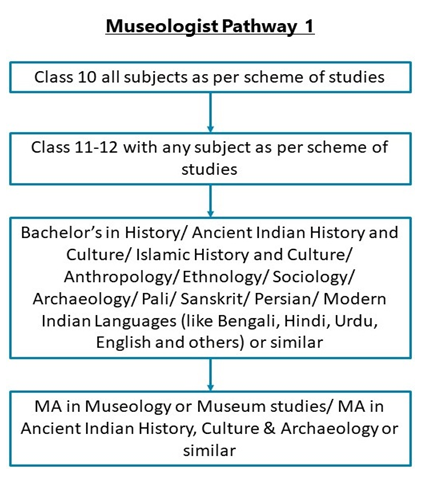
After completing Class 11-12 with any subject as per scheme of studies, you can go for a Bachelor’s in History/ Ancient Indian History and Culture/ Islamic History and Culture/ Anthropology/ Ethnology/ Sociology/ Archaeology/ Pali/ Sanskrit/ Persian/ Modern Indian Languages (like Bengali, Hindi, Urdu, English and others) or similar. Then pursue a Master’s degree specifically MA in Museology or Museum studies/ MA in Ancient Indian History, Culture & Archaeology or similar.
Class 10 all subjects as per scheme of studies – Class 11-12 with any subject as per scheme of studies – Bachelor degree in Fine Art or Visual Art– MA in Museology or Museum studies/ PG Diploma course in Museology & Conservation or similar courses
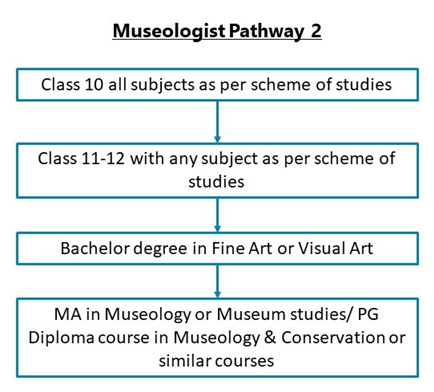
After completing Class 11-12 with any subject as per scheme of studies, you may go for a Bachelor degree in Arts, Fine Arts. Then you may opt for a MA in Museology or Museum studies or a PG Diploma course in Museology & Conservation or similar courses.
Class 10 all subjects as per scheme of studies – Class 11-12 with any subject as per scheme of studies – BA Degree in Archaeology/Art History/Anthropology/Ancient Indian Culture/Literature/Sociology/Political Science/History/Philosophy/Liberal Arts/Psychology– PG Diploma course in Modern and Contemporary Indian Art and Curatorial Studiesor similar courses
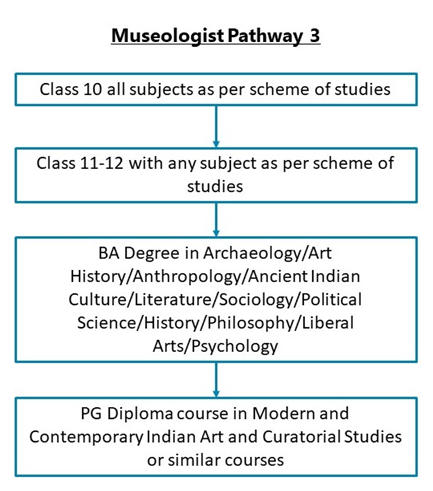
After completing Class 11-12 with any subject as per scheme of studies, you may go for a Bachelor degree in any field of Science. Then you may opt for a PG Diploma course in Modern & Contemporary Indian Art & Curatorial Studies or similar courses.
Class 10 all subjects as per scheme of studies – Class 11-12 with any subject as per scheme of studies - Bachelor of Fine Arts or similar – MFA – Ph.D.
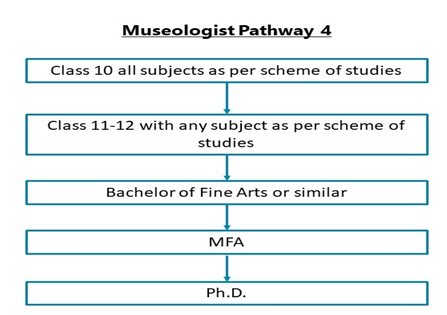
After completing Class 11-12 with any subject as per scheme of studies, you may go for a Bachelor of Fine Arts or similar and then go for a Master’s degree (Master of Fine Arts). Thereafter you may pursue a PhD in Curatorial Practice or Practice in Curating, Museum History, Fine Art, Art Writing, Miniature Art, Cultural Landscapes, Art Design & Architecture, Asian & African Art, Art History & Conservation, Renaissance Sculpture or any related area within your domain of interest in this field.
Class 10 all subjects as per scheme of studies – Class 11-12 with any subject as per scheme of studies – Bachelor degree in any discipline – Diploma in Fine Arts, Museum studies, Creative arts or any related discipline
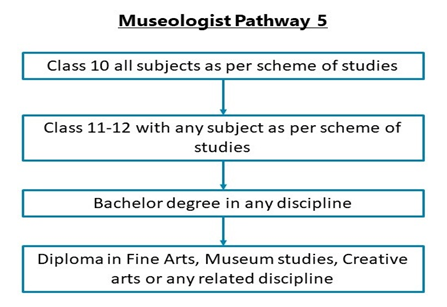
After completing Class 11-12 with any subject as per scheme of studies, you can go for a Bachelor degree in any discipline. Then go for a Diploma in Fine Arts, Museum studies, Creative arts or any related discipline.
Class 10 all subjects as per scheme of studies – Class 11-12 Physics, Chemistry, Biology along with any other subject as per scheme of studies/Class 11-12 Physics, Chemistry and Mathematics along with any other subject as per scheme of studies/Class 11-12 Physics, Chemistry, Biology and Mathematics along with any other subject as per scheme of studies - Bachelor’s in Zoology/ Botany/ Geology/ Geography/ Earth Sciences/Anthropology/ Agriculture/ Environmental Science/ Marine Science – Master degree in Museology / Master-Ph.D. integrated degree in Museology or a similar subject
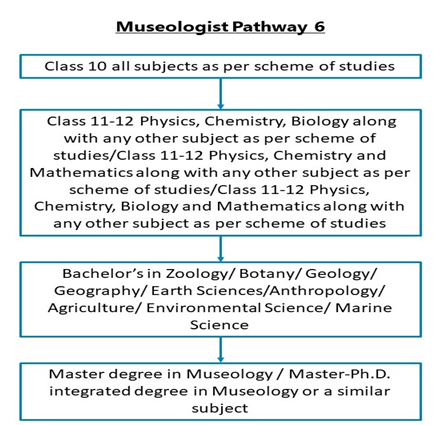
After completing Class 11-12 Physics, Chemistry, Biology along with any other subject as per scheme of studies/Class 11-12 Physics, Chemistry and Mathematics along with any other subject as per scheme of studies/Class 11-12 Physics, Chemistry, Biology and Mathematics along with any other subject as per scheme of studies, you can go for a Bachelor’s in Zoology/Botany/Geology/Geography/ Earth Sciences/Anthropology/ Agriculture/ Environmental Science/ Marine Science or in a related field. Thereafter you can go for Master degree in Museology or an integrated Master-Ph.D. degree in Museology or in a similar field.
Class 10 all subjects as per scheme of studies – Class 11-12 Science along with any other subject as per scheme of studies– Bachelor degree in any field of Science – PG Diploma course in Museology & Conservation or similar courses
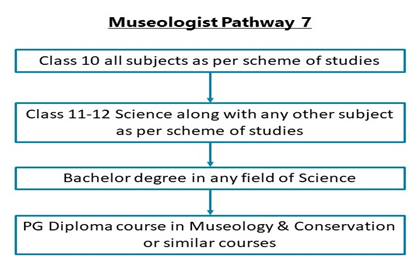
After completing Class 11-12 Science along with any other subject as per scheme of studies, you may go for a Bachelor degree in any field of Science. Then you may opt for a PG Diploma course in Museology & Conservation or similar courses.
Class 10 all subjects as per scheme of studies – Class 11-12 Physics, Chemistry and Mathematics along with any other subject as per scheme of studies – Bachelor’s degree in Architecture, Engineering, Interior Design/ Architecture, Planning, Landscape – PG Diploma in Heritage Studies
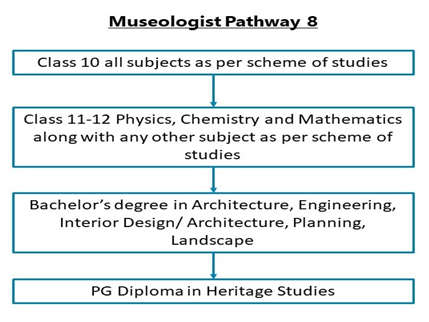
After completing Class 11-12 Physics, Chemistry and Mathematics along with any other subject as per scheme of studies, go for a Bachelor’s degree in Architecture, Engineering, Interior Design/ Architecture, Planning, Landscape. Then you can pursue a PG Diploma in Heritage Studies.
Class 10 all subjects as per scheme of studies – Class 11-12 with any subject as per scheme of studies – Bachelor’s degree in Archaeology, Conservation, Museology, History of Art, Architectural History or related subjects– PG Diploma in Heritage Studies
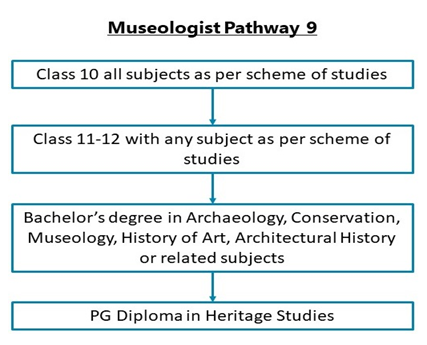
After completing Class 11-12 with any subject as per scheme of studies, go for a Bachelor’s degree in Archaeology, Conservation, Museology, History of Art, Architectural History or related subjects. Then you can pursue a PG Diploma in Heritage Studies.
Required Qualification & Competencies
1. To get into this field, you will need to pass Class 10 examination with Science, Mathematics, along with any other subjects.
2. Class 11-12 with any subject as per scheme of studies
3. Class 11-12 Physics, Chemistry, Biology along with any other subject as per scheme of studies
4. Class 11-12 Science along with any other subject as per scheme of studies
You can study for a Bachelor’s / Master’s / Doctoral degree in any of the following fields (Note that all these fields may not offer you a degree at all three levels, that is in Bachelor’s, Master’s and Doctoral. Some fields may offer a degree only at the Master’s or at the Doctoral level):
1. Ancient & Medieval History
2. Ancient History
3. Ancient History & Archaeology
4. Anthropology
5. Applied Art
6. Archaeological Anthropology
7. Archaeology
8. Archaeometry
9. Archival Studies
10. Art Appreciation
11. Asian History
12. Biblical Studies
13. Bioarchaeology
14. Biological Anthropology
15. Botany
16. Buddhist Studies
17. Calligraphy
18. Commercial Art
19. Conservation and Restoration of Art
20. Contemporary Art
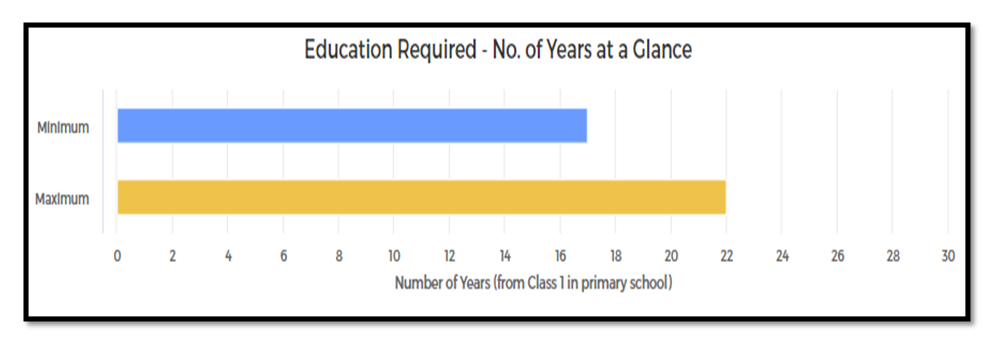
MINIMUM EDUCATION REQUIRED | MAXIMUM EDUCATION REQUIRED |
Post Graduate Postgraduate Degree / Diploma / Certificate Programs for which the minimum eligibility is a pass in Graduation / equivalent Diploma program like Honours Diploma or Graduate Diploma. | Doctoral All Ph.D. or eq uivalent degree programs for which the minimum eligibility is a Postgraduate or a Pre-Doctoral degree. |
Competencies Required
Interests
1. You should have interests for Enterprising Occupations. Enterprising occupations involve taking initiatives, initiating actions, and planning to achieve goals, often business goals. These involve gathering resources and leading people to get things done. These require decision making, risk taking and action orientation.
2. You should have interests for Artistic Occupations. Artistic occupations mostly involve working with creative ideas, art and designs. These occupations involve abstract or conceptual thinking, creative self-expression and often do not follow any set processes or rules for getting things done.
3. You should have interests for Conventional Occupations. Conventional occupations involve repetitive and routine tasks as well as fixed processes or procedures for getting things done. These occupations involve working more with data, systems, and procedures and less with ideas or creativity.
Knowledge
1. You should have knowledge of Fine Arts - Knowledge about the theories and techniques required for producing various works of fine arts such as painting, drawing, illustration, sculpture, digital art, installation art, craft, visual art, etc.
2. You should have knowledge of Applied Arts - Knowledge about the theories and techniques required for producing various works of applied and commercial arts such as graphics, textile, craft, advertising, floral design, landscape design, surface design, lighting design, etc.
3. You should have knowledge of Creative Design - Knowledge of various techniques, methods, and specifications for creating and developing designs for various products and materials.
4. You should have knowledge of Administration - Knowledge of various administrative and operational functions in managing a business or an organisation such as general administration, facility management, front office management, back office management, etc.
5. You should have knowledge of History and Archaeology - Knowledge of historical events and their causes, historical evidences, interpretations of the learning from historical events, influences of historical events on civilizations and cultures.
Skills
1. You will need Active Learning skills- Focused and continuous learning from various sources of information, observation and otherwise for application in getting work done.
2. You will need Artistic and Visual Design Skills - creating and developing designs which are visually appealing and attractive.
3. You will need Coordination Skills - working together with other people to get things done.
4. You will need Critical Thinking Skills - analysis of complex situations, using of logic and reasoning to understand the situations and take appropriate actions or make interpretations and inferences.
5. You will need Directing Skills - directing others' actions to get things done.
6. You will need Instruction Skills - training others how to do something.
7. You will need Judgment and Decision Making Skills - considering pros and cons of various decision alternatives; considering costs and benefits; taking appropriate and suitable decisions.
8. You will need skills in Managing Financial Resources- determining how money should be spent to get the work done, and accounting for these expenditures.
9. You will need Negotiation Skills - bringing others together and trying to reconcile differences.
10. You will need Persuasion Skills - persuading others to change their minds or behavior.
11. You will need Problem Solving Skills - analysis and understanding of problems, evaluating various options to solve the problems and using the best option to solve the problems.
12. You will need Public Speaking Skills - Talking effectively to a large group of people or an audience or addressing public at large in different settings such as conferences, seminars, meetings, etc.
13. You will need skills in Reading Comprehension- understanding written sentences and paragraphs in work related documents.
14. You will need Supervising Skills - Supervising and monitoring performance of others, businesses, and different projects.
15. You will need Troubleshooting Skills - determining causes of operating errors and deciding what to do about it.
Ability
1. You will need the ability of Abstract Reasoning - The ability to understand ideas which are not expressed in words or numbers; the ability to understand concepts which are not clearly expressed verbally or otherwise.
2. You will need the ability of Articulation - The ability to speak clearly so others can understand you.
3. You will need the ability of Category Flexibility - The ability to generate or use different sets of rules for combining or grouping things in different ways.
4. You will need the ability of Fluency of Ideas - The ability to come up with a number of ideas about a topic (the number of ideas is important, not their quality, correctness, or creativity).
5. You will need the ability of Oral Comprehension - The ability to listen to and understand information and ideas presented through spoken words and sentences.
6. You will need the ability of Originality - The ability to come up with unusual or innovative ideas about a given topic or situation, or to develop creative ways to solve a problem.
7. You will need the ability of Problem Sensitivity - The ability to tell when something is wrong or is likely to go wrong. It does not involve solving the problem, only recognizing there is a problem.
8. You will need the ability of Selective Attention - The ability to concentrate on a task over a long period of time without being distracted.
9. You will need the ability of Visualization - The ability to imagine how something will look after it is moved around or when its parts are moved or rearranged.
Personality Traits
1. You can always act independently or could do so in most situations.
2. You are always or mostly organized in your day-to-day life and activities.
3. You are always or mostly careful about your actions and behaviour.
4. You are always or mostly disciplined in your action and behaviour.
5. You are always calm or generally remain calm in most situations.
6. You are imaginative sometimes
Career - Job Opportunities & Profiles
1. Most students aspire to advanced careers in the arts or academia, including roles in universities, museums, galleries, and non-profit organizations. You may pursue a career in a field outside those traditionally targeted, such as in research, analysis, project design & management, and writing, among others. Museums, historical sites and similar institutions can be established by the private industry or local/ state/ national governments.
2. You may join a public resource museum/ private museum/ university museum or practice independently as a curator, and simultaneously be a successful artist or also author books. Many curators have transitioned into a critic and an author in the advanced stages of their careers. Almost all of them have published monographs and books.
3. Most incumbents at least have a Master’s degree in a relevant field or indulge in professional training during their formal Bachelor’s degree courses. Hands-on training and appropriate experience are extremely essential to be successful in this field.
The types of museums you may join may be government-run or private establishments including:
1. Science/ technology/ innovation museums
2. Archaeology/ Ornithology/ Anthropology museums
3. Art houses or art galleries
4. Encyclopedic museums (collections from around the world, not just from the nation where they are located)
5. Historic house museums (when a heritage building is reinstated such as a historic fortress or a palace)
6. Mobile museums (rather than people visiting it, these kinds are brought to the people in vehicles/trucks/trailers that drive to schools, libraries and rural events etc.)
You may start as a Curatorial Intern/ Museum Intern/ Exhibits Intern/ Collections Intern/ Photography Curatorial – Intern/ Intern-Paper Conservation etc. and then proceed to various roles such as the following. You may as well surpass internships and traineeships to directly join in any one of these roles with an advanced degree in a relevant field.
1. Museum Curator
2. Curatorial Assistant
3. Archivist
4. Provenance Specialist
5. Collections Curator
6. Exhibition Design Assistant
8. Curator Exhibitions
9. Gallery Curator
10. Vertebrate Zoology Curator
11. Associate Conservator
12. Exhibitions Coordinator
13. Curator of History
14. Gallery and Exhibition Preparator
15. Collections Care Specialist
16. Museum Development Officer
17. Visual Resource Specialist
Specialisation Tracks In This Career
1. Museum Curator
A Museum Curator oversees all artistic, financial, and operational functions in a museum. They set the artistic vision for the establishment. They are responsible for the museums exhibits, travelling shows, guest-curated projects and also work in collaboration with the artists. They conceptualize, curate and produce exhibitions & programs with a regional, local as well as global perspective to engage the public in ideas that matter. They manage, properly maintain, and care for the permanent collection, including work on display. They are also involved in providing support for fundraising and promotion of exhibitions & public programs. Curators identify and maintain active relationships with emerging artists and mid-career artists providing exposure to their work. They are the ones who intergrate artist exhibitions with exhibits of the permanent collection to build public awareness of the works represented. They are also sometimes involved in researching and writing copy for exhibition catalogues, programs, newsletters, gallery guides, interpretive materials, website, and articles for publication as appropriate.
2. Museum Technician
A Museum Technician is involved in handling, moving, installing, storing and managing permanent collection or loan artworks. They are “art handlers” working daily with Registrars and/or Installation Department crews on exhibition, loan & permanent collection projects to ensure the safe handling, movement, installation, packing, and crating of artworks. They design & construct crates, travel frames, storage containers, exhibition casework and storage fixtures for safely protecting art during transportation, storage, or exhibition. They may make offsite pickups & deliveries, which may include de-installation/installation in residential settings. They provide support in monitoring & managing storage and exhibition galleries/sites for proper environmental and display conditions.
3. Museum Administrator
The primary areas of focus of a Museum Administrator are development, fundraising, scheduling, operations and clerical. Administration team in a museum is the main point of contact for members & supporters, and serves as the Board liaison, arranging logistics of meetings, distributing materials, and maintaining schedule. Administrative & clerical tasks including, copying, collating, compiling data, answering calls, message taking, troubleshooting office equipment and filing. They are also involved in responding to inquiries, organizing shipping of materials, maintaining & managing all calendars for the organizations/ staff/ committees/ trustees, managing administrative projects including general research, prospect research (members, corporate & foundation) and database entry. They also manage corporate sponsorships, contracts, payments, and online presence of website and e-communications.
4. Museum Registrar
Registrars oversee all aspects of collection care & documentation related to the collections in a museum. In addition, they manage the logistics of loans, packing, and art shipments, and direct art installations. They monitor the condition of all collection objects in consultation with curators & conservators while coordinating conservation of objects as necessary. They enter & update object information, as well as loan and exhibitions records, in collections management databases or other internal database systems. They coordinate photography of the collection and storage of image files. They receive and respond to internal & external requests for use of those collection images as well as obtain copyright permission related to such reproduction requests. They also coordinate with insurance providers with regards to appropriate insurance coverage for collections & exhibitions. They also coordinate all aspects of outgoing loans, whatsoever. They also arrange for safe packing & transport of collections objects to and from other institutions.
5. Exhibit Content Developer/ Writer
Exhibit Content Developers are responsible for creating intellectually & emotionally engaging organized scientific information for museum exhibits by researching, writing, & editing labels for print and digital mediums. They conduct independent research which involves literature review, visitor research, theme and topic development and brainstorming with other team members. They research & interpret science information, images, objects, tools, and technologies; contributing to development of interpretive strategies and interactive elements for assigned exhibits. They write interpretive copy that aligns with exhibit goals, objectives, and key messages of the exhibit for project teams, internal, as well as external audiences. This includes writing lively text for labels and media scripts and editing, revising, fact-checking, proofreading, researching, selecting and helping to secure specimens, artifacts, images, diagrams, video, and other resources. They also need to coordinate the translation process for multilingual exhibits. They have to regularly collaborate and communicate progress with cross-functional teams including project managers, designers/ developers, scientists and subject matter experts, collections staff, educators, and other museum staff.
Career Growth
1. To give you an outline, you may start as an Education Officer/ Curator at historical sites and scale up through various roles like Digital Programme Manager in national art & design museums or as Head of learning, Head of Interpretation and Curation in museums & galleries, or Heads of Research in museums/galleries in India and internationally.
2. Typically, if you join as a Curatorial Intern/ Museum Intern/ Exhibits Intern/ Collections Intern/ Photography Curatorial – Intern/ Intern-Paper Conservation etc., then after completion of your training, you will be positioned as Museum Curator/ Curatorial Assistant/ Archivist/ Provenance Specialist/ Collections Curator/ Exhibition Design Assistantor in similar positions.
3. After 5-7+ years of experience, you can expect to become a Curator of Collections & Exhibitions; Senior Exhibition Designer; Senior Curator or similar.
4. After 7-10+ years of experience, you can expect to rise to the roles of Chief Curator; Chief Preparator; Museum Manager & Educator; Exhibits Manager; Manager of Installations and Operations; Head of Visitor Engagement; Head of Collections or similar roles.
5. Then after 10-12+years of experience, you can expect to rise to the roles of Deputy Director of Art, Museum Director, Director of Museum Design; Executive Director of Conservation and Science or similar roles.
Salary Offered
1. At the entry level jobs, you may expect to get about: Rs. 25,000 – 40,000 or even more a month (higher sides for premier institution graduates). In junior level jobs (after 5+ years of experience), you can make about Rs. 35,000 – 50,000 or more per month.
2. In mid-level jobsin India, you can expect to earn about Rs. 45,000 – 95,000 or even more a month.
3. In senior-leveljobsin India, you can expect to earn about Rs. 55,000 – 2,00,000 or even more a month.
4. All higher figures apply to large industrially funded establishments/ museums and some government-run institutions. The lower ones are for small, volunteer-based museums such as those of local historical societies.
5. Many aspirants are also proceeding to complete their Doctoral studies especially in Museum Studies, Curatorial practice or related domains aiming to associate with international establishments after their PhD.
6. After a Master’s degree, stipend in India while doing PhD is about Rs. 35,000-38,000 a month in a university or research centre or as a Research Associate with a salary of about Rs. 15,000-20,000 a month.
7. In other organizations/companies mostly after a Ph.D. as a Deputy Curatorial Head/ Chief Design Consultant, salaries in India may vary between Rs. 50,000-1,20,000 a month or even more.
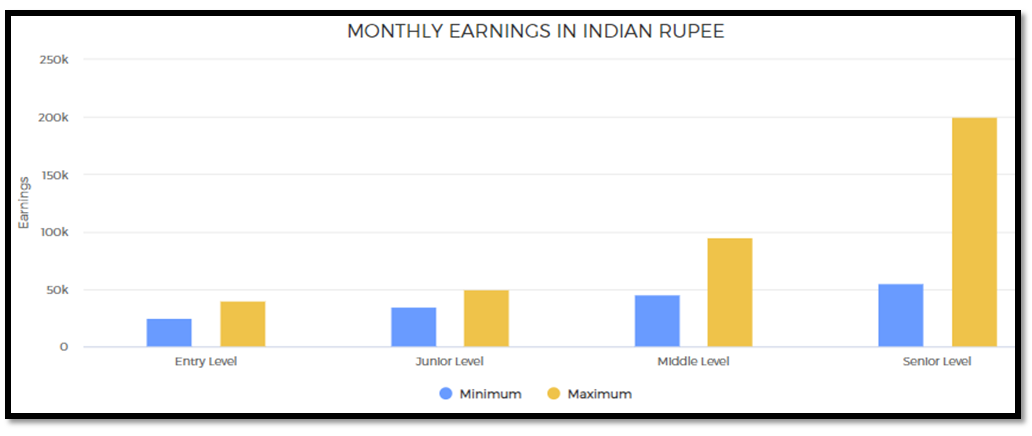
Monthly Earnings In Indian Rupee
Entry Level | Junior Level | Mid Level | Senior Level | ||||
Min Earning | Max Earning | Min Earning | Max Earning | Min Earning | Max Earning | Min Earning | Max Earning |
25000 | 40000 | 35000 | 50000 | 45000 | 95000 | 55000 | 200000 |
1. Entry level: 0 - 2 years of work experience
2. Junior Level: From 1 to 12 years of work experience
3. Mid Level: From 5 to 20+ years of work experience
4. Senior Level:From 10 to 25+ years of work experience (there could be exceptions in some high-end technical, financial, engineering, creative, management, sports, and other careers; also in the near future, people will reach these levels much faster in many careers and in some careers, these levels will have no meaning as those careers will be completely tech skill driven such as even now, there is almost no level in a Cyber Security Expert’s job)
Work Activities
1. Analyzing and interpreting data and information - Analysis of data and information to find facts, trends, reasons behind situations, etc.; interpretation of data to aid in decision making.
2. Assessing and determining compliance with standards, laws, rules and guidelines - Using relevant information, auditing information, processes and systems to determine whether organisations or people are complying with standards, laws, rules and guidelines.
3. Assessing and evaluating quality - Assessing and evaluating quality of materials, systems, processes, products, services, etc.
4. Communicating with co-workers and others -Communicating with people in writing through delivery of various types of literary/ media content for internal as well as an external audience who have professional relationships with your place of work including clients, government, etc. or with people at large.
5. Creative thinking - Developing new ideas, concepts, innovative solutions to problems, newer ways of getting things done, designing products and services, creating work of art and craft, etc.
6. Drawing, drafting, laying out and specifying objects, equipment, devices, tools, and systems - Creating and developing designs, drawings, layouts and specifications about how to construct, manufacture, assemble, build, use, and maintain various equipment, devices, tools and systems.
7. Estimating quantity, cost, time and resources - Estimating sizes, volumes, distance, and quantity; estimating and determining time, costs, and resources; estimating materials required to perform a task.
8. Getting Information and learning - Observing, hearing, reading, using computers, or otherwise obtaining information and learning from it.
9. Handling and moving objects and materials - Using hands or otherwise use physical strength to handle and move objects and materials; maneuver, install, lift, place, manipulate, etc.
10. Inspecting equipment, systems, structures, and materials - Inspecting equipment, systems, structures, and materials to ascertain quality, performance, defects, causes of errors, etc.
11. Making decisions and solving problems - Analysis of data and information; evaluation of alternative decisions and results of decisions; taking the right decisions and solving problems.
12. Managing and supervising - Managing and supervising work of others; setting goals; giving instructions; monitoring work performance, etc.
13. Monitoring use of resources - Monitoring and controlling use of resources, materials as well as spending of money.
14. Negotiating - Negotiating terms, conditions, costs, prices and about other issues.
15. Providing advices and consultation to others - Giving advices or consultation to others about various issues, conceptual matters, know-hows, scientific matters, products or services.
16. Updating and using relevant knowledge - Keeping updated with the latest knowledge relevant to your fields of work and use of the relevant knowledge in getting things done.
Future Prospects
1. This pathway has moderate to low prospects. Although government-run establishments in the museum industry is grappling with limitations in the form of protocols and lack of funds, private museums in India are collaborating with industry experts to equip the spaces with technology and make them more relevant for the inquisitive tech-savvy individual of today, whether in her teens or ahead of it.
2. Digitization has widely reinvented museums in the West, turning them into vibrant cultural spaces. Practicing in the curatorial domain especially for today’s technologically equipped galleries & museums, whether it houses history of space exploration or social injustices suffered across cultures in the world, has become an extremely competitive space and demands extensively trained and practiced professionals.
3. Globally, museum offerings are maturing and modernizing. Nowadays, museums are looking to engage and sustain the interest of the younger generation, while maintaining their primary purpose: to educate and inform people at large. The museum industry has, in recent years, been embracing technological trends such as virtual reality, 3D printing, art cameras, street views and 360-degree videos and others.
4. Museums have begun using VR to further the visitor experience. Plus, some have begun to present “aural” experiences to visitors such as the Centre for Indian Music Experience which has 40 iPads across different galleries containing multimedia content to strengthen the exhibits. Some galleries have touch-sensitive installations hence transforming a museum into a multimedia exhibit area.
5. Even, history-reminiscing establishments of the sorts of the Partition Museum in Amritsar have video footages and adaptations that may help a visitor listen to their ancestor’s voice again! Initiatives like Google Arts & Culture are currently helping about 50 museums in India with their digital life-cycle. Such exemplary set-ups are revolutionizing this industry today and skilled curators, who can efficiently strike equilibrium between a digital experience and an organic one, are still in dearth.
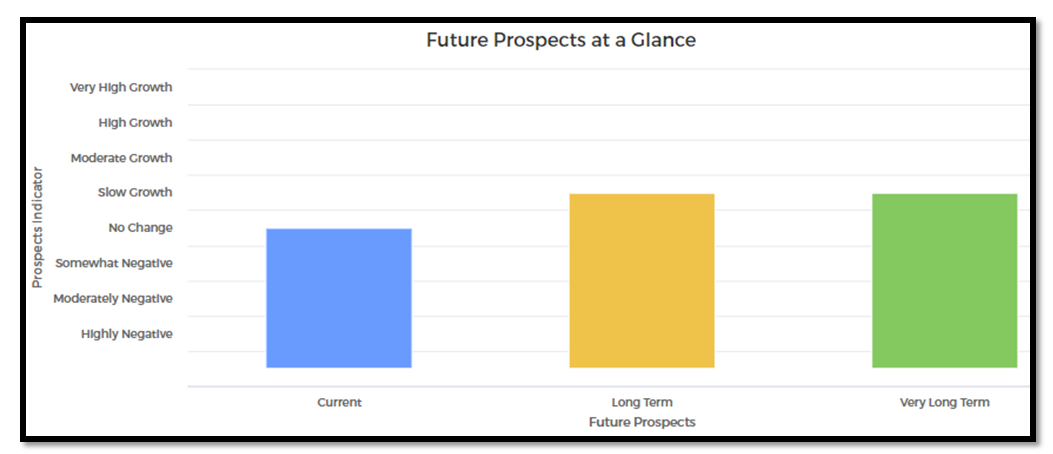
Future Prospects At A Glance
Current (0-1 Year) | Long Term (2-5 Year) | Very Long Term (6-10 Years) |
No Change | Slow Growth | Slow Growth |


