

Geographer
Entry Level Qualification
Class Graduate
Career Fields
Humanities, Liberals Arts & Social Science
For Specially Abled


About Career
1. As a Geographer, you will be concerned with the study of climate patterns, landforms, vegetation, soils, water, human settlements and economic activities. You will study Earth’s natural environment and its relationships with human society.
2. You will analyze political, cultural and social norms and how they are related to the geography of the land. You will research the inhabitants and features (human or physical) of a region on a global or local level.
3. You will use tools and techniques such as Geographic Information Systems (GIS), Remote Sensing, Global Positioning Systems (GPS), and online mapping such as Google Earth. You will compile, interpret and write your research findings, and present them to target audience and groups that will be able to benefit from it.
Key Roles And Responsibilities:
1. Creating and modifying maps, graphs, or diagrams, using geographical information software and equipment as well as principles of cartography, for example, latitude, longitude, coordinate systems, natural features of land, elevation,and scales of maps.
2. Analyzing geographic distributions of physical as well as cultural phenomena on regional, local, continental, or the global scales.
3. Writing and presenting reports of relevant research findings.
4. Gathering and compiling geographic data from sources including censuses, field observations, satellite imagery, and preexisting maps.
5. Teaching geography.
6. Studying the economic, political, and cultural characteristics of a specific region's population.
7. Collect data on geological formations, climates, and vegetation using various equipment.
8. Conducting field work at outdoor sites.
9.Providing geographical information systems support to the private and public sectors.
10. Provide consulting services in fields such as resource development and management, business location and market area analysis, environmental hazards, and urban social planning.
PARTICULARS | DESCRIPTION |
Name | Geographer |
Purpose | Study The Earth's Landscapes, Environments |
Career Field | Humanities, Liberals Arts & Social Science |
Required Entrance Exam | CUET UG, CUET PG |
Average Salary | 300000 - 400000 Rs. Per Year |
Companies For You | Research Institutions, Environmental Agencies & Many More |
Who is Eligible | Garduate |
Career Entry Pathway
Class 10 all subjects as per scheme of studies - Class 11-12 Arts/Humanities along with any other subject as per scheme of studies - BA (Hons) Geography
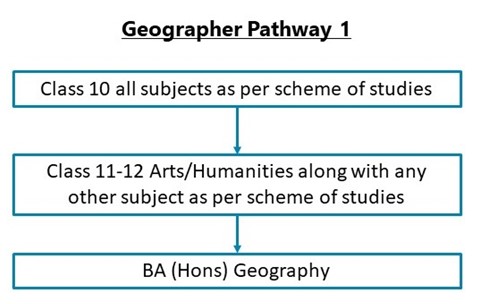
After finishing your Class 10 all subjects as per scheme of studies, you can study Class 11-12 Arts/Humanities along with any other subject as per scheme of studies and then go for a B.A. Hons course in Geography. Thereafter you can do an M.A. in Geography or related subjects followed by a Ph.D. Master's degree is a minimum requirement to build a good career in Geography.
Class 10 all subjects as per scheme of studies – Class 11-12 Physics, Chemistry and Mathematics along with any other subject as per scheme of studies - BSc Geography -MSc Geography - PhD Geography
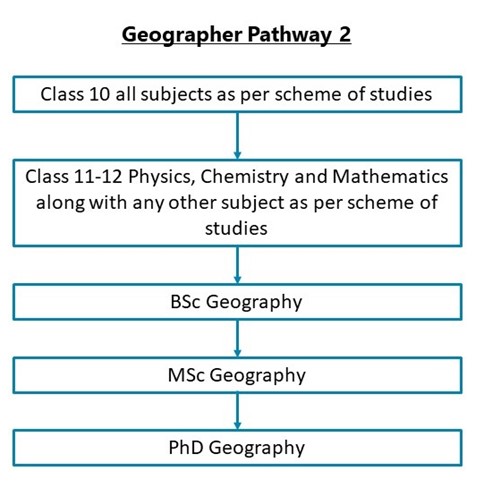
After finishing your Class 10 all subjects as per scheme of studies, you can study Class 11-12 Physics, Chemistry and Mathematics along with any other subject as per scheme of studies and then go for a B,Sc. course in Geography. Thereafter you can go for higher studies and do an M.Sc. followed by a Ph.D. Master's degree is a minimum requirement to build a good career in Geography.
Required Qualification & Competencies
For Graduation
1. After Finishing Your Class 10 All Subjects As Per Scheme Of Studies, You Can Study Class 11-12 Arts/Humanities Along With Any Other Subject As Per Scheme Of Studies You Can Go For A Graduate Degree In Ba With A Honours Or Major In Geography.
2. Alternatively, You Can Opt Class 11-12 Physics, Chemistry And Mathematics Along With Any Other Subject As Per Scheme Of Studies And Then Go For A Graduate Degree In Ba (Hons Geography)/ Bsc Geography.
For Post Graduation
After This, You Can Go For Masters Degree Courses (Ma/Msc Geography) & Read Further While Picking Up A Specialization Such As Geoinformatics, Geoscience & Gis, Petroleum Geoscience & More. If You Wish To Research Further, You May Go For A Doctorate In Geography (Ph.D.).
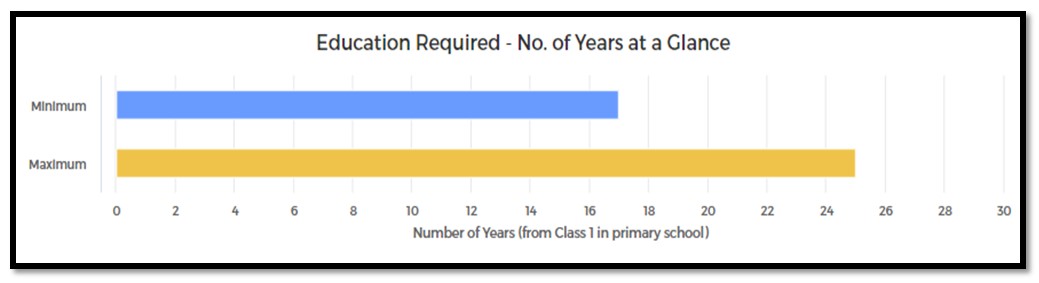
MINIMUM EDUCATION REQUIRED | MAXIMUM EDUCATION REQUIRED |
Post Graduate Postgraduate Degree / Diploma / Certificate Programs for which the minimum eligibility is a pass in Graduation / equivalent Diploma program like Honours Diploma or Graduate Diploma. | Post-Doctoral Post Ph.D. programs for which the minimum eligibility is a Doctoral degree. |
Competencies Required
Interests
1. Investigative: You should have interests for Investigative Occupations. Investigative occupations involve working with ideas and quite a lot of thinking, often abstract or conceptual thinking. These involve learning about facts and figures; involve use of data analysis, assessment of situations, decision making and problem solving.
2. Social: You should have interests for Social Occupations. Social occupations involve helping or assisting others; these involve working with and communicating with people to provide various services; these may involve educating and advising others.
Knowledge
Geography: Knowledge of principles and methods for describing the features of land, sea, and air masses, including their physical characteristics, locations, interrelationships, and distribution of plant, animal, and human life.
Skills
1. Active Learning: Focused and continuous learning from various sources of information, observation and otherwise for application in getting work done.
2. Communication in English: Skills in communicating effectively in writing as well as verbally with others in English language.
3. Critical Thinking: Skills in analysis of complex situations, using of logic and reasoning to understand the situations and take appropriate actions or make interpretations and inferences.
4. Judgment and Decision Making: Skills in considering pros and cons of various decision alternatives; considering costs and benefits; taking appropriate and suitable decisions.
5. Reading Comprehension: Skills in understanding written sentences and paragraphs in work related documents.
6. Writing: Skills in communicating effectively in writing as appropriate for the needs of the readers.
Abilities
1. Abstract Reasoning: The ability to understand ideas which are not expressed in words or numbers; the ability to understand concepts which are not clearly expressed verbally or otherwise.
2. Deductive Reasoning: The ability to apply general rules and common logic to specific problems to produce answers that are logical and make sense. For example, understanding the reasons behind an event or a situation using general rules and common logic.
3. Emotional Intelligence: The ability to understand your own and others' emotions and feelings; empathy for others; adjusting your behaviour or self-control and self-regulation according to others' emptions and situations.
4. Verbal Reasoning: The ability to think and reason with words; the ability to reason out ideas expressed in words.
5. Fluency of Ideas: The ability to come up with a number of ideas about a topic (the number of ideas is important, not their quality, correctness, or creativity).
Personality
1. You are a soft-hearted person sometimes.
2. You trust others sometimes but not always.
3. You are helpful to others sometimes.
4. You are self-satisfied sometimes but some other times you don't feel satisfied with your life and situations.
5. You are imaginative sometimes.
6. You prefer to experience new things and have new experiences sometimes.
7. You are caring, supportive, sympathetic and kind to others sometimes.
Career - Job Opportunities & Profiles
Entry level jobs can be availed after a graduate level BA/BSc degree. However, most jobs are available only after obtaining a Masters’ level degree or getting a Ph.D.
1. Junior Research Fellow, after post graduation
2. Assistant Professor, as a Ph.D. pursuant/ holder, or by clearing NET exam after post graduation
3. GIS Mapping Assistant
4. Subject Matter Consultant
5. Geo Analyst Trainee
6. Remote Sensing Assistant
7. GIS technician
8. Demographer
9. Cartographer
Some Organizations where you can get jobs:
1. Colleges and Universities
2. Information Technology services companies involved in GIS technologies
3. Agriculture Industry
4. Wildlife Conservation Agencies
5. Information Technology companies such as Accenture
6. Environmental Consultancies
7. Tourism and Planning Industry
Work Environment
Duration of the typical work week is more than 40 hours. The job is highly research intrinsic. Field work may be a major part. A lot of documentation, filing, recording, communication, and research is involved. Fieldwork may consist of working on all kinds of terrain. Exposure to dust can be high. Contact with others is frequent. Frequent use of specialist & safety equipment may be involved.
Specialisation Tracks In This Career
1. Cartographer/Digital Cartographer
Cartography is the study and practice of making maps. Combining science, aesthetics, and technique, cartography builds on the premise that physical coordinates can be modeled in ways that communicate spatial information effectively. Cartography is the process by which a collection locational of data is compiled and formatted into a virtual image, i.e. to say making virtual maps through digital software.
2. Specialist (Geoinformatics)
Geoinformatics is the scientific technique that makes use of information science infrastructures such as GPS and GIS to address the problems of geography, cartography, geosciences and related branches of science and engineering.
3. Specialist (Geomatics & GIS)
Geomatics is defined in the ISO/TC 211 series of standards as the "discipline concerned with the collection, distribution, storage, analysis, processing, presentation of geographic data or geographic information”.
4. Geoscientist
Earth science or geoscience includes all fields of natural science related to the planet Earth. It is the study of the Earth - its oceans, atmosphere, rivers and lakes, ice sheets and glaciers, soils, its complex surface, rocky interior, and metallic core It is the branch of science dealing with the physical constitution of the Earth and its atmosphere. Earth science is the study of our planet’s physical characteristics, from earthquakes to raindrops, and floods to fossils.
5. Specialist (Geopolitics)
Geopolitical studies focus on the relationships between politics, norms and traditions of a land with its geographical features.
6. Geographer (Human Geography)
Human geography is the branch of geography that deals with the study of people and their communities, cultures, economies, and interactions with the environment by studying their relations with and across space and place.
7. Geographer (Physical Geography)
Physical geography is the branch of natural science which deals with the study of processes and patterns in the natural environment like the atmosphere, hydrosphere, biosphere, and geosphere, as opposed to the cultural or built environment, the domain of human geography.
8. Geoscientist (Petroleum Geoscience)
Concerned with the application of Geosciences and technology to petroleum and reservoir engineering.
9. Geographer (Urban & Regional Development)
Urban planners use knowledge geographical information systems, land development, data analysis, economics and other activities to provide superior quality planning and development of space in towns and cities.
Career Growth
1. The chances of career growth as a Geographer are moderate. You can start with entry levels roles such as GIS technician, Transport & logistics executive, junior planner, assistant professor, among others.
2. You can get to mid-level jobs in 3-6 years with roles such as GIS System Assistant, Assistant Logistics Manager, Assistant Project Manager, and more.
3. With more than 8 years of experience, you can start moving to senior level roles such as Professor, GIS system manager, Logistics Manager, Project Manager and more.
Salary Offered
1. The salary of professionals in the field of Geographer varies according to the job profiles, and subject to your personal skill and qualification. The annual salary range increases as you rise up from entry-level jobs to mid-level to senior level roles.
2. For Instance, Starting out as a GIS specialist, urban planner, logistics executive associate professor, you may earn in the range of Rs. 15,000 to Rs 2,50,000, whereas a climatologist or remote sensing assistant may attract salaries in the range of Rs 25,000 to 2,50,000 from entry level to senior level.
3. Senior level jobs with more than 8 years of experience you can start to move into senior levels of administration and professor roles & earn in the range of Rs 1.90,000 to Rs 2,40,000 per month, which is also subject to personal skill and qualification.
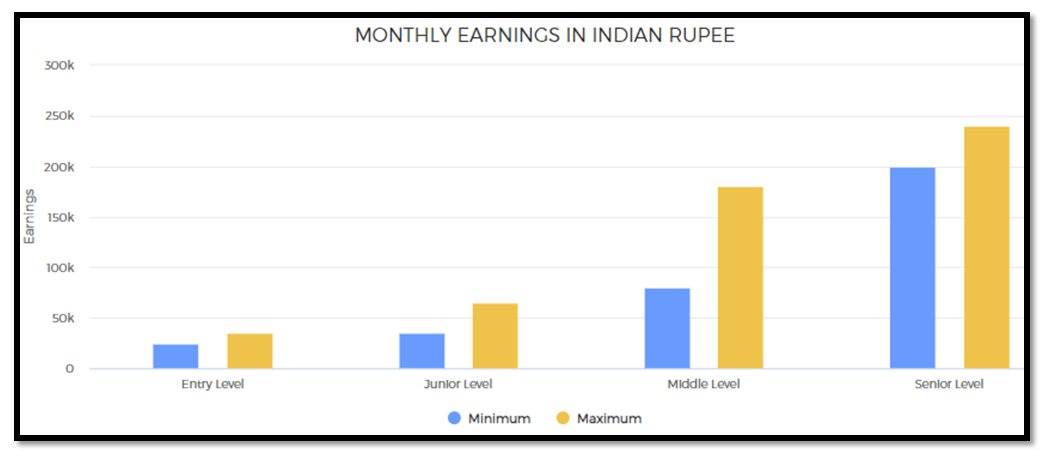
Monthly Earnings In Indian Rupee
Entry Level | Junior Level | Mid Level | Senior Level | ||||
Min Earning | Max Earning | Min Earning | Max Earning | Min Earning | Max Earning | Min Earning | Max Earning |
25000 | 35000 | 35000 | 65000 | 80000 | 180000 | 200000 | 240000 |
1. Entry level: 0 - 2 years of work experience
2. Junior Level: From 1 to 12 years of work experience
3. Mid Level: From 5 to 20+ years of work experience
4. Senior Level: From 10 to 25+ years of work experience (there could be exceptions in some high-end technical, financial, engineering, creative, management, sports, and other careers; also in the near future, people will reach these levels much faster in many careers and in some careers, these levels will have no meaning as those careers will be completely tech skill driven such as even now, there is almost no level in a Cyber Security Expert’s job)
Work Activities
1. Analysis and interpretation of data and information: Analysis of data and information to find facts, trends, reasons behind situations, etc.; interpretation of data to aid in decision making.
2. Communicating with co-workers and others: Communicating with co-workers and others
3. Estimating quantity, cost, time and resources: Estimating sizes, volumes, distance, and quantity; estimating and determining the time, costs, and resources; estimating materials required to perform a task.
4. Getting Information and learning: Observing, hearing, reading, using computers, or otherwise obtaining information and learning from it.
5. Information processing: Searching, compiling, tabulating, calculating, auditing, verifying or otherwise dealing with information processing including data entry, transcription, recording, storing and maintaining databases.
6. Organizing, planning and prioritizing tasks: Planning and organizing tasks in order to achieve work goals; prioritizing tasks to achieve goals and making the best use of the time available.
7. Updating and using relevant knowledge: Keeping updated with the latest knowledge relevant to your fields of work and use of the relevant knowledge in getting things done.
8. Using computers for work: Using computers for day-to-day office work; using computer software for various applications in day-to-day professional work; entering data and process information; for writing.
Future Prospects
1. The government has already identified Information Technology as one of twelve champion service sectors for which an action plan is being developed. The government has also set up a Rs 5,000 crore (US$ 745.82 million) fund for the purpose of realizing the potential of these champion service sectors. According to the Ministry of Housing and Urban Poverty Alleviation, there will be an integration of GIS and MIS technology in many slum and urban areas, which would require geographers in this case. In India, the Geographic Information System (GIS) Market was valued at USD 5.33 Billion and it is expected to reach USD 10.12 Billion, which is an approximate growth of CAGR of 9.6% .
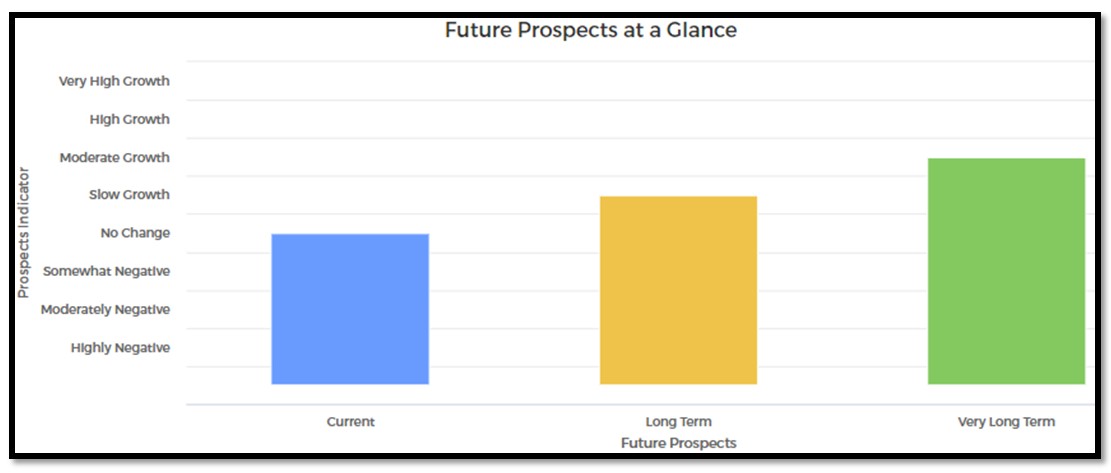
Future Prospects At A Glance
Current (0-1 year) | Long Term (2-5 year) | Very Long Term (6-10 years) |
No Change | Slow Growth | Moderate Growth |


