

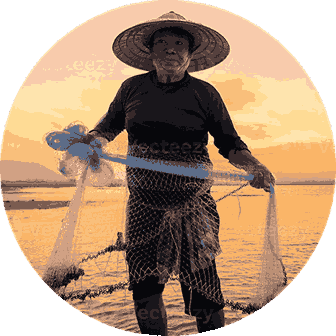
Fisherman
Entry Level Qualification
Class 8
Career Fields
Agriculture & Food Science
For Specially Abled


Career Entrance Exam
About Career
PARTICULARS | DESCRIPTION |
Name | Fisherman |
Purpose | Catching Fishes |
Career Field | Agriculture & Food Science |
Required Entrance Exam | No Entrance Exam |
Average Salary | 50000 - 100000 Rs. Per Year |
Companies For You | American Seafoodsn, Aqua, Trident Seafoods & Many More |
Who is Eligible | Any One |
As a fisherman or a fishery worker, you’ll be using nets, fishing rods, traps, or other equipment to catch and gather fish or other aquatic animals from rivers, lakes, or oceans, for human consumption or export.
You may work on fishing trawlers or fishing boats, or even raise fishes through fish farming or aquaculture. The profession might also involve you to prevent fish deterioration, and perform filleting and freezing of fresh fishes for forwarding distribution.
Key Roles And Responsibilities:
1. Steer fishing vessels and operate navigational instruments.
2. Put fishing equipment into the water and anchor or tow equipment, according to the fishing method used.
3. Maintain engines, fishing gear, and other equipment and perform minor repairs.
4. Catch fish and other aquatic animals like lobsters and crabs.
5. Sort, pack, and store fishes, lobsters, crabs etc in holds with salt and ice.
6. Locate fish, using equipment or scouts.
7. Return undesirable or illegal fishes to the water.
8. Direct fishing operations, and supervise crew members.
9. Oversee the purchase of supplies and equipment
10. Attach nets, slings, hooks, blades, or lifting devices to cables, booms, hoists, or dredges.
11. Transport fish to processing plants or to buyers.
12. Interpret weather and vessel conditions to determine appropriate responses.
13. Plan and budget fishing operations, establishing the fish to be sought, the location, the method of capture, and the duration of the trip.
14. Sell catches by contracting and negotiating with buyers or through fish auctions.
15. Grow fish and shellfish as cash crops or for release into freshwater or saltwater.
16. Maintain optimum conditions for aquatic life.
17. Segregate fishes according to weight, age, color, and physical condition.
18. Operate and maintain cultivating and harvesting equipment.
Career Entry Pathway
Class 10 all subjects as per the scheme of studies – Class 11-12 with any subject combination as per the scheme of studies - Skill Training Vocational Course by ICAR or State fishery boards.
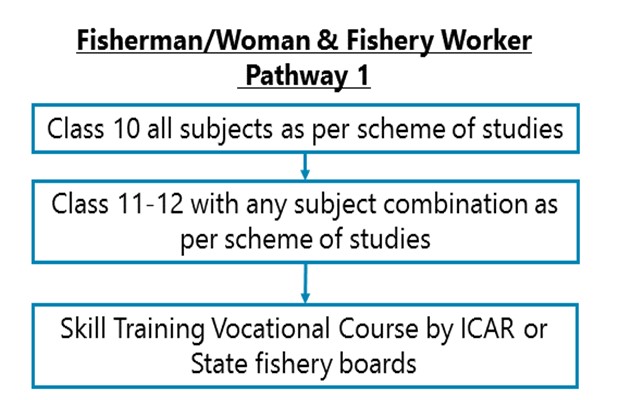
After Class 12, you can enroll yourself into skill training vocational programs by ICAR (Indian Council of Agricultural Research) or State fishery boards.
Required Qualification & Competencies
After finishing Class 10 and Class 12, after which you can go for a Diploma In Aquaculture. After finishing class 10 you can go for fisheries or aquaculture training by ICAR or various state training departments or various animal science institutes. Some of the skill training options are stated below:
1. Krishi Vigyan Kendras under ICAR conducts training in collaboration with eight of their institutes and offers fisheries as a vocational course at 10(+2) level with active assistance from NCERT.
2. The Coastal States have fisheries schools at fishermen's dominating villages and conduct regular programs on skill development among the fishermen.
3. Training programs are also offered on Deep Sea Fishing and Navigation by the Central Institute of Fisheries Nautical & Engineering Training (CIFNET).
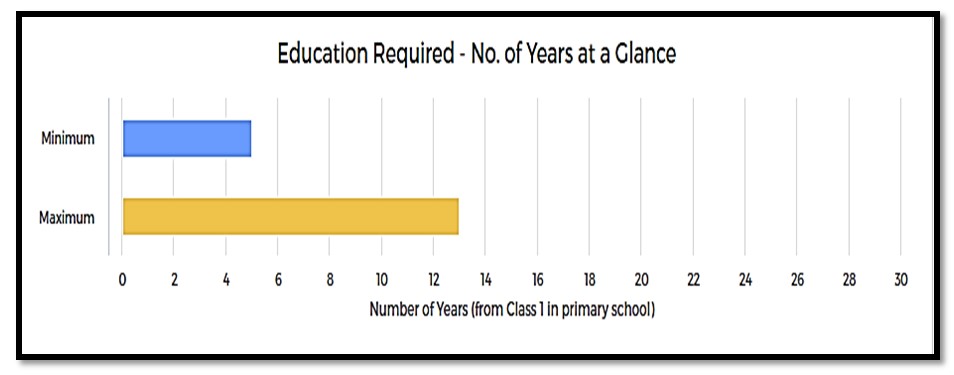
MINIMUM EDUCATION REQUIRED | MAXIMUM EDUCATION REQUIRED |
Under Secondary Certificate Programs for which the minimum eligibility is a pass in any class below class X. | Post Higher Secondary Diploma / Certificate Programs for which the minimum eligibility is a pass in Higher Secondary / Class XII School Leaving examination. |
Competencies Required
Interests
1. Investigative: You should have an interest in Investigative Occupations. Investigative occupations involve working with ideas and quite a lot of thinking, often abstract or conceptual thinking. These involve learning about facts and figures; involve the use of data analysis, assessment of situations, decision-making, and problem-solving.
2. Realistic: You should have an interest in Realistic Occupations. Realistic occupations involve more practical and hands-on activities than paperwork or office work. Realistic occupations often involve physical activities for getting things done using various tools and equipment.
Knowledge
1. Animal Care: Knowledge about how to take care of animals and cater to different needs for both domestic and farm animals. This includes knowledge about animal breeding, raring, raising, basic healthcare and grooming,
2. Biological Sciences: Knowledge of plants and animals, their anatomical structure, cell structure, tissues, physiological functions, evolution, and all other related aspects.
Skills
1. Active Learning: Focused and continuous learning from various sources of information, observation, and otherwise for application in getting work done.
2. Critical Thinking: Skills in the analysis of complex situations, using logic and reasoning to understand the situations and take appropriate actions or make interpretations and inferences.
3. Judgment and Decision Making: Skills in considering the pros and cons of various decision alternatives; considering costs and benefits; and making appropriate and suitable decisions.
4. Problem Solving: Skills in analysis and understanding of problems, evaluating various options to solve the problems, and using the best option to solve the problems.
5. Reading Comprehension: Skills in understanding written sentences and paragraphs in work-related documents.
Abilities
1. Abstract Reasoning: The ability to understand ideas that are not expressed in words or numbers; the ability to understand concepts that are not clearly expressed verbally or otherwise.
2. Deductive Reasoning: The ability to apply general rules and common logic to specific problems to produce answers that are logical and make sense. For example, understanding the reasons behind an event or a situation using general rules and common logic.
3. Mental Stamina: The ability to sustain the prolonged mental effort.
4. Naturalistic Intelligence: The ability to recognize different flora and fauna of the world; sensitivity towards nature and natural surroundings; sensitivity towards the needs of different flora and fauna.
5. Problem Sensitivity: The ability to tell when something is wrong or is likely to go wrong. It does not involve solving the problem, only recognizing there is a problem.
6. Selective Attention: The ability to concentrate on a task over a long period without being distracted.
Personality
1. You are always or mostly a soft-hearted person.
2. You are always or mostly helpful to others.
3. You are always or mostly caring, supportive, sympathetic, and kind to others.
4. You are somewhat organized in your day-to-day life and activities.
5. You prefer to experience new things and have new experiences sometimes.
Career - Job Opportunities & Profiles
After completing your Skill training or finishing your Diploma, you can find work as a Fisherman or Fishery worker.
Work Environment
The duration of the typical work week is usually more than 40 hours. You will frequently be outdoors or exposed to weather, which may occasionally turn hostile. A lot of effort and time is spent using your hands to handle, control, or feel objects, tools, or controls. Sounds or noise levels may frequently become distracting or uncomfortable. Safety is of high importance & you will frequently wear common protective or safety equipment such as safety shoes, glasses, gloves, hearing Protection, Hard Hats, or life jackets. You will also be responsible for others' health and safety because you will usually work with a team. You will spend time a lot of time bending or twisting the body and may be exposed to hazardous equipment. You might also find yourself in a cramped workspace.
Career Growth
There is limited to no growth in a career as a fishery worker or fisherman. People start as fishery workers and in a few years move to supervisory and group leader positions, which is mostly the extent of job growth they manage.
Salary Offered
1. Typically, while starting as a fisherman or fishery worker you can earn about 8,000 to 18,000 per month, depending on the employer.
2. As you gain experience and knowledge in the field, you can move to supervisory positions or own your own boat/ fishing vessel. As a Supervisor in an aquaculture farm, you can earn about Rs. 15,000 to 25,000 per month.
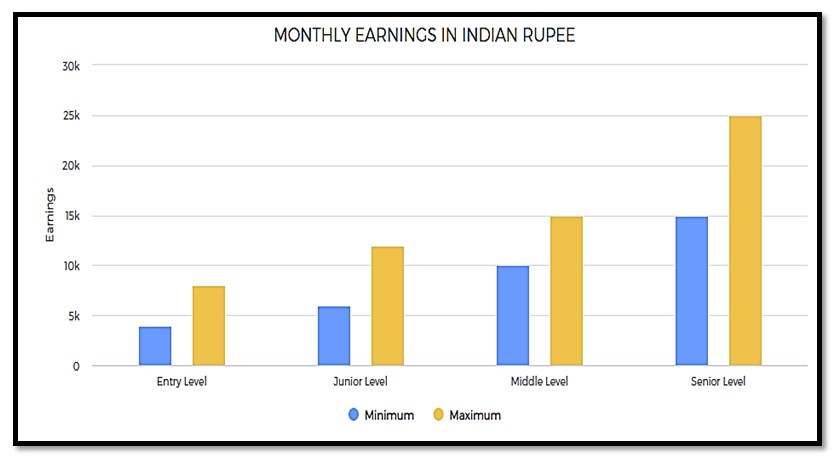
Monthly Earnings In Indian Rupee
Entry Level | Junior Level | Mid Level | Senior Level | ||||
Min Earning | Max Earning | Min Earning | Max Earning | Min Earning | Max Earning | Min Earning | Max Earning |
4000 | 8000 | 6000 | 12000 | 10000 | 15000 | 15000 | 25000 |
1. Entry level: 0 - 2 years of work experience
2. Junior Level: From 1 to 12 years of work experience
3. Mid-Level: From 5 to 20+ years of work experience
4. Senior Level: From 10 to 25+ years of work experience (there could be exceptions in some high-end technical, financial, engineering, creative, management, sports, and other careers; also shortly, people will reach these levels much faster in many careers and some careers, these levels will have no meaning as those careers will be completely tech skill driven such as even now, there is almost no level in a Cyber Security Expert’s job)
Work Activities
1. Assisting and caring for animals: Taking care of animals in different situations and settings.
2. Communicating with co-workers and others: Communicating with people in writing, verbally or otherwise inside your workplace and various other people who have professional relationships with your place of work including vendors, government officials, etc., or with people at large.
3. Decision-making and problem-solving: Analysis of data and information; evaluation of alternative decisions and results of decisions; taking the right decisions and solving problems.
4. Getting Information and learning: Observing, hearing, reading, using computers, or otherwise obtaining information and learning from it.
5. Inspecting situations, events, and people: Inspecting situations, events, and people to understand the reasons and causes for the situation or events to happen; inspecting people to understand reasons behind their behavior and actions.
6. Organising, planning, and prioritizing tasks: Planning and organizing tasks to achieve work goals; prioritizing tasks to achieve goals and making the best use of the time available.
7. Providing advice and consultation to others: Giving advice or consultation to others about various issues, conceptual matters, know-how, scientific matters, products, or services.
8. Working in a team: Working in a team of people; developing a team; and maintaining professional relationships among team members.
Future Prospects
1. India is the second largest producer of fish through aquaculture next to China and the annual production could be doubled by utilizing the available reservoir areas.
2. Favorable schemes to boost what is already an extremely large fishing industry, coupled with the increase of skill training programs facilitated by the Government indicate favorable prospects for a career as a Fisherman & Fishery Worker.
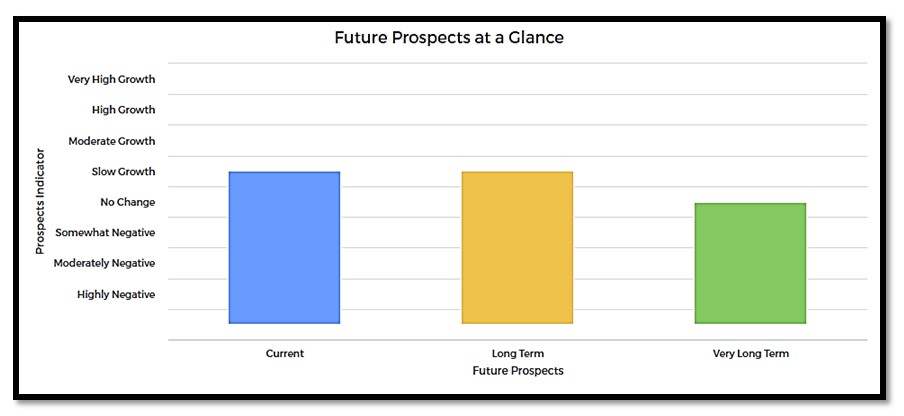
Future Prospects At A Glance
Current (0-1 year) | Long Term (2-5 years) | Very Long Term (6-10 years) |
Slow Growth | Slow Growth | No Change |


