
Concrete Moulder
Entry Level Qualification
8
Career Fields
Architecture & Planning
For Specially Abled


Career Entrance Exam
About Career
PARTICULARS | DESCRIPTION |
Name | Concrete Moulder |
Purpose | Shape And Form Concrete |
Career Field | Architecture & Planning |
Required Entrance Exam | No Entrance Exam |
Average Salary | 60000 - 150000 Rs. Per Year |
Companies For You | UltraTech Cement, Ambuja Cement & Many More |
Who is Eligible | Any One |
1. A Concrete moulder’s responsibility is to mould (making particular shapes) and finish different sizes and shapes of concrete blocks as per requirement using an appropriate mould.
2. At first, a concrete moulder has to prepare the estimates of all required material, then examine drawings and select the wooden mould of the needed size, shape and pattern, prepare concrete mix, and add cement, lime and sand. He has to use a sufficient quantity of water to arrange cement concrete mortar and place the required number of iron rods into a mould in which cement concrete mortar is poured. Once it is compact, then he levels the surface, smoothens it with a trowel and allows the concrete to set. This kind of job calls for a good fitness level and the ability to work for long hours. Concrete moulders work majorly with concrete so there are a few health risks that individuals must take care of beforehand and ensure that they get the required training that helps them do their job.
3. You may have to work with different machinery and equipment so physical labour is necessary. A shift system may be available. Generally, Concrete Moulders have to work for 8-9 hours per day and have to attend work 5-6 days a week, that is, roughly 40 hours per week.
Key Roles and Responsibilities
As a Concrete Moulder, you will be engaged with one or more of the following roles and responsibilities: -
1. You will be involved in finishing and moulding cement concrete blocks of different sizes and shapes.
2. You will have to examine drawings and other specifications.
3. You will have to prepare approximate estimates of the different materials required.
4. You will have to select a wooden mould of a specific size and pattern.
5. You will be engaged in mixing sand, cement, lime etc.
6. You will prepare cement concrete mortar by adding the required amount of water.
7. You will place and fix the necessary number of specifically sized iron rods into a mould.
8. You will pour cement concrete mortar into the specific cement mixture.
9. You will ram concrete with iron rods to make it compact.
10. You will level the surface of the mould by filling it with concrete.
11. You will smoothen it with a wooden smoother or trowel.
12. You will allow the concrete to settle for a specified period in a mould so that it gets hardened.
13. You will remove the shuttering or soak it in water for curing and then, get it dried in shades.
Career Entry Pathway
Class 5 in school – MES courses for ‘Mason’.
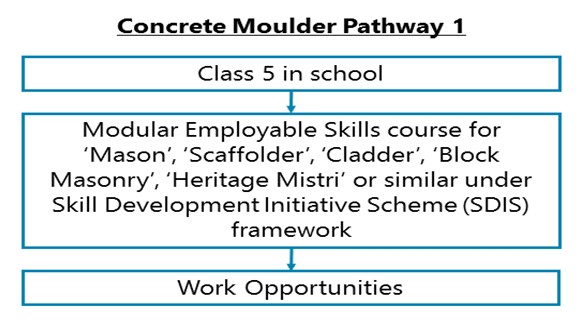
After completing Class 5 in school, you can go Modular Employable Skills course for ‘Mason’, ‘Scaffolder’, ‘Clade’, ‘Block Masonry’, ‘Heritage Mistri’ or similar under the Skill Development Initiative Scheme (SDIS) framework approved by the National Council of Vocation Training (NCVT).
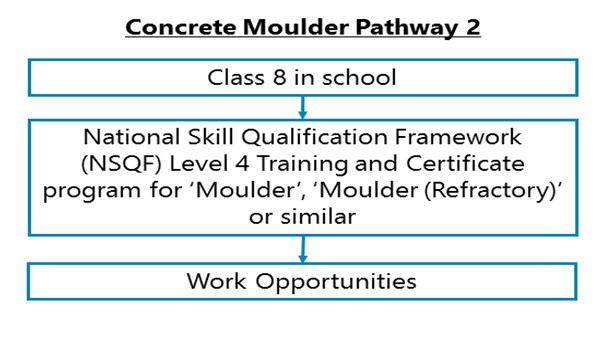
After completing Class 8 in school, you can go for the National Skill Qualification Framework (NSQF) Level 4 Training and Certificate program for ‘Moulder’, ‘Moulder (Refractory)’, or similar courses. The total number of training hours is 2080.
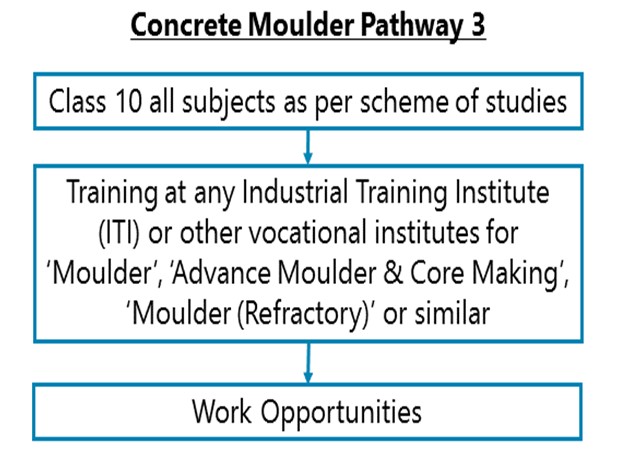
After completing Class 10, you can go for training at any Industrial Training Institute (ITI), National Skill Training Institute (NSTI), Regional Vocational Training Institute (RVTI), National Vocational Training Institute (NVTI), Industrial Training Center (ITC) or other vocational institutes for ‘Moulder’, ‘Advance Moulder & Core Making’, ‘Moulder (Refractory)’ or similar. You will sit for the All India Trade Test (AITT) to get a National Trade Certificate (NTC) after this course. This exam is held twice a year in February and July.
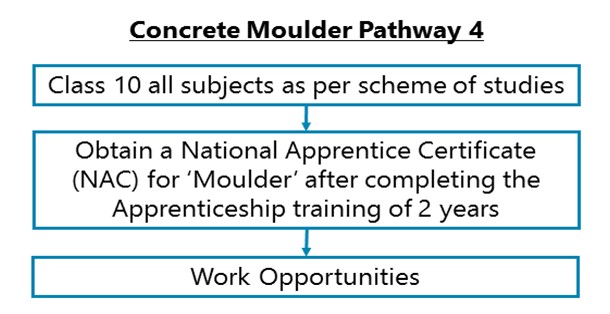
After completing Class 10, you can obtain a National Apprentice Certificate for ‘Moulder’ after completing the Apprenticeship training of 2 years.
Required Qualification & Competencies
After Class 10, you can go for:
1. NSQF courses.
2. MES courses.
3. ITI training courses.
4. NAC training.
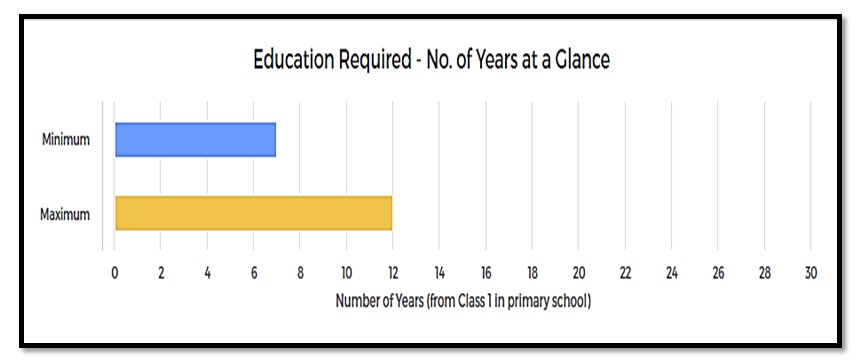
MINIMUM EDUCATION REQUIRED | MAXIMUM EDUCATION REQUIRED |
Under Secondary Certificate Programs for which the minimum eligibility is a pass in any class below class X. | Post-Secondary Certificate / Diploma Programs for which the minimum eligibility is a pass in class X. |
Competencies Required
1. You should have an interest in Realistic Occupations. Realistic occupations involve more practical and hands-on activities than paperwork or office work. Realistic occupations often involve physical activities for getting things done using various tools and equipment.
2. You should have an interest in Conventional Occupations. Conventional occupations involve repetitive and routine tasks as well as fixed processes or procedures for getting things done. These occupations involve working more with data, systems, and procedures and less with ideas or creativity.
3. You should have knowledge of Civil construction - materials, methods, and the tools involved in the construction or repair of houses, buildings, or other structures such as industrial factories, dams, bridges, highways, and roads.
4. You should have Time Management Skills - prioritizing work, and managing time effectively.
5. You should have Manual Dexterity – The ability to quickly move your hand, your hand together with your arm, or your two hands to grasp, manipulate, or assemble objects.
6. You should have Arm-Hand Steadiness - The ability to keep your hand and arm steady while moving your arm or while holding your arm and hand in one position.
7. You should have Physical Stamina - The ability to exert yourself physically over long periods without getting winded or out of breath.
8. You should have Civil Repair and Maintenance Skills - performing repair and maintenance of different types of civil structures such as buildings, bridges, dams, roads, highways, factories, etc.
9. You always or mostly prefer to stick within a routine or carry out routine and repetitive activities.
10. You are always or mostly dependent on others or set rules and procedures.
11. You are always or mostly organized in your day-to-day life and activities.
Career - Job Opportunities & Profiles
You will mainly find work in the construction industry. You may also develop your own contracting company, hire more laborers for your company, take work projects from other big construction companies, and make your laborers work there.
Career Growth
From a Concrete Moulder, you can become a Chief Mason and then a Contractor. As a contractor, if you can set up your own contracting company in the future and hire more laborers for your company, you may look forward to earning much more.
Salary Offered
1. At the beginning of your career as a Helper Concrete Moulder, you will be earning about Rs. 5,000-10,000 per month or more.
2. When you acquire about 2-5 years of experience, you can earn about Rs. 16,500-20,500 or even more per month or more.
3. After 12-15 years of experience, you can earn about Rs. 20,500-23,000 or more per month or more.
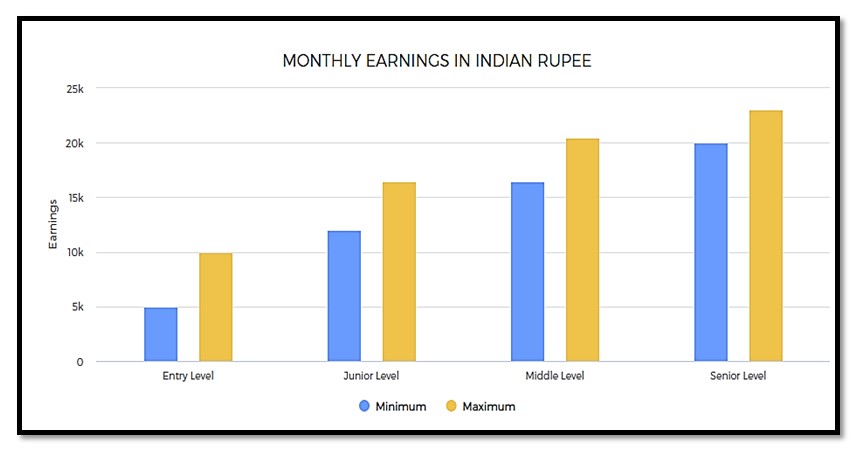
Monthly Earnings In Indian Rupee
Entry Level | Junior Level | Mid-Level | Senior Level | ||||
Min Earning | Max Earning | Min Earning | Max Earning | Min Earning | Max Earning | Min Earning | Max Earning |
5000 | 10000 | 12000 | 16500 | 16500 | 20500 | 20000 | 23000 |
1. Entry level: 0 - 2 years of work experience
2. Junior Level: From 1 to 12 years of work experience
3. Mid-Level: From 5 to 20+ years of work experience
4. Senior Level: From 10 to 25+ years of work experience (there could be exceptions in some high-end technical, financial, engineering, creative, management, sports, and other careers; also shortly, people will reach these levels much faster in many careers and some careers, these levels will have no meaning as those careers will be completely tech skill driven such as even now, there is almost no level in a Cyber Security Expert’s job)
Work Activities
1. Performing physical activities - Performing physical activities that require the use of your arms and legs and moving your whole body, such as climbing, lifting, balancing, walking, stooping, and handling materials.
2. Fabricating, assembling, and constructing equipment, devices, and products – Fabricating, assembling, constructing or otherwise manufacturing products, equipment, devices, and tools.
3. Inspecting equipment, systems, structures, and materials - Inspecting equipment, systems, structures, and materials to ascertain quality, performance, defects, causes of errors, etc.
4. Handling and moving objects and materials - Using hands or otherwise using physical strength to handle and move objects and materials; maneuver, install, lift, place, manipulate, etc.
5. Operating machines, equipment, devices, systems, and processes - Using various methods and techniques to operate equipment, devices, systems, and processes in industrial and other settings.
6. Communicating with co-workers and others - Communicating with people in writing, verbally or otherwise inside your workplace and various other people who have professional relationships with your place of work including vendors, government officials, etc., or with people at large.
7. Working in a team - Working in a team of people; developing a team; and maintaining professional relationships among team members.
Future Prospects
It is estimated that India’s real estate market will reach a market size of $180 billion. It is also estimated that India will become the third-largest construction market globally. It will also be one of the largest employers, and hire about 75 million people. So, the sector is looking for massive growth in the future.

Future Prospects At A Glance
Current (0-1 year) | Long Term (2-5 years) | Very Long Term (6-10 years) |
Somewhat Negative | Moderate Growth | Moderate Growth |


