

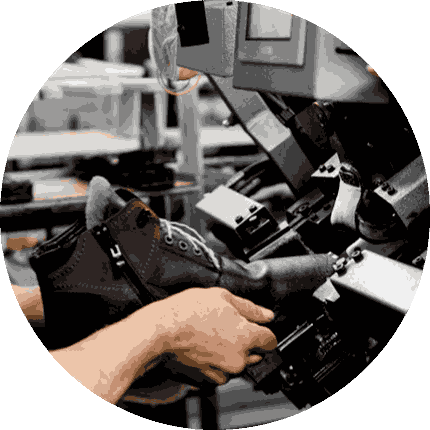
Footwear Technician
Entry Level Qualification
Class 8
Career Fields
Apparel & Accessories
For Specially Abled


Career Entrance Exam
About Career
1. As a Footwear Technician, you will be involved in all the technical processes for the manufacturing of leather or non-leather (i.e., plastic, wood, jute, rubber, etc.) footwear or other footwear that are leather substitutes. You may be involved in the manufacturing process of sports shoes, casual shoes, formal shoes, formal footwear for men, and formal and informal footwear for women such as Pumps, Stilettos, Ankle Booties, Wedges, Gladiator Sandals, Cone Heels, etc.
2. You will be involved in the process of carrying out footwear sample-making operations which include making product samples as per the guidelines of footwear designers. Sample making involves cutting leather or other materials, putting together various cut pieces, stitching, and finishing to produce samples of footwear.
3. Once samples are approved by a footwear company’s managers or their clients (clients could be footwear retail stores), then you will be required to manufacture footwear. First, you will be required to create pieces of the patterns of various footwear by cutting leather and non-leather materials. Patterns of footwear are prepared by footwear makers on paper sheets or other similar sheets (such as cardboard) using the design given by footwear designers or as per samples of footwear.
4. Using the pieces of patterns, you will be required to cut leather and other materials (such as fabric, vinyl, rubber, etc.) for manufacturing various footwear. You will also be involved in the process of stitching activities for making the upper part of the footwear as per the instructions provided by designers or supervisors. You will also be performing repair work on different types of footwear and leather goods using hand tools or machines.
Key Roles and Responsibilities
As a Footwear Technician, you will be engaged in all or some of the following key roles and responsibilities:
1. You will be required to study drawings of designers and will be involved in preparing patterns, choosing materials, or cutting parts manually by following the patterns made.
2. You will be required to cut out parts, according to patterns or outlines, using shears, knives, machine presses, or scissors.
3. You will be required to construct, decorate, and repair footwear products following specifications, using needles and thread, sewing machines, glue, leather lacing, hand tools, etc.
4. You will be required to press and bend parts to form the required shape, glue lining materials to leather parts and stitch them together.
5. You will be required to repair or replace heels, soles, and other parts of footwear, using buffing, sewing, and other shoe repair materials, machines, and equipment.
6. You will be required to dye, soak, polish, paint, stamp, stitch, or buff raw materials to obtain desired effects, shapes, or decorations.
7. You will be responsible for inspecting, maintaining, and ensuring the quality of the product at various stages of production until the final stage of packing.
PARTICULARS | DESCRIPTION |
Name | Footwear Technician |
Purpose | Repair or Replace |
Career Field | Apparel & Accessories |
Required Entrance Exam | No Entrance Exam |
Average Salary | 100000 - 150000 Rs. Per Year |
Companies For You | Footwear Maker, Footwear Worker, Stitching Operator & Many More |
Who is Eligible | Any One |
Career Entry Pathway
Class 10 all subjects as per the scheme of studies – Diploma in ‘Footwear Technology’ or similar courses– Work opportunities in the footwear manufacturing industry.
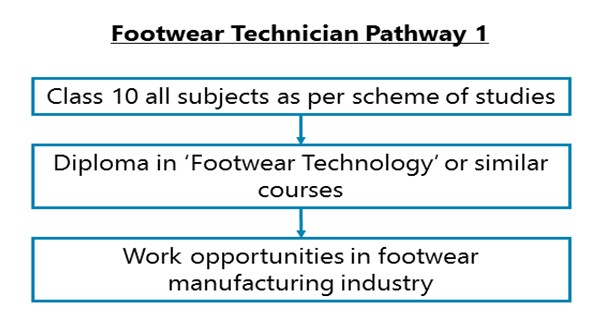
After Class 10, you can enroll for a Diploma in ‘Footwear Technology’ or similar courses. The duration of this course is generally 1 year. Many institutes offer this course in distance learning mode which means you do not have to go to the Institute for classes other than for in-plant or practical training. Alternatively, you can also apply for a regular mode course where you have to visit the Institute to take the classes.
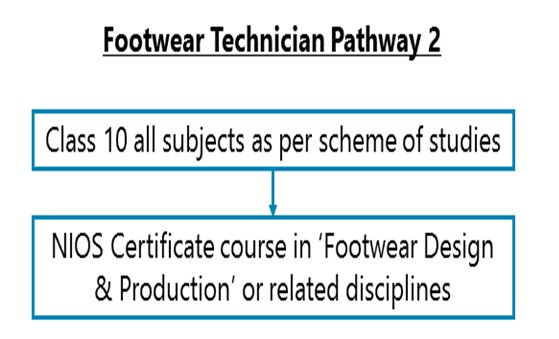
After Class 10, you can apply for a 1-year certificate course in ‘Footwear Design & Production’ or related disciplines under the National Institute of Open Schooling of India (NIOS) or any other institute. The total number of training hours is 800.
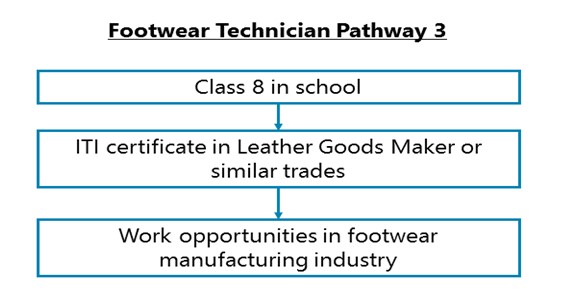
After your class 8 in school, you can enroll for an ITI (Industrial Training Institute) certificate in Leather Goods Maker or in a similar trade. After that, you can get a job in a footwear manufacturing firm.
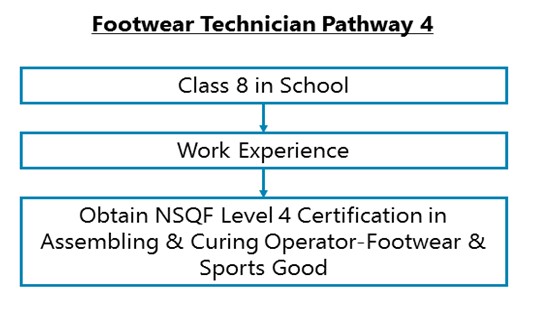
After completing Class 8 in School and after obtaining work experience as a semi-skilled helper for a minimum of 6 months in the same process (Assembling and Curing), then you may obtain National Skills Qualification Framework (NSQF) Level 4 Certification in Assembling & Curing Operator-Footwear & Sports Good or similar course. The total number of training hours is 350.
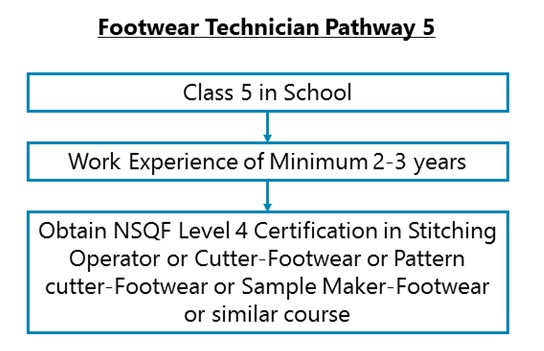
After completing Class 5 in School and after obtaining work experience as a helper in footwear manufacturing for a minimum of 2-3 years (preferred), then you may obtain National Skills Qualification Framework (NSQF) Level 4 Certification in Stitching Operator(300 hours) or Cutter -Footwear(300hours) or Pattern cutter-Footwear(200 hours) or Sample Maker-Footwear(200 hours) or similar course. The numbers in brackets are the total number of training hours for each course. Alternatively, for obtaining NSQF Certification in Pattern cutter footwear and Sample maker footwear, training in footwear manufacturing is preferred (not mandatory).
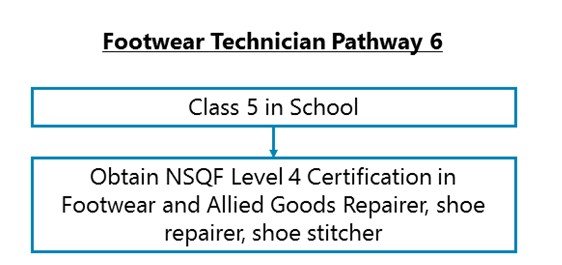
After Class 5, then you may obtain the National Skills Qualification Framework (NSQF) Level 4 Certification in Footwear and Allied Goods Repairer, shoe repairer, shoe stitcher, or similar course.
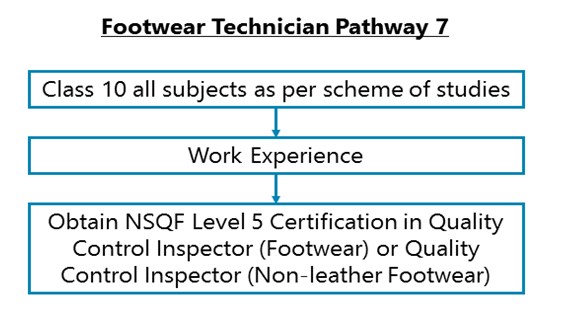
After Class 10 and after obtaining experience as an operator for a minimum of 3-4 years or as a supervisor for 1-2 years in footwear manufacturing, you may obtain National Skills Qualification Framework (NSQF) Level 5 Certification in Quality Control Inspector (Leather Footwear) or Quality Control Inspector (Non-leather Footwear) or similar course. The total number of training hours is 120 for each course.
Required Qualification & Competencies
After completing class 5 in school, you may:
1. Obtain NSQF Level 4 Certification in Footwear and Allied Goods Repairer, shoe repairer, shoe stitcher
2. Obtain work experience as a helper in footwear manufacturing for a minimum of 2-3 years (preferred), and then you may obtain NSQF Level 4 Certification in Stitching Operator or Cutter -Footwear or Pattern cutter-Footwear or Sample Maker-Footwear or similar course.
After completing class 8 in school, you may:
1. You can enroll for an ITI trade certificate course in Leather Goods Maker or in a similar trade.
2. Obtain work experience as a semi-skilled helper for a minimum of 6 months in the same process (Assembling and Curing), and then you may obtain NSQF Level 4 Certification in Assembling & Curing Operator-Footwear & Sports Good or similar course.
After completing Class 10, you may:
1. Apply for a Diploma in ‘Footwear Technology’ or similar courses
2. Apply for NIOS Certificate course in ‘Footwear Design & Production’ or related disciplines
3. Obtain Work experience as an operator for a minimum of 3-4 years or as a supervisor for 1-2 years in footwear manufacturing, and then you may obtain National Skills Qualification Framework (NSQF) Level 5 Certification in Quality Control Inspector (Leather Footwear) or Quality Control Inspector (Non-leather Footwear) or similar course.
Competencies Required
Interests
1. Realistic: You should have an interest in Realistic Occupations. Realistic occupations involve more practical and hands-on activities than paperwork or office work. Realistic occupations often involve physical activities for getting things done using various tools and equipment.
2. Conventional: You should have interests in Conventional Occupations. Conventional occupations involve repetitive and routine tasks as well as fixed processes or procedures for getting things done. These occupations involve working more with data, systems, and procedures and less with ideas or creativity.
Skills
1. Active Listening: Giving full attention to what other people are saying, understanding the points being made by others, asking questions, etc.
2. Quality Control Analysis: Skills in conducting tests and inspections of products, services, or processes to evaluate quality or performance.
3. Coordination: Skills in working together with other people to get things done.
4. Operation Monitoring: Skills in monitoring the operational work which includes watching, inspecting, and advising others to make sure operations are done properly.
Abilities
1. Arm-Hand Steadiness: The ability to keep your hand and arm steady while moving your arm or while holding your arm and hand in one position.
2. Control Precision: The ability to quickly and repeatedly adjust the controls of a machine or a vehicle to exact positions.
3. Manual Dexterity: The ability to quickly move your hand, your hand together with your arm, or your two hands to grasp, manipulate, or assemble objects.
Personality
1. You are always or mostly organized in your day-to-day life and activities.
2. You are always or mostly disciplined in your actions and behavior.
3. You are always or mostly a soft-hearted person.
4. You are always or mostly helpful to others.
Career - Job Opportunities & Profiles
You will get job opportunities for roles like:
1. Footwear Maker
2. Footwear Worker
3. Footwear Technician – Sports Footwear or leather footwear
4. Pattern Master
5. Operator – Footwear Machinery
6. Stitching Operator
7. Cutter - Footwear
Specialisation Tracks In This Career
1. Pre Assembly Operator Footwear
As a Pre Assembly Operator-Footwear, you will be responsible for assembling the appropriate dimensions of the product for manufacturing the required footwear type or rubber sports shoes or other footwear. Pre Assembly Operator-Footwear is also known as Assembling & Curing Operator-Footwear & Sports Goods.
2. Cutter (Footwear)
As a Cutter (Footwear), you will be performing the cutting of leather and non-leather materials (such as bark cloth, glazed cotton, waxed cotton, paper, polyvinyl chloride (PVC), and polyurethane) with the help of cutting dies into a different size or parts for making footwear. You will be required to maintain quality and number accuracy while cutting the leather and non-leather components as per the requirement of designers or supervisors.
3. Pattern Cutter – Footwear
As a Pattern Cutter – Footwear, you will be responsible for creating pieces of the pattern by cutting the leather and non-leather materials. You will be creating pattern pieces as per pattern block, pattern bases, or pattern dummies to determine the final look of the footwear as per the requirement.
4. Quality Control Inspector (Non-Leather Footwear)
As a Quality Control Inspector (Non-Leather Footwear), you will be responsible for inspecting, maintaining, and ensuring the quality of the product at various stages of production till the final stage of packing. You will be required to ensure that the raw material received for manufacturing footwear is of good quality.
5. Quality Control Inspector (Footwear)
As a Quality Control Inspector (Footwear), you will be responsible for inspecting, maintaining, and ensuring that the manufactured footwear is made as per the requirement of the customer and organization standards or not.
6. Sample Maker (Footwear)
As a Sample Maker (Footwear), you will be responsible for carrying out sample-making operations which include making product samples as per the guidelines of designers. You will be required to ensure that all sample-making operations are done effectively as per the guidelines.
Career Growth
From entry-level job positions as a Footwear Technician, Trainee, Cutter–Footwear, Junior Craftsman, etc., you will grow up to roles like Junior / Senior Supervisor, Master Cutter, and Master Craftsman. And later on, after gaining experience you may grow and become a Production line supervisor, Sewing machine expert, Maintenance Manager, Quality Supervisor, etc.
Salary Offered
1. Salaries vary according to job profiles and the kind of facilities you get to work at.
2. In entry-level jobs: You may get about Rs. 7,000 – Rs. 10,000 or more per month.
3. Salaries increase with your work experience and as you get promoted.
4. After having 1-6 years of experience, you may expect about Rs. 10,000 – Rs. 15,000 per month or more.
5. After having 6-12 years of experience, you may get about Rs. 12,000 – Rs. 20,000 or more per month.
6. In senior-level jobs, with 12-20 years of work experience, you may expect to get about Rs. 20,000 – Rs. 50,000 or more per month.
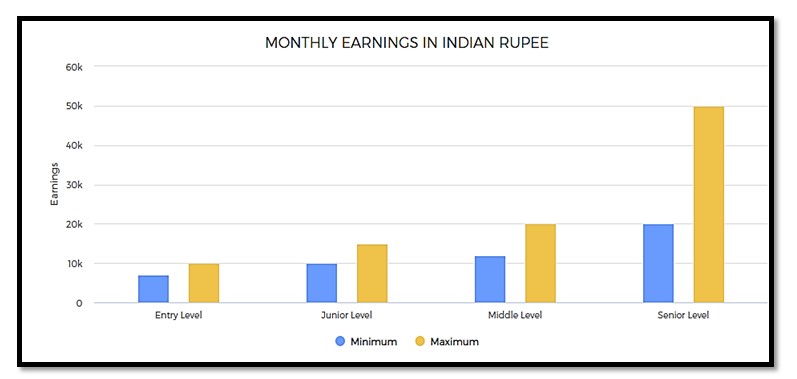
Monthly Earnings In Indian Rupee
Entry Level | Junior Level | Mid Level | Senior Level | ||||
Min Earning | Max Earning | Min Earning | Max Earning | Min Earning | Max Earning | Min Earning | Max Earning |
7000 | 10000 | 10000 | 15000 | 12000 | 20000 | 20000 | 50000 |
1. Entry level: 0 - 2 years of work experience
2. Junior Level: From 1 to 12 years of work experience
3. Mid-Level: From 5 to 20+ years of work experience
4. Senior Level: From 10 to 25+ years of work experience (there could be exceptions in some high-end technical, financial, engineering, creative, management, sports, and other careers; also shortly, people will reach these levels much faster in many careers and some careers, these levels will have no meaning as those careers will be completely tech skill driven such as even now, there is almost no level in a Cyber Security Expert’s job)
Work Activities
As a Footwear Technician, you will be involved in the following work activities:
1. Operating machines, equipment, devices, systems, and processes - Using various methods and techniques to operate machines, equipment, devices, systems, and processes in industrial and other settings.
2. Getting Information and learning - Observing, hearing, and reading, using computers, or otherwise obtaining information and learning from it.
3. Inspecting equipment, systems, structures, and materials - Inspecting equipment, systems, structures, and materials to ascertain quality, performance, defects, causes of errors, etc.
4. Performing physical activities - Performing physical activities that require the use of your arms and legs and moving your whole body, such as climbing, lifting, balancing, walking, stooping, and handling materials.
5. Handling and moving objects and materials - Using hands or otherwise using physical strength to handle and move objects and materials; maneuver, install, lift, place, manipulate, etc.
6. Communicating with co-workers and others - Communicating with people in writing, verbally or otherwise inside your workplace and various other people who have professional relationships with your place of work including vendors, government officials, etc., or with people at large.
Future Prospects
1. The future possibilities for this pathway appear to be enormously improving. India is expected to soon grow and become a global hub of footwear manufacturing to serve the growing demand of consumers for fashion footwear.
2. According to recent reports by IBEF (Indian Brand Equity Framework), a special package grant of INR 26 billion was sanctioned for the leather and footwear industry. This package is expected to generate around 300,000 more jobs. India has also started exporting to new emerging markets like African countries.
3. As this number will only continue to scale up in the future, employment in the Footwear Sector will also increase significantly.
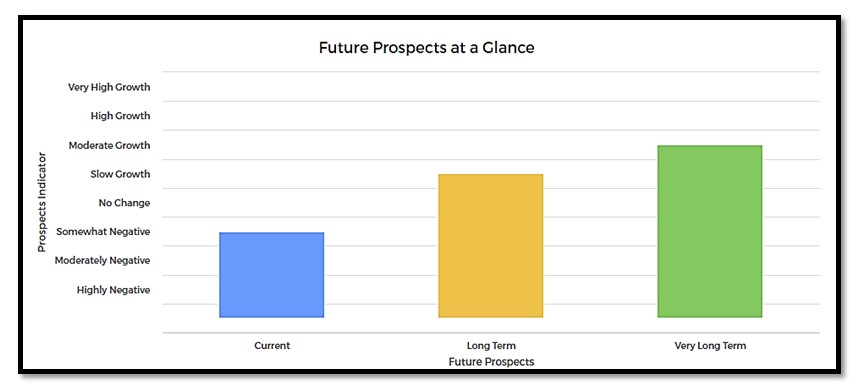
Future Prospects At A Glance
Current (0-1 year) | Long Term (2-5 years) | Very Long Term (6-10 years) |
Somewhat Negative | Slow Growth | Moderate Growth |


