
Database Management System Expert
Entry Level Qualification
Class 12
Career Fields
Information Technology & Computer Science
For Specially Abled


Career Entrance Exam
About Career
PARTICULARS | DESCRIPTION |
Name | Database Management System Expert |
Purpose | Monitor Database Activity |
Career Field | Information Technology & Computer Science |
Required Entrance Exam | CUET UG, CUET PG, JEE MAIN BE/BTECH |
Average Salary | 500000 - 600000 Rs. Per Year |
Companies For You | Tata Consultancy Services Limited, Cognizant Technology Solutions & Many More |
Who is Eligible | Class 12th Pass |
As a Database Management System Expert, you will be actively participating in the modeling, design, coding, development, and implementation of online/ offline repository or data management system infrastructures which will contain all crucial information regarding any business/ businesses.
This information is of tremendous value to the performance, scalability (growth) and reliability of the concerned business. It is used for accurate & actionable reporting, data analysis and for creating analytical reports to be used by workers throughout a enterprise.
What is a Database and a Database System?
A database is an organized collection of data, generally stored and accessed electronically from a computer system. The database management system (DBMS) is the software that interacts with users to capture and analyze the data. The collection of the database, the DBMS and the associated applications put together can be referred to as a "database system".
Let us think of an example.
Take ‘Zomato’. Do you realize how a database can be useful to the business? Consider the hundreds of thousands of customers, hundreds of thousands of restaurants, hundreds of thousands of orders every day, millions of food items, promotional codes, customer feedback, the restaurant reviewing system, the rating systems of delivery partners, the personal data of delivery partners, the phone numbers of users, the billing, and sales data.
These data items make up just a small part. There are so many others. Each of these are related to the other in a specific manner and such relations have to be used in productive ways to affect the business growth positively.
The Scenario today
There is a confounding amount of data created every day, as we continue to rely on massive computer networks and digital devices managed by multinational corporations. Although data does not occupy any physical space but the hardware on which it is stored does. Database Management System Experts are challenged with addressing the tall task of managing where our data ends up and making data management processes more efficient.
Can you vaguely picture the volume of data that prevails today?
Hundreds of thousands of Terabytes (1000GB) of data summing up to petabytes (1000000GB) already. Immensely difficult to store in any hardware independently. And this volume leads us to the ruling concept of ‘metadata’. To control, analyze and draw inferences from these terabytes of data, we need more data that defines and provides information about the existing data! Confused?
‘Metadata’ – Further, Briefly
Take for example, metadata for a music file might include the artist's name, the album name, and the year it was released. The artist’s name may be associated with a short description of her achievements, the album name may be followed by a brief about it and the year may be connected to other popular releases.
Associative, Hierarchical and Cyclical
Metadata is associative, hierarchical and cyclical. ‘Associative’ means there exists some kind of relationship between two sets of information. ‘Hierarchical’ means layered: there exist multiple layers of information. Cyclical’ means there exists no defined climax. This means that any metadata framework never ends: one point leads to the other and that to another. When you think you have closed in towards the last point, you will actually be back at square 1. There is no last point.
This is where cloud technologies come in.
We have arrived at the age where such huge volumes of generated data and the associated metadata cannot be accommodated in local hardware systems and so scientists developed a way of remotely handling digital information, specifically through a ‘cloud’.
What is a Cloud?
‘Cloud’ basically refers to information technology services rendered over a communication and data transmission network, use of which could be limited to a single organization, available to many organizations, available to people at a geographical area, or to the public at large all over the world. Cloud Computing refers to the application of the collection of all cloud technologies and cloud-hosted products.
Who Uses Cloud Computing?
Most companies today require a place where they can securely store their data. Almost 2/3rds of global enterprises are using cloud computing today. Companies are currently investing 4.5 times the rate of traditional IT spending in cloud infrastructure.
Getting the idea?
Here’s an Example
For an example, think of the entire framework of Google Docs, think of whatever comes to your mind first while working with Google Docs (maybe storing your study materials or writing mock answers). You most definitely need an Internet connection and you do not need to store anything locally on the system which you are working on but you are able to access all your data whenever you require them. This is basically stored on something called the ‘public cloud’ which allows access to any user across the globe.
So Much Was About Storing the Volume. What use is it?
Now, the exploitation, representation, use and the larger benefit of accumulating so much data is described in the later sections in detail.
First, understand that
Database management system experts perform a number of functions with the data contained in databases. These functions are mostly: controlling access to data, defining data types (such as creating, or altering, tables and the relationships among them), performing tasks such as inserting/ updating/ deleting data occurrences, searching for data within the database (data querying) and analyzing derived information.
SQL, Sequel or Ess-cue-ell!
Each of these functions as just described uses a specific special-purpose language. SQL, “the most popular” of these special-purpose languages, combines the roles of data definition, data manipulation, and query in a single language. Almost all companies work with their databases using SQL today.
There are, although, many other alternatives in the market today but you will find SQL enjoying the highest recognition among all recruiters today. Also, exposure to only SQL, most likely also ensures a smooth transition into learning ways to use the other options too.
Digging Deeper
Traditionally, DBMSes were built to store data in the form of files. This convention has been replaced by the relational model of a database. This is called RDBMS or relational Database Management System.
What is a relational database?
A relational database refers to a database that stores data in a structured format, using rows and columns. RDBMS store data in a tabular form, while traditional DBMS applications store data as files.
The vast majority of databases used in modern applications are relational. RDBMS is an advanced version of a DBMS system.
Data values in a RDBMS are stored in the form of tables. The ‘relationships’ between these data values are also separately stored in the form of a table. This is why it is called Relational – DBMS. Each of the tables are characterized by an identifier called primary key.
The Graph Database Model
Advancing further, takes us to a ‘graph database model’ which is much more accurate than a relational database. A graph database is gathering of nodes & edges. A node represents a substance, for example, a person or business.
An edge represents a connection or relationship between the two nodes. Each node and each edge are labeled by unique identifiers. Such interconnections have led to better response time & accuracy to discover new data correlations, optimize marketing performance and fuel the growth of a business.
You can gradually start realizing the complexity of such database systems and the importance of management system experts who handle such crucial tasks.
Now how do we utilize this data?
This is where the duties of Data Warehousing Specialists and Administrators come in.
Database Administrators install & maintain the performance of database servers. They manage database access of the connected devices. They also install, upgrade, and manage database applications too. A database server in simple terms is the hardware/ cloud storing the database.
Example?
Let’s talk about the bike-sharing service Hubway, which includes data on over 1.5 million trips made with the service. Database Administrators of Hubway will work with databases that store crucial information including customer name, customer address, customer phone number, order number, date, amount due, sales data etc. in different tables and all of them are linked in the form of an RDBMS/ graph-DBS.
Data Warehousing Specialists work on systems (warehouses) used for accurate & actionable reporting and data analysis drawing existing information integrated from the internal or external repositories/ databases of a company.
Warehouses are used for creating analytical reports for workers throughout the enterprise. These warehouses are considered a core component of business intelligence, online analytical processing, market research and decision support.
Key Roles and Responsibilities
As a Database Management System Expert, you will be engaged with one or more of the following roles & responsibilities as well as other associated duties:
1. You will develop database architectural strategies at the modeling, design & implementation stages to address business concerns and design databases to support business applications, performance & reliability.
2. You will monitor database activity & file usage; modify existing databases & database management systems or direct programmers & analysts to make changes, and ensure that necessary resources are present so that databases function properly by removing or deleting old or obsolete files.
3. You will design database applications, such as interfaces, data partitions, global temporary tables, and data transfer mechanisms, to enable efficient access to the generic database structure.
4. You will develop data warehouse process models, including sourcing, loading, transformation, and extraction.
5. You will design, implement, or operate comprehensive data warehouse systems to balance optimization of data access, according to customer requirements.
6. You will write new programs or modify existing programs and perform system analysis/ data analysis to meet customer requirements, using current programming languages & technologies.
7. You will develop data models describing data points and how they are used, using statistical reporting & computer technologies, including Siebel Analytics, SQL Server, Tableau, ETL, Informatica, Power BI or Teradata.
8. You will set up database clusters, backup, or recovery processes; work on database development standards and develop & document database architectures.
9. You will identify, evaluate and recommend hardware or software technologies to achieve desired database performance.
Career Entry Pathway
Class 10 all subjects as per scheme of studies – Class 11-12 Physics, Chemistry, Computer (optional) and Mathematics along with any other subject as per scheme of studies - B Tech/ BE in CSE, Information Systems Engineering, IT, Software Engineering or similar
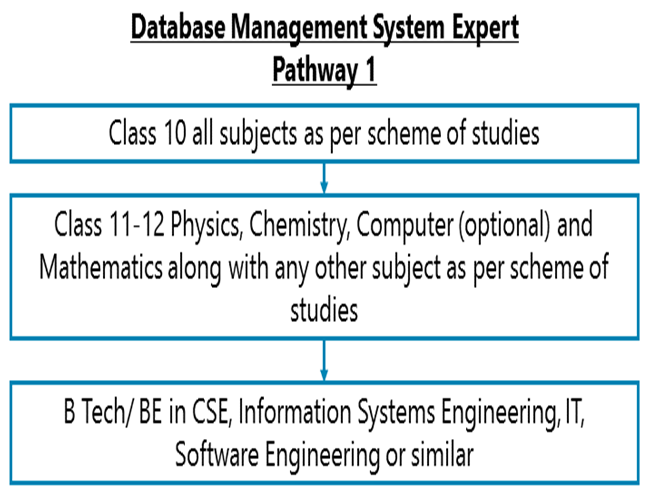
After completing Class 11-12 Physics, Chemistry, Computer (optional) and Mathematics along with any other subject as per scheme of studies, go for a B Tech/ BE in CSE, Information Systems Engineering, IT, Software Engineering or similar
Class 10 all subjects as per scheme of studies – Class 11-12 Physics, Chemistry, Computer (optional) and Mathematics along with any other subject as per scheme of studies - B Tech/ BE in CSE, Information Systems Engineering, IT, Software Engineering or similar – M Tech/ ME/ M Sc in Data Sciences, Computer Science Engineering, Computer Engineering, IT, Information Systems or similar
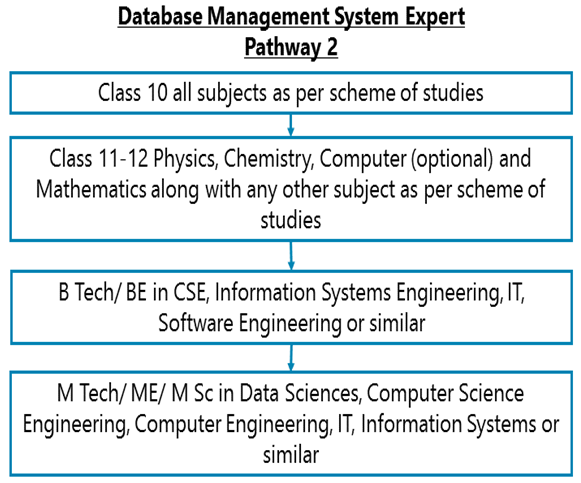
After completing Class 11-12 Physics, Chemistry, Computer (optional) and Mathematics along with any other subject as per scheme of studies, you can go for B Tech/ BE in Computer Science Engineering, Information Systems Engineering, IT, Software Engineering or similar. Then go for post-graduation: M Tech/ ME/ M Sc in Data Sciences, Computer Science Engineering, Computer Engineering, IT, Information Systems or similar.
Class 10 all subjects as per scheme of studies – Class 11-12 with Mathematics & any other subject as per scheme of studies - BBA / BISM / B.Com
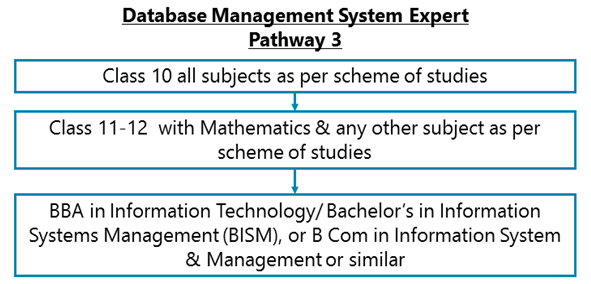
After completing Class 11-12 with Mathematics & any other subject as per scheme of studies, you can go for a Bachelor’s degree in Business Administration (BBA) with specialization in Information Technology, or Bachelor’s in Information Systems Management (BISM), or B Com in Information System & Management or similar.
Class 10 all subjects as per scheme of studies – Class 11-12 with Mathematics & any other subject as per scheme of studies – BBA in Information Systems Management – MBA (IT)
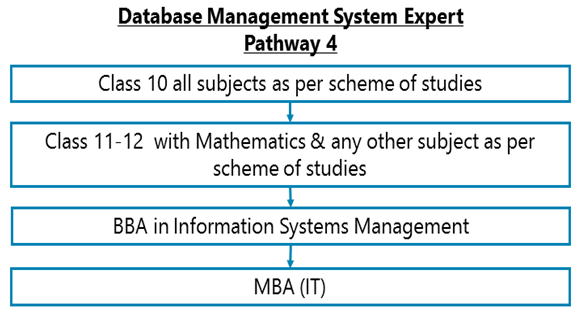
After completing Class 11-12 with Mathematics & any other subject as per scheme of studies, you can go for a Bachelor’s degree in Business Administration (BBA) with specialization in Information Technology, or Bachelor’s in Information Systems Management (BISM), or B Com in Information System & Management or similar. Thereafter, go for an MBA in IT.
Class 10 all subjects as per scheme of studies – Class 11-12 Physics, Chemistry (optional), Computer (optional) and Mathematics along with any other subject as per scheme of studies - BCA – MCA
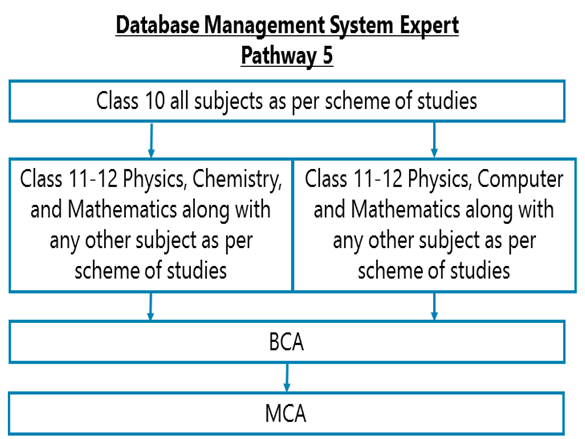
After completing Class 11-12 Physics, Chemistry (optional), Computer (optional) and Mathematics along with any other subject as per scheme of studies, go for a BCA then MCA
Class 10 all subjects as per scheme of studies – Class 11-12 Physics, Chemistry, Computer (optional) and Mathematics along with any other subject as per scheme of studies - BCA – MCA
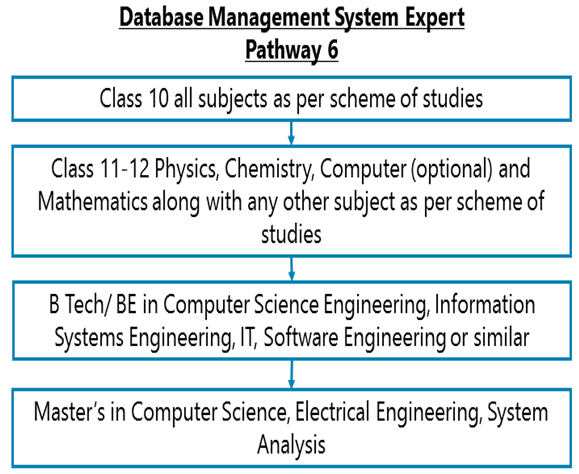
After completing Class 11-12 Physics, Chemistry, Computer (optional) and Mathematics along with any other subject as per scheme of studies, you can go for B Tech/ BE in Computer Science Engineering, Information Systems Engineering, IT, Software Engineering or similar. Then go for a Master’s in Computer Science, Electrical Engineering, System Analysis.
Class 10 all subjects as per scheme of studies – Class 11-12 Physics, Chemistry, Computer (optional) and Mathematics along with any other subject as per scheme of studies - B Tech/ BE - M Tech/ ME/ MCA
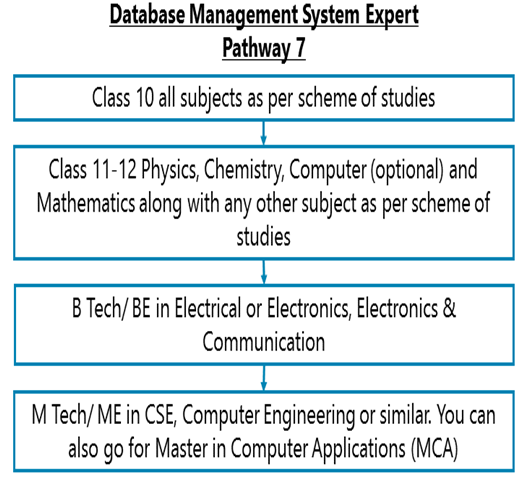
After completing Class 11-12 Physics, Chemistry, Computer (optional) and Mathematics along with any other subject as per scheme of studies, you can go for B Tech/ BE in Electrical or Electronics, Electronics & Communication or similar. Then go for M Tech/ ME in CSE, Computer Engineering or similar. You can also go for Master in Computer Applications (MCA).
Class 10 all subjects as per scheme of studies – Class 11-12 Physics, Chemistry, Computer (optional) and Mathematics along with any other subject as per scheme of studies - B.Sc - M.Sc/MCA
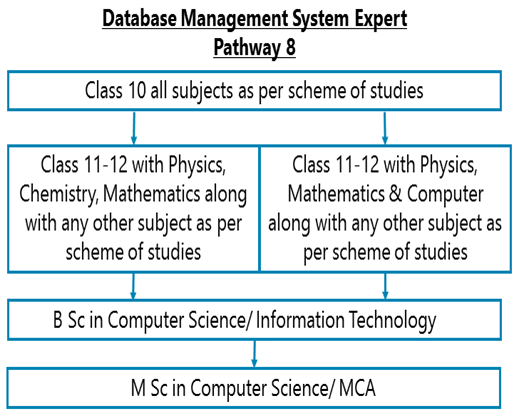
After completing Class 11-12 Physics, Chemistry, Computer (optional) and Mathematics along with any other subject as per scheme of studies, you can go for B Sc in Computer Science/ Information Technology or similar. Then go for a M Sc in Computer Science/ MCA.
Class 10 all subjects as per scheme of studies – Class 11-12 Physics, Chemistry, Computer (optional) and Mathematics along with any other subject as per scheme of studies - B Tech/ BE - MBA/Master's
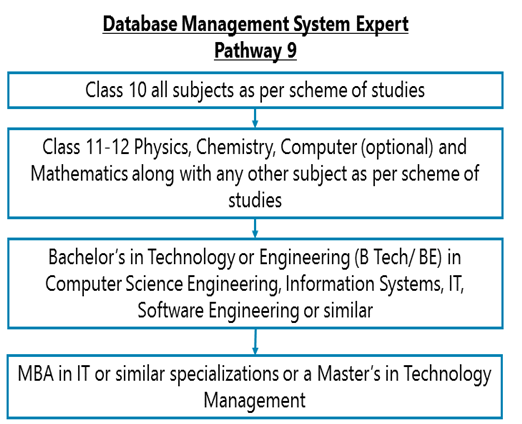
After completing Class 11-12 Physics, Chemistry, Computer (optional) and Mathematics along with any other subject as per scheme of studies, you can go for Bachelor’s in Technology or Engineering (B Tech/ BE) in Computer Science Engineering, Information Systems, IT, Software Engineering or similar. Then you can pursue an MBA in IT or similar specializations or a Master’s in Technology Management.
Class 10 all subjects as per scheme of studies – Class 11-12 Physics, Chemistry, Computer (optional) and Mathematics along with any other subject as per scheme of studies - B Tech/ BE in CSE, Information Systems, IT – MBA (IT)
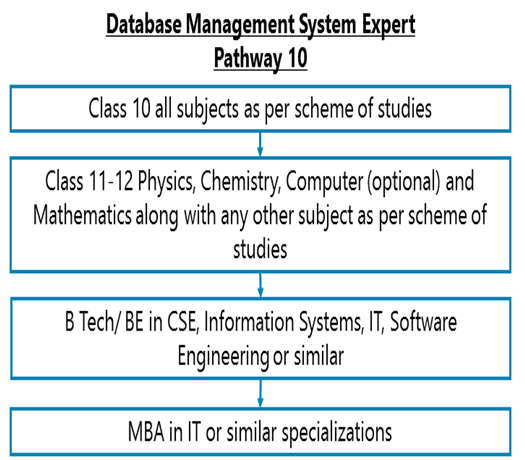
After completing Class 11-12 Physics, Chemistry, Computer (optional) and Mathematics along with any other subject as per scheme of studies, go for B Tech/ BE in CSE, Information Systems, IT, Software Engineering or similar. Then go for MBA in IT or similar specializations
Class 10 all subjects as per scheme of studies – Class 11-12 Physics, Chemistry, Computer (optional) and Mathematics along with any other subject as per scheme of studies - Bachelor’s in Mathematics, Physics, Statistics – M Sc – M Tech in CSE
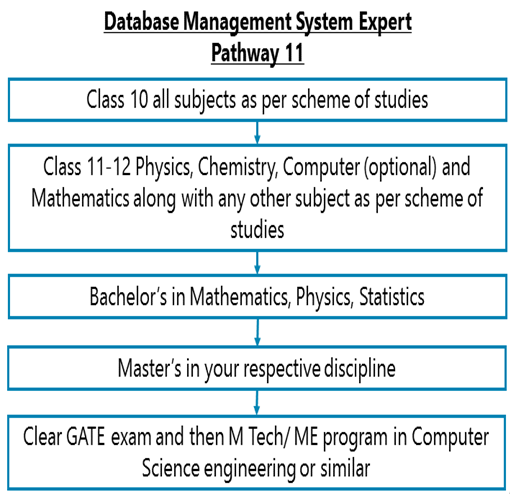
After completing Class 11-12 Physics, Chemistry, Computer (optional) and Mathematics along with any other subject as per scheme of studies, you can go for Bachelor’s in Mathematics, Physics, Statistics and then go for a Master’s in your respective discipline. Thereafter clear GATE exam, to gain entry into an M Tech/ ME program in Computer Science engineering or similar.
Class 10 all subjects as per scheme of studies – Class 11-12 Physics, Chemistry, Computer (optional) and Mathematics along with any other subject as per scheme of studies - BCA - Work for 1-3 years - M.Sc
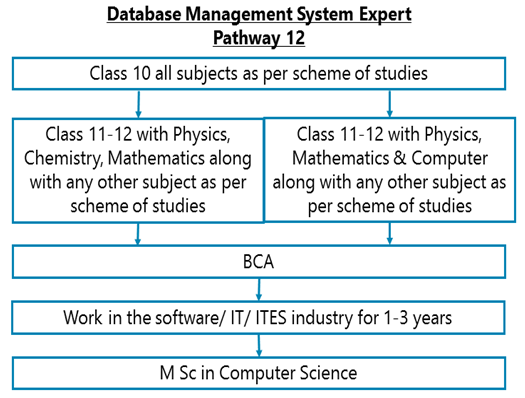
After completing Class 11-12 Physics, Chemistry, Computer (optional) and Mathematics along with any other subject as per scheme of studies, you can go for a Bachelor’s in Computer Applications. Then work in the software/ IT/ ITES industry for 1-3 years. Thereafter go for M Sc in Computer Science.
Class 10 all subjects as per scheme of studies – Class 11-12 Physics, Chemistry, Computer (optional) and Mathematics along with any other subject as per scheme of studies –Bachelor’s in Electrical Engineering, Electronics & Communication Engineering or similar–Professional Certifications
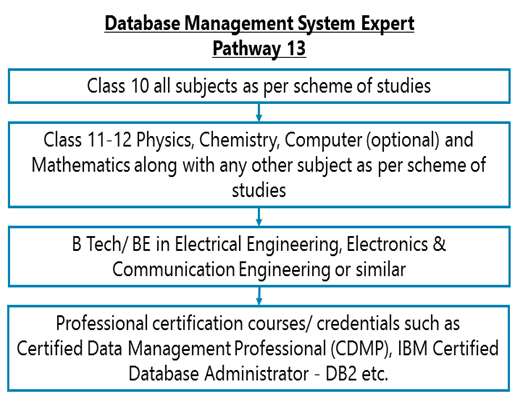
After completing Class 11-12 Physics, Chemistry, Computer (optional) and Mathematics along with any other subject as per scheme of studies, you can go for B Tech/ BE in Electrical Engineering, Electronics & Communication Engineering or similar. Thereafter go for professional certification courses/ credentials such as - Certified Data Management Professional (CDMP, IBM Certified Database Administrator - DB2, Microsoft SQL Server database certifications for Microsoft Certified Solutions Associates (MCSA: SQL Database Administration, MCSA: SQL Database Development, MCSE: Data Management and Analytics and MTA: Database), Oracle Certified Professional, MySQL Database Administrator, Oracle Database 12c Administrator, SAP HANA Out of these the Microsoft certifications enjoy the maximum popularity among recruiters today. Career Entry Pathway Name 14
Class 10 all subjects as per scheme of studies – Class 11-12 Physics, Chemistry (optional), Computer (optional) and Mathematics along with any other subject as per scheme of studies - BCA/ B Sc in Information Technology – Post Graduate Diploma in Computer Application (PGDCA) - Lateral entry to 3rd semester of M Sc Computer Science
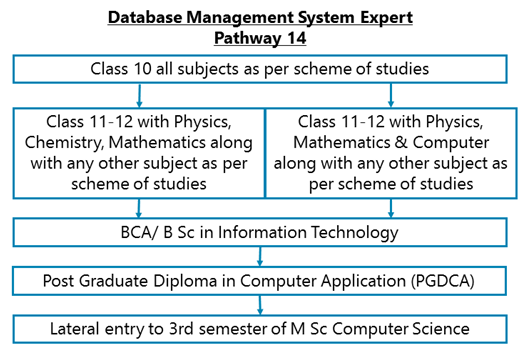
After completing Class 11-12 Physics, Chemistry (optional), Computer (optional) and Mathematics along with any other subject as per scheme of studies, you can go for BCA (Bachelor of Computer Applications)/ B Sc in Information Technology. Thereafter go for a Post Graduate Diploma in Computer Science / Computer Application (DCA). Then you can take a direct lateral entry to 3rd semester of M Sc Computer Science. This is only offered by select reputed universities in India.
Required Qualification & Competencies
After Class 11-12:
1. You can go for a Bachelor’s in Computer Science or any of the engineering fields especially Electrical/Electronics, Electronics & Communication. Information Systems Engineering or similar.
2. You can go for a Bachelor’s degree in Computer Applications or similar
3. Bachelor degree in Physics, Mathematics, Statistics
4. BBA with specialization in IT, B Com with specialization in Information Systems & Management or Bachelor of Information Systems Management (BISM)
Acquiring any among these professional certifications will prove to be beneficial in the long run:
1. Certified Data Management Professional (CDMP)
2. IBM Certified Database Administrator - DB2
3. Microsoft SQL Server database certifications for Microsoft Certified Solutions Associates (MCSA: SQL Database Administration,
4. MCSA: SQL Database Development, MCSE: Data Management and Analytics and MTA: Database)
5. Oracle Certified Professional
6. MySQL Database Administrator
7. Oracle Database 12c Administrator
8. SAP HANA
You can study for a Bachelor’s / Master’s / Doctoral degree in any of the following fields (Note that all these fields may not offer you a degree at all three levels, that is in Bachelor’s, Master’s and Doctoral. Some fields may offer a degree only at the Master’s or at the Doctoral level):
1. Communication Engineering
2. Computer Applications
3. Computer Science & Engineering
4. Computer Science and Management
5. Data Analytics
6. Data Science & Engineering
7. Data Sciences
8. Database Management and Analytics
9. Electrical & Electronics Engineering
10. Electrical Engineering
11. Electronics & Communication Engineering
12. Electronics Engineering
13. Information and Computer Engineering and Technologies
14. Information Science and Engineering
15. Software Engineering
16. Web Technology
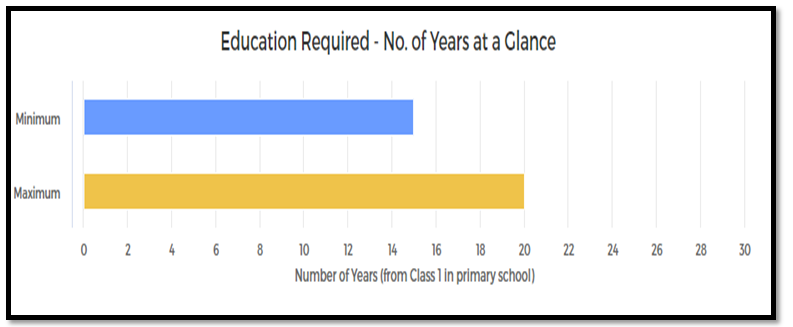
MINIMUM EDUCATION REQUIRED | MAXIMUM EDUCATION REQUIRED |
Under Graduate Undergraduate Degree / Honours Diploma / Graduate Diploma (equivalent to a Degree) Programs for which the minimum eligibility is a pass in Higher Secondary / Class XII School Leaving examination. | Post Graduate Postgraduate Degree / Diploma / Certificate Programs for which the minimum eligibility is a pass in Graduation / equivalent Diploma program like Honours Diploma or Graduate Diploma. |
COMPETENCIES REQUIRED
Interests
1. You should have interests for Investigative Occupations. Investigative occupations involve working with ideas and quite a lot of thinking, often abstract or conceptual thinking. These involve learning about facts and figures; involve use of data analysis, assessment of situations, decision making and problem-solving.
2. You should have interests for Enterprising Occupations. Enterprising occupations involve taking initiatives, initiating actions, and planning to achieve goals, often business goals. These involve gathering resources and leading people to get things done. These require decision making, risk-taking, and action orientation.
3. You should have interests for Realistic Occupations. Realistic occupations often involve physical activities for getting things done using various tools and equipment.
Knowledge
1. You should have knowledge of Computers– Knowledge of computer hardware and software, computer programming, computer networks, computer and mobile applications.
2. You should have sound knowledge of commercial DBMSspecific to UNIX/Linux platforms such as Oracle products (like the open-source MySQL environment and Oracle itself), Microsoft SQL Server, IBM DB2, MariaDB etc.
3. You should have knowledge and understanding of containerization, understanding of SQL/PLSQL & database programming, Microsoft Enterprise Server software, RAC Oracle Cluster databases, troubleshooting Oracle Server issues, troubleshooting Data Guard issues, Oracle Data Guard Switchover & Failover Procedures, IIS, Active Directory LDAP Authentication Process, Message Queue and working knowledge of RMAN backup restore.
4. You may need knowledge and an understanding of statistical reporting and computer technologies, including Siebel Analytics, SQL Server, Tableau, ETL, Informatica, Power BI or Teradata.
5. You should have knowledge and understanding of AWS RDS Aurora, DynamoDB and Redshift etc. and metadata management software such as CA Erwin Data Modeler, Data dictionary software, Data mapping software, Data modeling software, IBM Rational Data Architect, Pentaho Kettle, Visual Paradigm DB Visual ARCHITECT etc.
6. You should have knowledge of data mining algorithms including classifiers, clustering algorithms and anomaly detection techniques and familiarity with database modeling, data warehousing and Big Data tools like Spark, Hive etc.
Skills
1. You should have Scientific Skills - in using various scientific rules and methods to get things done or solve problems.
2. You should have Technical Skills - using various technologies and technical methods to get things done or solve problems.
3. You should have Quality Control Analysis Skills - conducting tests and inspections of products, services, or processes to evaluate quality or performance.
4. You should have experience working independently under general direction within the scope of an assignment and use sound judgment in determining methods, techniques, and evaluation criteria.
5. You should have Systems Analysis Skills - determining how a system should work and how changes in conditions, operations, or the environment will affect outcomes.
6. You should have enough verbal and written communication skills necessary to effectively collaborate in a team environment and present technical ideas/results.
7. You should have Critical Thinking skills- Skills in the analysis of complex situations, using logic and reasoning to understand the situations and take appropriate actions or make interpretations and inferences.
8. You should have Judgment and Decision Making Skills - considering pros and cons of various decision alternatives; considering costs and benefits; taking appropriate and suitable decisions.
9. You should have Problem Solving Skills - Skills in analysis and understanding of problems, evaluating various options to solve the problems and using the best option to solve the problems.
10. You may need Programming Skills - writing computer programs for various applications, installation of computer programs and troubleshooting of problems in computer programs or software.
11. You should have Systems Evaluation Skills - identifying measures or indicators of system performance and the actions needed to improve or correct performance, relative to the goals of the system.
Ability
1. You should have Deductive Reasoning Ability - apply general rules and common logic to specific problems to produce answers that are logical and make sense. For example, understanding the reasons behind an event or a situation using general rules and common logic.
2. You should have Problem Sensitivity - The ability to tell when something is wrong or is likely to go wrong. It does not involve solving the problem, only recognizing there is a problem.
3. You should have Inductive Reasoning Ability - to combine pieces of information from various sources, concepts, and theories to form general rules or conclusions. For example, analyzing various events or situations to come out with a set of rules or conclusions.
4. You should have Information Ordering Ability - to arrange things or actions in a certain order or pattern according to a specific rule or set of rules (e.g., patterns of numbers, letters, words, pictures, mathematical operations).
5. You should have Oral Comprehension Ability - listen to and understand information and ideas presented through spoken words and sentences.
6. You should have Oral Expression Ability - communicate information and ideas in speaking so others will understand.
7. You should have Fluency of Ideas - The ability to come up with several ideas about a topic (the number of ideas is important, not their quality, correctness, or creativity).
Personality Traits
1. You are always or mostly careful about your actions and behavior.
2. You are always or mostly disciplined in your action and behavior.
3. You are always calm or generally remain calm in most situations.
4. You can always act independently or could do so in most situations.
5. You always prefer to experience new things and have new experiences, or you mostly do.
Career - Job Opportunities & Profiles
Work in this field is not very diverse. People work mainly in IT departments of enterprises operating in different industrial sectors including automotive, manufacturing, warehouse, logistics, agriculture, healthcare, retail, banking, entertainment, cleaning, personal care, and education for a wide range of pay.
Today all companies globally require specific cloud-based DBMSes and are typically already committed to a specific cloud provider, such as Amazon Web Services (AWS), Microsoft Azure or Google Cloud Platform. You can find excellent placements in top ranking global companies as well as research-oriented industries.
You may first join as a Trainee Engineer/ Associate Level Database Analyst/ Research Intern/ Graduate Trainee/ Program Extern/ Support Intern or directly in one of these positions depending on your educational qualifications:
1. Database Management System Expert
2. Database & Program Analyst
3. Database Administrator
4. Database Developer
5. Database Architect
6. Reporting Analyst
7. Data Management Coordinator
8. Data Engineer - Data Warehouse
9. Consultant - SQL Server DBA Architect
10. Data Modeler
11. Coordinator, Database Administration
12. Data Management Analyst
13. Data Architect
14. Information Management Specialist
15. Database Reporting Specialist
16. Database Support Analyst
Various types of companies may recruit you:
1. IT &IT Enabled Services companies (large scale to micro scales) such as Tata Consultancy Services Limited, Cognizant Technology Solutions, Tech Mahindra, Infosys, Wipro, MindTree etc.




2. Behemoths ruling the global operational database management systems market: Microsoft Corporation, SAP SE, IBM Corporation, Oracle Corporation



3. Cloud platform developers and software industry leaders such as Google, Facebook, Tencent, Twitter, Amazon Web Services etc.



4. Big Data, cloud computing leviathans (large groups of companies) which are dealing with power analytics and business intelligence such as Talend, Dell Boomi, Hitachi Data Systems, Oracle etc.


5. Online retailing companies such as Flipkart, Amazon Services Inc., Alibaba etc.



6. Automobile leviathans (large groups of companies) dealing with futuristic technologies that enable cars to drive themselves, routine flights to mars or fusion reactors that produce limitless energy such as Lockheed Martin Corporation etc.
7. Other IT companies focused on software engineering in the field of AI, machine learning or automation such as Quantcast Corporation, IPSoft, OpenAI, Deepmind, H20, Iris AI, Active.ai, etc.



8. Fin Tech - Companies which are into the BFSI industry such as insurers, consultancies, banks, financial institutions, investment banking companies or others like CitiGroup, Kasisto, YotaScale Inc, Zestfinance, Underwrite.Ai, Kensho etc.


9. Gaming, media and entertainment industry with biggies such as Nvidia, Sony Interactive Entertainment PlayStation, Electronic Arts, Blizzard Entertainment, MGM, Twentieth Century Fox, Sony Pictures etc. or even casino gaming businesses (!) which make casino management software systems for tracking activity on the casino floor as well as multiplayer game software & customer relationship management (CRM) systems such as International Game Technology PLC.
Health Tech –
1. Providers of medical image and information products and technologies for acquiring, processing, managing and storing diagnostic images and related data such as Fujifilm etc.
2. Companies such as MetaMind involved in deep learning networks, image recognition, text analysis, machines/systems / devices to cater to the healthcare sector or
3. Healthcare analytics solutions & services companies such as Geneia LLC that focus on improving systems to support personalized, patient-centered care
4. Innovative software solutions companies that design products to protect patient safety, mitigate operational risks, and reduce cost and time of drug development such as Covance Inc. etc.
SPECIALISATION TRACKS IN THIS CAREER
Database Administrator
Database Administrators install & maintain the performance of database servers. A database is a repository of information usually in an unstructured form (not readable and without any semantic meaning) and a server generally is a high-end network computer managing connected devices and their access too. Hence a database server in simple terms is a server storing the database. Database Administrators manage database access of the connected devices. They also install, upgrade, and manage database applications too. Example: let’s talk about the bike-sharing service Hubway, which includes data on over 1.5 million trips made with the service. Database Administrators of Hubway will work with databases that store crucial information including customer name, customer address, customer phone number, order number, date, amount due, sales data etc. in different tables and all of them are linked in the form of an RDBMS.
Database Language Specialist
Database Language Specialists use special-purpose languages for controlling access to data, defining data types (such as creating, or altering, tables and the relationships among them), performing tasks such as inserting/ updating/ deleting data occurrences, searching for data within the database (data querying) and computing derived information. Each of these functions uses a specific special-purpose language. Example: SQL, “the most popular” of these special-purpose languages, combines the roles of data definition, data manipulation, and query in a single language. Almost all companies work with their databases using SQL today.
Database Architect (Relational Database Management System-RDBMS)
Database Architects may work to develop relational databases. A relational database refers to a database that stores data in a structured format, using rows and columns. RDBMS store data in a tabular form, while traditional DBMS applications store data as files. The vast majority of databases used in modern applications are relational. RDBMS is an advanced version of a DBMS system. Data values in a RDBMS are stored in the form of tables. The tables have an identifier called primary key. The ‘relationships’ between these data values will also be stored in the form of a table. This is why it is called Relational – DBMS. Examples are all the major industry leaders including Oracle Database, MySQL, Microsoft SQL Server, and IBM DB2.
Cloud-Hosted Database Systems Expert
Cloud-Hosted Database Systems Experts are involved in the development & maintenance of cloud-based information technology infrastructures. ‘Cloud’ basically refers to services rendered over a communication and data transmission network, use of which could be limited to a single organization, available to many organizations, available to people at a geographical area, or to the public at large all over the world. For an example, think of the entire framework of Google Docs, think of whatever comes to your mind first while working with Google Docs (maybe storing your study materials or writing mock answers). You most definitely need an Internet connection and you do not need to store anything locally on the system which you are working on but you are able to access all your data whenever you require them. This is basically stored on something called the ‘public cloud’ which allows access to any user across the globe.
Data Warehousing Specialist
Data Warehousing Specialists work on systems used for accurate & actionable reporting and data analysis, drawing information integrated from the internal or external repositories/ databases of a company. These systems are considered a core component of business intelligence, online analytical processing, market research and decision support. It drives all crucial business decisions and the results of data modeling decide the success, scalability and the reliability of a business. Data warehouses store current & historical data in one single place and are used for creating analytical reports for workers throughout the enterprise. IBM InfoSphere DataStage, Ab Initio Software, Informatica – PowerCenter are some of the tools which are widely used to implement a data warehouse. Warehouse Specialists are of immense importance especially to the financial services industry to gain new customers, provide accurate investment advice and support the technology powered fund transactions, client correspondence, market analytics, and sales strategies.
Database Security Engineer
Database Security Engineers plan, coordinate & implement security measures to safeguard information in computer files, stored in local database servers or cloud-hosted, servers against accidental or unauthorized damage, modification or disclosure. They also develop related policies or procedures to put these measures in place. They ensure safeguarding of digital files and all vital electronic infrastructures within a database management system. They encrypt data transmissions and erect firewalls to conceal confidential information as it is being transmitted. They are responsible for modifying computer security files to incorporate new software, correct errors, or change individual access status.
CAREER GROWTH
If you join as a Trainee Engineer/ Associate Level Database Analyst/ Research Intern/ Graduate Trainee/ Program Extern/ Support Intern, then after completion of your training, you will be positioned as Database Management System Expert/ Database & Program Analyst/ Database Developer/ Database Architect/ Data Management Analyst or in similar positions. However, if you join after your post-graduation or higher advanced qualifications in a relevant discipline, you can surpass traineeship/ internship to directly get a job as any one of these positions.
After 5-7+ years of experience, you can expect to become a Senior Information Systems Associate (Database Development), Senior Database Administrator, Senior Database Architect, Principal Database Management Expert, Lead Database Engineer, Senior Platform Engineer, Principal Storage Engineer, Principal Architect, Senior Tech Lead, Deputy/ Assistant Manager etc.
After 8-12+ years in this field, you can grow into roles like that of a BI & Analytics Lead, Senior Consultant- ETL/ Configuration Management, Senior Principal Engineer, Software Development Manager - Database & Analytics; Information Solutions Manager; Delivery Manager or similar roles.
Then after 15+ years of experience, you may grow as a Member of Technical Staff; Area Vice President; Senior Vice President, Technology Risk; Corporate Vice President, Strategy & Internal Consulting; Director, Database Operations; Director, Database Engineering; Director of Infrastructure and Operations; Director Enterprise Architecture Strategy; Managing Director, Endpoint Engineering; Senior Director, Information Technology (Database Administration); Chief Information Technology Officer (CITO), CEO or similar roles.
Salary Offered
1. At the entry-level jobs with private companies, after your post-graduation, you may expect to get about Rs. 35,000 – 50,000 or even more a month. In junior level jobs (after 5+ years of post-graduation), you can make about Rs. 45,000 – 80,000 or more per month.
2. In mid-level jobs with private companies in India, you can expect to earn about Rs. 55,000 – 2,00,000 or even more a month.
3. In senior-level jobs with private companies in India, you can expect to earn about Rs. 90,000 – 4,00,000 or even more a month.
4. Major opportunities today are concentrated at these locations Hyderabad, Bangalore, Mumbai, Pune, Vizag, Chennai and Delhi in declining order of abundance.
Global (US)
1. At the entry-level jobs, after your Master's degree depending upon the institution where you are graduating from, you may expect to get about, USD 2500 – 3500 or even more a month. Work opportunities are rare for graduates from India who have completed their post-graduation in the US. Most recruiters operating in this field will require you to be a green card holder, national citizen or a permanent resident in the country.
2. However, if you can obtain an advanced degree (in healthcare, management, IT, robotics, AI, ML etc.) after your post-graduation in a relevant discipline there, you may start with temporary or assistive roles like that of a Graduate/ Doctoral/ Higher Level/ Part-time Teaching Assistant or Graduate Program Assistant or Summer Intensive Instructor or at similar positions and then gradually work your way up the ladder.
3. For larger MNCs (think Microsoft, Google etc.) with operational units in India, you may be placed on a temporary/ contractual basis for project-based work at international locations while you are permanently posted in India. Some do get permanently transferred to such locations too however that is few and far between.
4. With junior level jobs, you may expect to earn around USD 3000-4500 a month or more depending on your job location and roles.
5. In mid-level jobs, you can expect to earn about USD 4500 – 6000 or even more a month.
6. In senior-level jobs, you can expect to earn about USD 6500-12000 or even more a month. Senior corporate leadership positions such as the roles of Senior Director, Infrastructure Engineering or Chief Information Technology Officer get much more than this (usually a 7-figure sum); their total remuneration including performance bonuses could be as high as 2 million dollars a year.
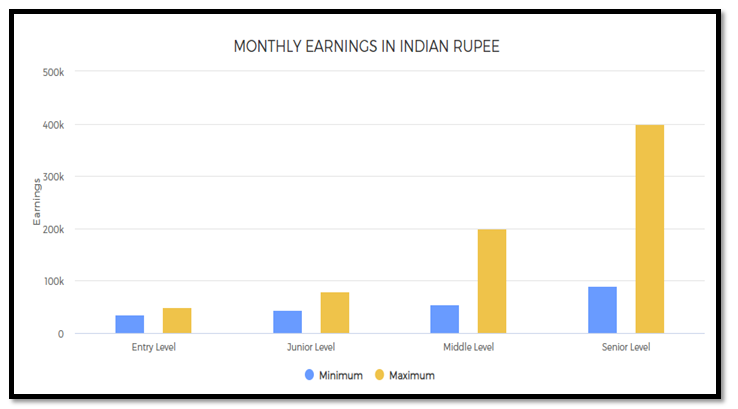
MONTHLY EARNINGS IN INDIAN RUPEE
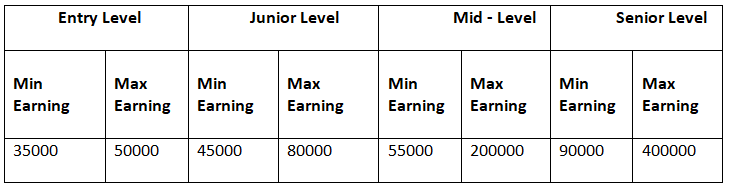
1. Entry level: 0 - 2 years of work experience
2. Junior Level: From 1 to 12 years of work experience
3. Mid-Level: From 5 to 20+ years of work experience
4. Senior Level: From 10 to 25+ years of work experience (there could be exceptions in some high-end technical, financial, engineering, creative, management, sports, and other careers; also in the near future, people will reach these levels much faster in many careers and in some careers, these levels will have no meaning as those careers will be completely tech skill driven such as even now, there is almost no level in a Cyber Security Expert’s job)
Work Activities
1. Analysing and interpreting data and information - Analysis of data and information to find facts, trends, reasons behind situations, etc.; interpretation of data to aid in decision making.
2. Computing - using various computer software applications; writing algorithms for various computer and mobile applications; using software applications for scientific and technical work.
3. Creative thinking - Developing new ideas, concepts, innovative solutions to problems, newer ways of getting things done, designing products and services, creating work of art and craft, etc.
4. Getting Information and learning - Observing, hearing, reading, using computers, or otherwise obtaining information and learning from it.
5. Making decisions and solving problems - Analysis of data and information; evaluation of alternative decisions and results of decisions; taking the right decisions and solving problems.
6. Organizing, planning and prioritizing tasks - Planning and organizing tasks in order to achieve work goals; prioritizing tasks to achieve goals and making the best use of the time available.
7. Processing Information - Compiling, tabulating, calculating, auditing, verifying or otherwise dealing with information processing including data entry, transcription, recording, storing and maintaining databases.
8. Strategic planning - Developing visions and goals, developing strategies and action plans for achieving visions and goals.
9. Updating and using relevant knowledge - Keeping updated with the latest knowledge relevant to your fields of work and use of the relevant knowledge in getting things done.
10. Using computers for work - Using computers for day-to-day office work; using computer software for various applications in day-to-day professional work; entering data and process information; for writing.
11. Working in a team - Working in a team of people; developing team; maintaining professional relationships among team members.
12. Working with computers, programming and performing technical tasks - Using computers and computer systems, hardware, and software for programming, developing software and/or hardware, developing computer applications, systems, and networks; developing mobile applications.
Future Prospects
The future of this pathway seems extremely bright especially as the industry statistics are very encouraging. There will always be a need for knowledgeable database professionals at all levels and in numerous database-related job roles with the advancement in Cloud Computing, Storage and proliferation of voluminous data (Big Data).
The Global Big Data market accounted for USD 31.93 billion in 2017 and is expected to reach USD 156.72 billion by 2026 growing at a compound annual growth rate (CAGR) of 19.3% during 2017-2026.
The In-Memory Database Market size is estimated to grow from USD 2.72 billion to USD 6.58 billion , at a CAGR of 19.3%. Faster data processing, falling RAM prices, & a massive amount of data being generated from various industries is driving this growth. However, memory space constraints & lack of standards are acting as the restraining factors for the in-memory segment. Most companies use a mix of in-memory and cloud storage.
The Database Automation Market size is expected to grow from USD 493.4 million to USD 1,714.0 million , at a CAGR of 28.3%. The abundance of cloud-based applications & services and rising partnerships & acquisitions in the database management space are expected to fuel this growth. Middle East and Africa (MEA) is expected to grow at the highest CAGR in this segment.
CAGR of 19.3%. Modernization of data warehouse architecture, rising need for data traffic management, and advancements in wireless technologies are propelling the growth.
Education is a strikingly bright segment in the database software market. The Smart Learning Systems Market was valued at USD 57.5 billion in 2018, and is expected to reach a value of USD 130.7 billion by 2024, at a CAGR of 15% during 2019 – 2024, as schools & training centers move from traditional blackboard approach to integrating smart technology.
The Global Graph Database Market is anticipated to reach USD 4,603.4 million by 2027, expanding at a CAGR of 24.3% from 2019 to 2027. Asia Pacific is anticipated to be the largest connected devices market with more than 11 billion connected devices across the region.
As larger enterprises generate a large volume of data every year, they require periodic analysis of the data generated. Amazon, Netflix, and LinkedIn are some of the large consumer-facing platforms that effectively use a graph database platform for storing consumer behavior and relationships.
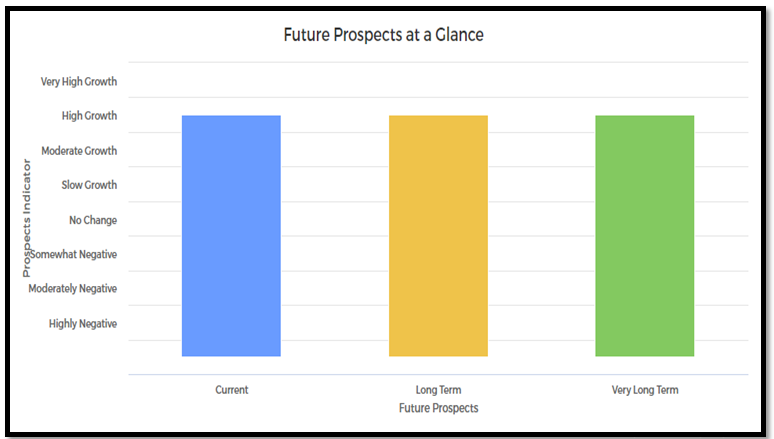
FUTURE PROSPECTS AT A GLANCE



