

Cast and Diamonds – Set Jewellery Manufacturing Worker
Entry Level Qualification
Class 10
Career Fields
Apparel & Accessories
For Specially Abled


Career Entrance Exam
About Career
1. As a Cast and Diamonds – Set Jewellery Manufacturing Worker, you will be involved in the process of designing a 3D CAD drawing of jewellery as per the requirement of the customer or client. You will be responsible for studying and sketching various designs for unique jewellery ideas. You will be sketching the jewellery design by using different types of stationery, hand-held tools, measuring tools, etc.
2. As a Cast and Diamonds–Set Jewellery Manufacturing Worker, you will be involved in all the manufacturing processes such as Filing and Assembling, Polishing, Wax Setting, Mould Making, Wax Piece Making, etc.
3. You will also be responsible for inserting and fixing or setting gemstones or other metals into pieces of jewellery and similar lifestyle accessories. You will be fixing or setting metals in the frame or collet (meaning socket) of jewellery pieces after they are finished through other manufacturing and finishing processes. Once the jewellery piece is designed as per the sketch, you will be responsible for giving it a final touch by polishing filing and assembling it.
PARTICULARS | DESCRIPTION |
Name | Cast and Diamonds – Set Jewellery Manufacturing Worker |
Purpose | Design and Create Jewelry |
Career Field | Apparel & Accessories |
Required Entrance Exam | No Entrance Exam |
Average Salary | 100000 - 200000 Rs. Per Year |
Companies For You | Jewellery Stores, Repair Shops, Studios, Workshops & Many More |
Who is Eligible | Class 10th Pass |
Key Roles and Responsibilities
As a Cast and Diamonds – Set Jewellery Manufacturing Worker, you will be engaged with one or more of the following roles and responsibilities:
1. You will be required to study, design, and sketch out innovative and unique jewellery ideas.
2. You will be required to create sketches on paper as well as on computers using computer-aided design (CAD).
3. You will be required to develop designs that comply with the creative, functional, and financial goals of the brand.
4. You will be required to use different metals and precious and semi-precious stones according to the given specifications.
5. You will be required to make models of jewellery designs using wax or cheap metals as per the requirement of the client.
6. You will be reviewing and correcting product designs for technical accuracy from the prototype to the final design.
7. You will be responsible for the safety and security of the jewellery and ensure the repairing of broken clips of the jewellery, cleaning, and polishing by using chemical baths.
8. You will have to manage workflow and develop and maintain good professional relationships with suppliers, silversmiths, goldsmiths, clients, etc.
Career Entry Pathway
Class 10 all subjects as per the scheme of studies – Obtain NSQF Level 3 certification in Hand Sketch Designer (Basic) / Filer and Assembler / Metal Setter (Basic) / Jewellery Polisher / Wax Setter / Wax Tree Maker or similar course.
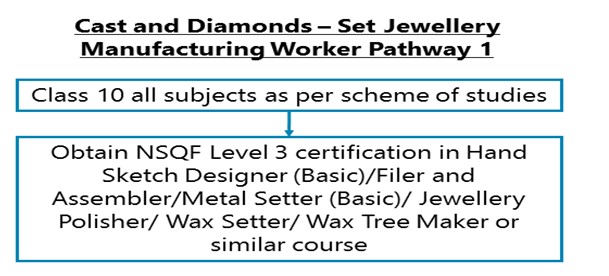
After completing Class 10, you may obtain NSQF (National Skills Qualification Framework) Level 3 certification in Hand Sketch Designer (Basic) / Filer and Assembler / Metal Setter (Basic) / Jewellery Polisher/ Wax Setter / Wax Tree Maker or any other similar course. You need to be 18 years of age and also training in computer operations is required if you want to obtain certification in Wax Tree Maker.
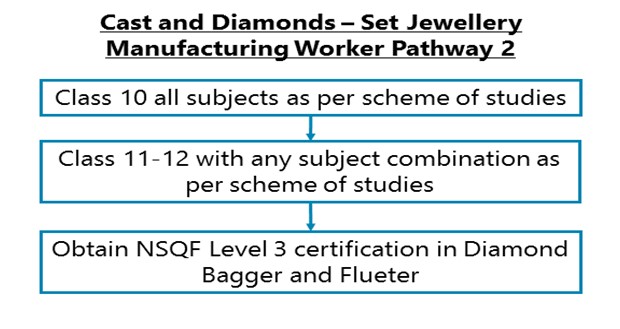
After completing Class 12, you may obtain NSQF (National Skills Qualification Framework) Level 3 certification in Diamond Bagger and Flueter or any other similar course.
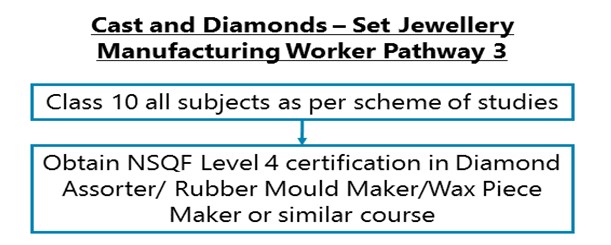
After completing Class 10, you may obtain NSQF (National Skills Qualification Framework) Level 4 certification in Diamond Assorted / Rubber Mould Maker / Wax Piece Maker or any other similar course. You must have obtained training in computer operations to obtain NSQF certification in Rubber Mould Maker / Wax Piece Maker.
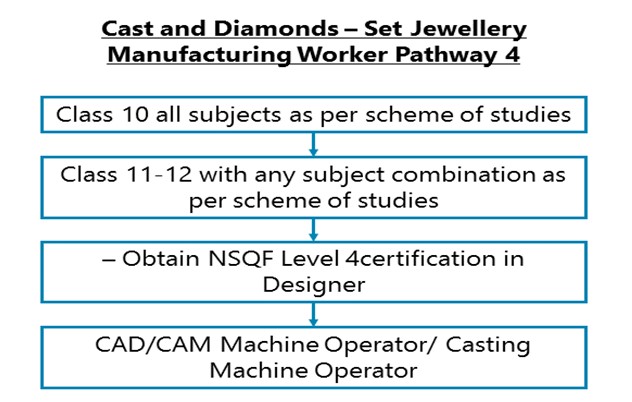
After completing Class 12, you may obtain NSQF (National Skills Qualification Framework) Level 4 certification in Designer – CAD/CAM Machine Operator / Casting Machine Operator or any other similar course. You must have obtained training in computer operations to obtain certification in Designer – CAD and CAD design software are required for obtaining certification in CAM Machine Operator.
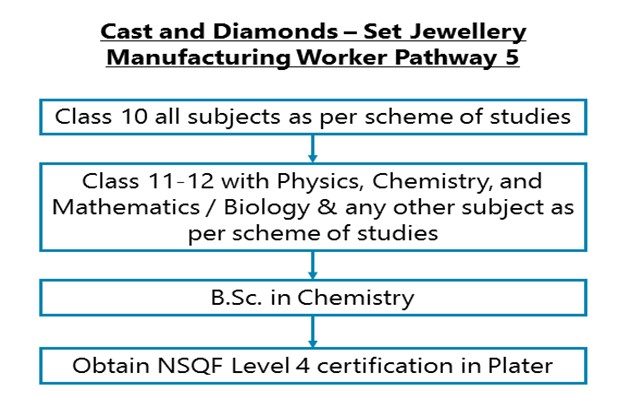
After completing Class 12, you may apply for a B.Sc. in Chemistry and then obtain NSQF (National Skills Qualification Framework) Level 4 Qualification in Plater. You must have obtained training in computer operations to obtain this certification.
Required Qualification & Competencies
If you have completed Class 10 in School, then you may:
1. Obtain NSQF Level 3 certification in Hand Sketch Designer (Basic) / Filer and Assembler / Metal Setter (Basic) / Jewellery Polisher / Wax Setter / Wax Tree Maker or similar course
2. Obtain NSQF Level 4 certification in Diamond Assorted / Rubber Mould Maker / Wax Piece Maker or similar course
Alternatively, if you have completed Class 12, then you may:
1. Obtain NSQF Level 3 certification in Diamond Bagger and Flutter
2. Obtain NSQF Level 4 certification in Designer – CAD or CAM Machine Operator or Casting Machine Operator
However, if you have completed a B.Sc. in Chemistry, then also you may:
1. Obtain NSQF Level 4 certification in Plater
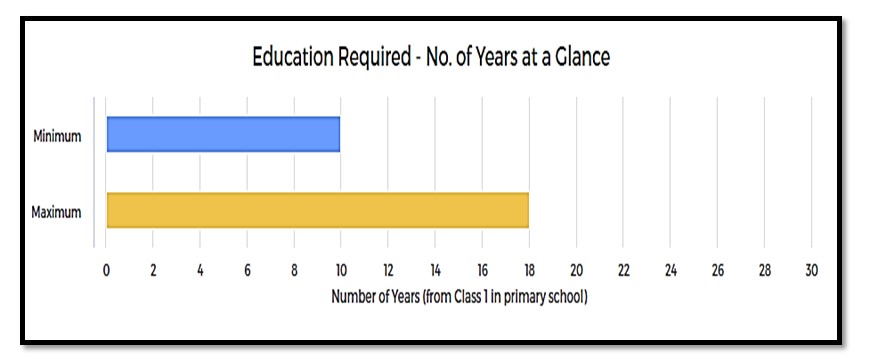
MINIMUM EDUCATION REQUIRED | MAXIMUM EDUCATION REQUIRED |
Post-Secondary Certificate / Diploma Programs for which the minimum eligibility is a pass in class X. | Under Graduate Undergraduate Degree / Honours Diploma / Graduate Diploma (equivalent to a Degree) Programs for which the minimum eligibility is a pass in Higher Secondary / Class XII School Leaving examination. |
Competencies Required
Interest
1. Enterprising: You should have an interest in Enterprising Occupations. Enterprising occupations involve taking initiative, initiating actions, and planning to achieve goals, often business goals. These involve gathering resources and leading people to get things done. These require decision-making, risk-taking, and action orientation.
2. Realistic: You should have an interest in Realistic Occupations. Realistic occupations involve more practical and hands-on activities than paperwork or office work. Realistic occupations often involve physical activities for getting things done using various tools and equipment.
3. Conventional: You should have interests in Conventional Occupations. Conventional occupations involve repetitive and routine tasks as well as fixed processes or procedures for getting things done. These occupations involve working more with data, systems, and procedures and less with ideas or creativity.
Knowledge
1. Biological Sciences: Knowledge of plants and animals, their anatomical structure, cell structure, tissues, physiological functions, evolution, and all other related aspects.
2. Healthcare Science and Services: Knowledge of different fields that are related to offering various types of healthcare services to people; assisting physicians and surgeons to carry out diagnosis, treatment, and prevention of human diseases, ailments, and disorders. This includes knowledge of different practices apart from medicine which are used to treat and prevent human diseases or to provide holistic healthcare and wellness. This also includes knowledge about drugs and medicines.
Skills
1. Active Listening: Giving full attention to what other people are saying, understanding the points being made by others, asking questions, etc.
2. Coordination: Skills in working together with other people to get things done.
3. Critical Thinking: Skills in the analysis of complex situations, using logic and reasoning to understand the situations and take appropriate actions or make interpretations and inferences.
4. Judgment and Decision Making: Skills in considering the pros and cons of various decision alternatives; considering costs and benefits; and making appropriate and suitable decisions.
5. Problem Solving: Skills in analysis and understanding of problems, evaluating various options to solve the problems, and using the best option to solve the problems.
6. Technical: Skills in using various technologies and technical methods to get things done or solve problems.
7. Time Management: Skills in prioritizing work, and managing time effectively.
8. Troubleshooting: Skills in determining causes of operating errors and deciding what to do about it
Abilities
1. Abstract Reasoning: The ability to understand ideas that are not expressed in words or numbers; the ability to understand concepts that are not clearly expressed verbally or otherwise.
2. Deductive Reasoning: The ability to apply general rules and common logic to specific problems to produce answers that are logical and make sense. For example, understanding the reasons behind an event or a situation using general rules and common logic
3. Inductive Reasoning: The ability to combine pieces of information from various sources, concepts, and theories to form general rules or conclusions. For example, analyzing various events or situations to come out with a set of rules or conclusions
4. Inter-Personal: The ability to build and maintain good relationships with others at workplaces and elsewhere.
5. Oral Comprehension: The ability to listen to and understand information and ideas presented through spoken words and sentences.
6. Oral Expression: The ability to communicate information and ideas in speaking so others will understand.
7. Problem Sensitivity: The ability to tell when something is wrong or is likely to go wrong. It does not involve solving the problem, only recognizing there is a problem.
Career - Job Opportunities & Profiles
As a Cast and Diamonds – Set Jewellery Manufacturing Worker, you will get various opportunities at jewellery stores, repair shops, studios, workshops, retail stores, designing outlets, boutiques, galleries, fashion designing companies etc. You can also get an opportunity as a graphic designer, CAD designer, product designer, technical designer, etc. As a Cast and Diamond – Set Jewellery Manufacturing Worker, you will be getting various job opportunities in/with:
1. Jewellery manufacturing units – from micro-scale units to large-scale units set up by large-scale jewellers such as Tanishq, Kiran Gems, Malabar Gold and Diamonds, PC Jewellers, Kalyan Jewellers, etc.



2. Individual Jewellery Designers or Accessories Designers who work independently.
3. Large scale Jewellers in their design and merchandising divisions
4. Diamond manufacturing units such as Gitanjali Group, Asian Star Company, Laxmi Diamond, Rosy Blue (India), Tara Jewellers, Tribhovandas Bhimji Zaveri, Firestar Diamonds, etc.
Specialisation Tracks In This Career
1. CAD Designer (Jewellery)
As a CAD Designer (Jewellery), you will be responsible for producing three-dimensional (3D) CAD drawings of jewellery as per the requirement of the customer or client. You will be required to provide information about the detailing, size, shape, and weight of the designed jewellery for manufacturing.
2. Hand Sketch Designer (Jewellery)
You will have to make creative designs of jewellery, creating bangles, necklaces or earrings of various styles like bracelets, necklaces, rings, pendants, etc. with different stones or precious metals. You will be using different types of stationery, hand-held tools, measuring tools, etc. to make the designs.
3. Filer and Assembler (Jewellery)
You will be responsible for removing sprues from the casted jewellery piece by using various hand and machine tools. You will also be involved in rectifying the casting defects such as porosity, blisters, bubbles, and cracks; and will be assembling the final jewellery component for further manufacture of jewellery.
4. Metal Setter (Jewellery)
As a Metal Setter (Basic), you will be inserting and fixing or setting gemstones or other metals into pieces of jewellery and similar lifestyle accessories. You will fix or set metals in the frame or collet (meaning socket) of jewellery pieces after they are finished through other manufacturing and finishing processes.
5. Polisher (Jewellery)
As a Jewellery Polisher, you will be responsible for providing clean, shinning and finished jewellery at different stages (i.e., pre-setting polish and final polish) of jewellery making. You will be working with different types of tools, polishing compounds, and soft and hard buffs fixed on the high-speed rotating motor bench.
6. Wax Setter (Jewellery)
You will be responsible for setting various metals such as diamonds, gemstones, etc. of different types and shapes in the wax replica of jewellery as per the requirement of the customer or client. Wax replica is required for producing a large number of identical jewellery pieces using metal casting and other methods.
7. CAM Machine Operator (Jewellery)
As a CAM Machine Operator, you will be using a Computer-Aided Manufacturing Machine and other different technologies for producing jewellery prototypes. You will be interpreting the three-dimensional (3D) jewellery design, and feeding design parameters in the CAM machine and will be producing resin-based prototypes.
8. Casting Machine Operator (Jewellery)
You will be involved in the process of converting wax models to jewellery pieces through the investment casting process. In the Indian Jewellery industry, a casting machine operator is also known as a “Caster”.
Career Growth
Career growth opportunities are limited in the career as a Cast and diamond – Set Jewellery Manufacturing Worker. From entry-level job positions, you can join for an internship working as a junior or assistant jewellery designer (precious jewellery designer, jewellery CAD designer, manual jewellery designer or Hand Sketch Designer)/Filer and Assembler/Metal Setter/ Jewellery Polisher/ Wax Setter/ Wax Tree Maker/Diamond Bagger and Flueter/Diamond Assorter/Rubber Mould Maker/Wax Piece Maker/Plater/Gold Refiner or Refiner, etc. you will grow up to roles like Jewellery Design Head, Technical Design Head, Manual Design Head, or other Senior positions, etc.
Salary Offered
1. Salaries vary according to job profiles and the kind of facilities you get to work at.
2. In entry-level jobs, you may earn anything between Rs. 8,000 - 15,000 per month.
3. Salaries increase with your work experience and as you get promoted.
4. In junior-level roles, you can expect to earn about Rs. 12,000 - 25,000 per month.
5. In mid-level jobs, with 6-12 years of work experience, you can expect to earn about Rs. 18,000 - 40,000 per month.
6. In senior-level jobs, with 12-15 years of work experience, you can expect to earn about Rs. 30,000 - 60,000 or even more per month.
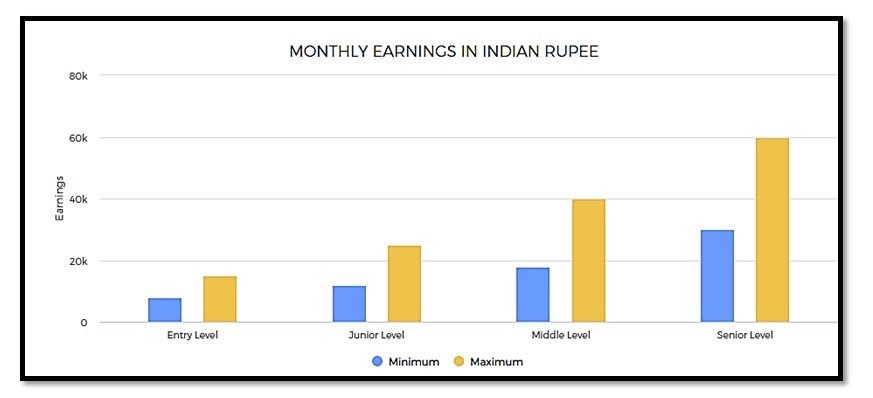
Monthly Earnings In Indian Rupee
Entry Level | Junior Level | Mid-Level | Senior Level | ||||
Min Earning | Max Earning | Min Earning | Max Earning | Min Earning | Max Earning | Min Earning | Max Earning |
8000 | 15000 | 12000 | 25000 | 18000 | 40000 | 30000 | 60000 |
1. Entry level: 0 - 2 years of work experience
2. Junior Level: From 1 to 12 years of work experience
3. Mid Level: From 5 to 20+ years of work experience
4. Senior Level: From 10 to 25+ years of work experience (there could be exceptions in some high-end technical, financial, engineering, creative, management, sports, and other careers; also shortly, people will reach these levels much faster in many careers and some careers, these levels will have no meaning as those careers will be completely tech skill driven such as even now, there is almost no level in a Cyber Security Expert’s job)
Work Activities
As a Cast and Diamonds – Set Jewellery Manufacturing Worker, you will be involved in the following work activities:
1. Drawing, drafting, laying out, and specifying objects, equipment, devices, tools, and systems - Creating and developing designs, drawings, layouts, and specifications about how to construct, manufacture, assemble, build, use, and maintain various types of jewelry.
2. Creative thinking - Developing new ideas, concepts, innovative solutions to problems, newer ways of getting things done, designing products and services, creating works of art and craft, etc.
3. Inspecting equipment, systems, structures, and materials - Inspecting equipment, systems, structures, and materials to ascertain quality, performance, defects, causes of errors, etc.
4. Assessing and evaluating quality - Assessing and evaluating the quality of materials, systems, processes, products, services, etc.
5. Getting Information and learning - Observing, hearing, reading, using computers, or otherwise obtaining information and learning from it.
6. Working with computers, programming, and performing technical tasks - Using computers computer systems, and computer software for designing tasks.
7. Updating and using relevant knowledge - Keeping updated with the latest knowledge relevant to your fields of work and using the relevant knowledge in getting things done.
8. Working in a team - Working in a team of people; developing a team; and maintaining professional relationships among team members.
9. Communicating with co-workers and others - Communicating with people in writing, verbally or otherwise inside your workplace and various other people who have professional relationships with your place of work including vendors, government officials, etc., or with people at large.
Future Prospects
1. The Casting and Diamond-Set Jewellery Manufacturing sub-sector currently employs around 0.61 million people and this is estimated to reach 1.08 million. This is expected to further fuel the demand for bridal / wedding jewellery in this period.
2. These increasing stats establish that employment opportunities will also increase. So the demand for various Cast and Diamond – Set Jewellery Manufacturing Workers will be high in upcoming years.
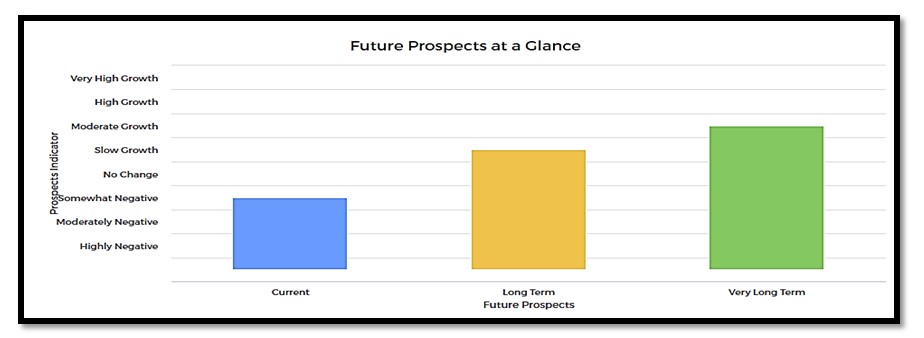
Future Prospects At A Glance
Current (0-1 year) | Long Term (2-5 years) | Very Long Term (6-10 years) |
Somewhat Negative | Slow Growth | Moderate Growth |