

Data Entry Operator
Entry Level Qualification
Class 10
Career Fields
Information Technology & Computer Science
For Specially Abled


Career Entrance Exam
About Career
As a Data Entry Operator, you will be mainly responsible for transferring data from paper formats into computer files or database systems of your company. You may have to type in data provided by customers too. You may need to create spreadsheets containing figures and data. An ideal data entry operator should be a fast typist and computer savvy having an eye for detail and familiarity with online forms and spreadsheets.
You also need to have an understanding of data confidentiality principles. The company you work for will be depending on you for updated and accurate data which is easily accessible through a virtual database. You will be updating and maintaining information on your company’s computer systems and databases. You will be collecting and feeding in data to databases and updating accurate records of up-to-date, usable and essential company information. You may work with a data team under a data manager.
PARTICULARS | DESCRIPTION |
Name | Data Entry Operator |
Purpose | . Inserting official data |
Career Field | Information Technology & Computer Science |
Required Entrance Exam | No Entrance Exam |
Average Salary | 100000 - 150000 Rs. Per Year |
Companies For You | various consultancies, banks, knowledge process units (KPOs) & Many More |
Who is Eligible | Class 10th Pass |
Key Roles and Responsibilities:
As a Data Entry Operator, you will be engaged with one or more of the following roles and responsibilities:
1. Inserting official data by inputting numerical or text-based information from source documents like canceled checks, sales reports, billsetc. and entering data in particular data fields or onto disks or tapes for subsequent entry, using scanners or keyboards.
2. Drafting business letters, typing reports, correspondence, text or written material from corrected copies, rough drafts or previous versions, using a computer, keyboards, word processor, typewriter etc. and keeping information confidential.
3. Compiling, verifying accuracy and electronically sorting text and numerical information to prepare source data for computer entry, according to priorities; updating, retrieving, and merging documents as needed.
4. Reviewing or editing data for errors or deficiencies or, correcting any incompatibilities and checking output; storing completed documents in proper locations.
5. Collating pages of reports and related documents prepared, adjusting settings for page layout, format, line spacing, or other style requirements.
6. Performing a variety of office and clerical tasks, such as filing, typing, or operating office machines.
7. Using data entry devices, like optical scanners, to feed data into computers for editing or revision and maintaining logs of completed work and activities.
8. Working with technical material, planning, and typing statistical tables, preparing statistical reports, rearranging or combining data from different sources.
Career Entry Pathway
Class 10 all subjects as per scheme of studies- NSQF Level 4 Certificate for ‘Domestic Data entry Operator’ or similar courses
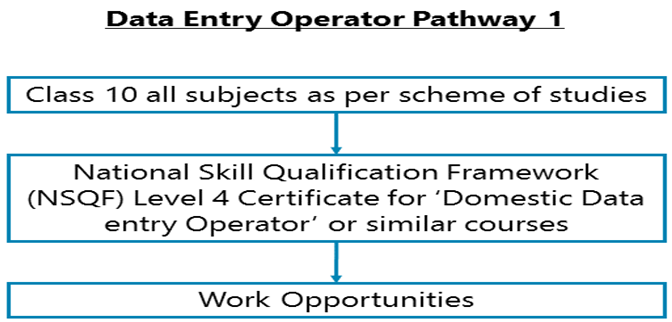
After Class 10, you can go for National Skill Qualification Framework (NSQF) Level 4 Certificate for ‘Domestic Data entry Operator’ or similar courses. The total number of training hours is 400.
Class 10 all subjects as per scheme of studies – training at an ITI or similar institute for ‘Data Entry Operator’ or related courses
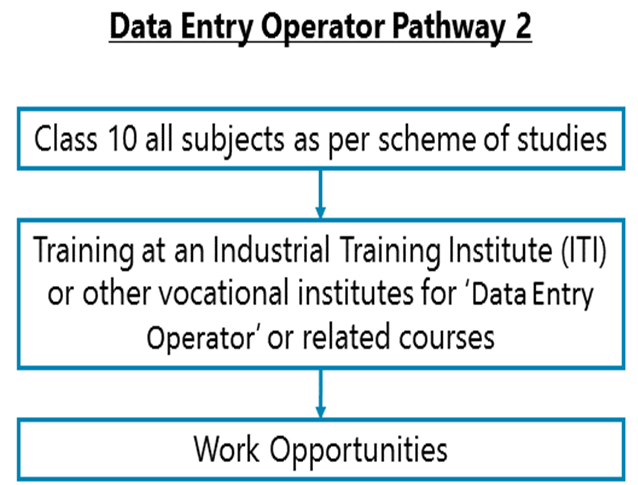
After Class 10, you can go for training at any Industrial Training Institute (ITI), National Skill Training Institute (NSTI), Regional Vocational Training Institute (RVTI), National Vocational Training Institute (NVTI), Industrial Training Center (ITC), Workshop Training Institute (WTI) or other vocational institutes for ‘Data Entry Operator’ or related courses. This is a 1-year course. You will sit for All India Trade Test (AITT) to get a National Trade Certificate (NTC) after this course. This exam is held twice a year in the months of February and July.
Class 10 all subjects as per scheme of studies – NSQF Level 4 CTS Training in ‘Computer Operator and Programming Assistant’, ‘Desktop Publishing Operator’ or related courses
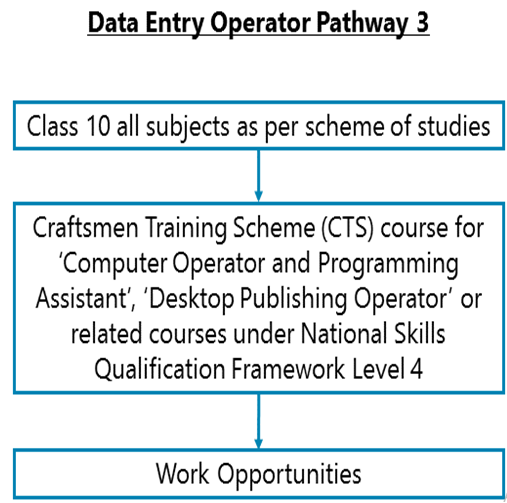
After Class 10, you can go for Craftsmen Training Scheme (CTS) course for ‘Computer Operator and Programming Assistant’, ‘Desktop Publishing Operator’ or related courses under National Skills Qualification Framework Level 4. This is a 1-year course with 2 semesters of 6 months each.
Class 10 all subjects as per scheme of studies - Class 11-12 with any subject combination as per scheme of studies - NSQF Level 5 CTS Training in ‘Database System Assistant’ or related courses
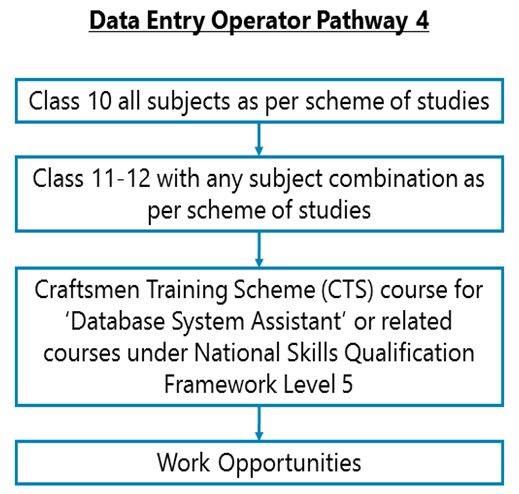
After Class 11-12, you can go for Craftsmen Training Scheme (CTS) course for ‘Database System Assistant’ or related courses under National Skills Qualification Framework Level 5. This is a 1-year course with 2 semesters of 6 months each.
Class 10 all subjects as per scheme of studies - Class 11-12 with any subject combination as per scheme of studies – obtain National Apprenticeship Certificate in related trades
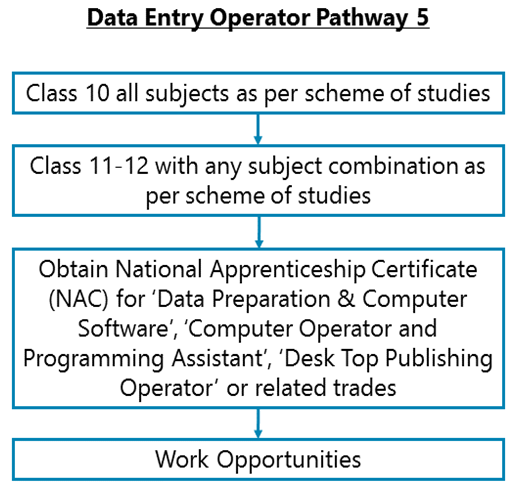
After Class 11-12, you can obtain National Apprenticeship Certificate (NAC) for ‘Data Preparation &Computer Software’, ‘Computer Operator and Programming Assistant’, ‘Desk Top Publishing Operator’ or related trades after completing Apprenticeship training. Apprenticeship training will be of 2 years.
Class 10 all subjects as per scheme of studies – undergo NIOS course for ‘Data Entry Operations’, ‘Certificate in Computer Applications’, ‘Certificate in Desk-Top Publishing’ or related courses
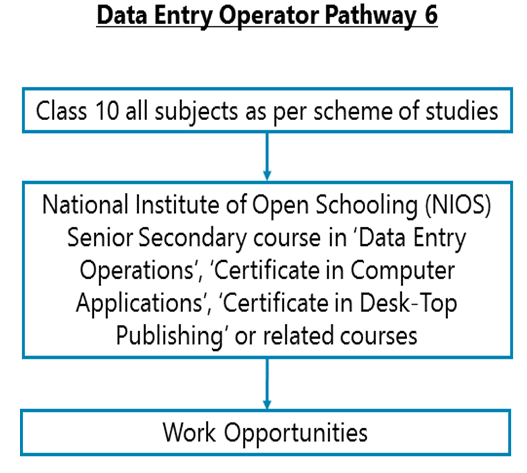
After Class 10, you can enroll for National Institute of Open Schooling (NIOS) Senior Secondary course in ‘Data Entry Operations’, ‘Certificate in Computer Applications’, ‘Certificate in Desk-Top Publishing’ or related courses. The medium of instruction is both in English and Hindi. It is for6 months to 1-year duration.
Class 10 all subjects as per scheme of studies - Class 11-12 with any subject combination as per scheme of studies - Diploma course in ‘Computer Applications’ (DCA)or related courses
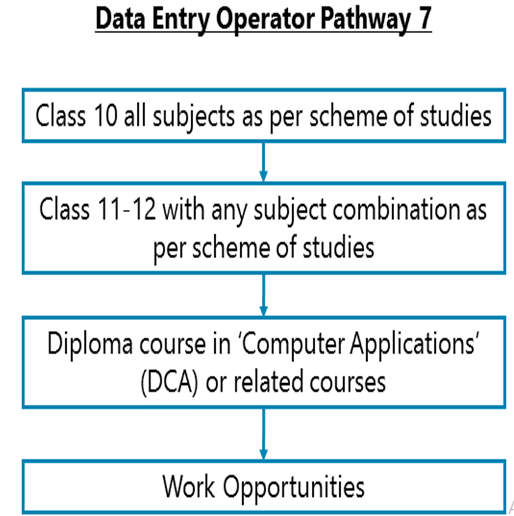
After Class 11-12, you can go for a Diploma course in ‘Computer Applications’ (DCA) or related courses. These are generally 1-2 year courses offered by various establishments across the country.
Class 10 all subjects as per scheme of studies - Class 11-12 with any subject combination as per scheme of studies –certificate course in ‘Data Entry and Processing’
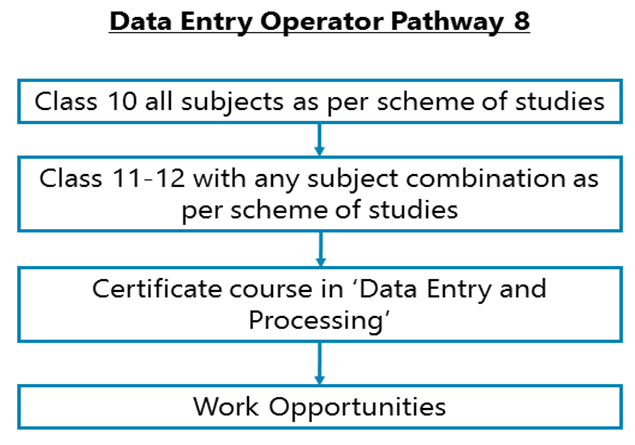
After Class 11-12, you can go for a certificate course in ‘Data Entry and Processing’. These are generally 6-month courses offered by various institutions across the country.
Required Qualification & Competencies
After class 10, you can go for:
1. NSQF Training courses.
2. CTS Training courses.
3. NIOS Training courses.
4. ITI Training courses.
5. Class 11-12.
After Class 11-12, you can go for:
1. National Apprenticeship Training.
2. CTS Training courses.
3. Diploma courses.
4. 6-month certificate course in ‘Data Entry and Processing’
Various private/public vocational training establishments across India offer related courses on:
1. Data Base System Assistant
2. Data Preparation and Computer Software
3. Computer Operator and Programming Assistant
4. Desk Top Publishing Operator
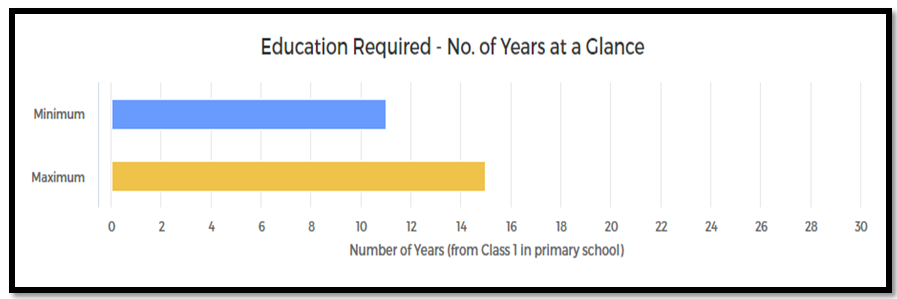
MINIMUM EDUCATION REQUIRED | MAXIMUM EDUCATION REQUIRED |
Post-Secondary Certificate / Diploma Programs for which the minimum eligibility is a pass in class X. | Post Higher Secondary Diploma / Certificate Programs for which the minimum eligibility is a pass in Higher Secondary / Class XII School Leaving examination. |
COMPETENCIES REQUIRED
1. You should have interests for Conventional Occupations. Conventional occupations involve repetitive and routine tasks as well as fixed processes or procedures for getting things done. These occupations involve working more with data, systems, and procedures and less with ideas or creativity.
2. You should have interests for Enterprising Occupations. Enterprising occupations involve taking initiatives, initiating actions, and planning to achieve goals, often business goals. These involve gathering resources and leading people to get things done. These require decision making, risk-taking, and action orientation.
3. You should have interests for Realistic Occupations. Realistic occupations involve more practical and hands-on activities than paperwork or office work. Realistic occupations often involve physical activities for getting things done using various tools and equipment.
4. You should have knowledge of Computers - computer hardware and software, computer programming, computer networks, computer, and mobile applications.
5. You should have knowledge of English Language - English grammar, words, spelling, sentence construction, using English to communicate with others, reading in English, etc.
6. You should have knowledge of Clerical and secretarial activities - Knowledge of various clerical tasks and procedures such as handling emails and phone calls, filling up forms, data entry, managing files, managing records, maintaining information databases, stenography, scheduling appointments, and other office procedures and general administrative tasks.
7. You should have Active Learning Skills - Focused and continuous learning from various sources of information, observation and otherwise for application in getting work done.
8. You should have Deductive Reasoning Ability –apply general rules and common logic to specific problems to produce answers that are logical and make sense. For example, understanding the reasons behind an event or a situation using general rules and common logic.
9. You should have Perceptual Speed - The ability to quickly and accurately compare similarities and differences among sets of letters, numbers, objects, pictures, or patterns. The things to be compared may be presented at the same time or one after the other. This ability also includes comparing a presented object with a remembered object.
10. You should have Finger Dexterity - The ability to make precisely coordinated movements of the fingers of one or both hands to grasp, manipulate, or assemble very small objects.
11. You should have Information Ordering Ability - The ability to arrange things or actions in a certain order or pattern according to a specific rule or set of rules (e.g., patterns of numbers, letters, words, pictures, mathematical operations).
12. You are always or mostly careful about your actions and behavior.
13. You are practical always or in most situations.
14. You are always or mostly disciplined in your action and behavior.
15. You are always or mostly organized in your day-to-day life and activities.
Career - Job Opportunities & Profiles
You will get job opportunities like the following in backend departments, back offices of various consultancies, banks, knowledge process units (KPOs), publishing companies, business process units (BPOs), corporate/public sector firms, academic institutions etc.:
1. Data Entry Operator
2. Computer Operator
3. Computer Data Entry Operator
4. Office Assistant - Data Entry
5. Data Entry Officer
6. Back Office Executive
7. Data Entry Clerk
8. Data Entry Executive
9. Data Entry Specialist
10. Secretary / Back Office Support
11. Office Automation – Executive
12. DTP (Desk-Top Publishing) Operator
You can also opt for work from home opportunities for this role. Various recruiters hire individuals who can provide their services without having to travel to the company premises.
CAREER GROWTH
From entry-level job positions as a Data Entry Operator, Computer Data Entry Operator, Data Entry Officer, Back Office Executive, Data Entry Clerk, Data Entry Executive, you may rise up to roles like Senior Data Entry Executive, Chief Data Entry Specialist etc.
Salary Offered
1. Salaries vary according to job profiles and the kind of facilities you get to work at.
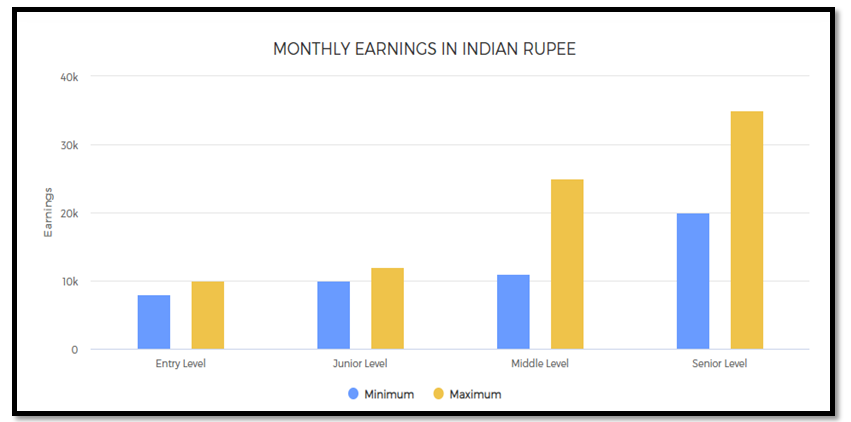
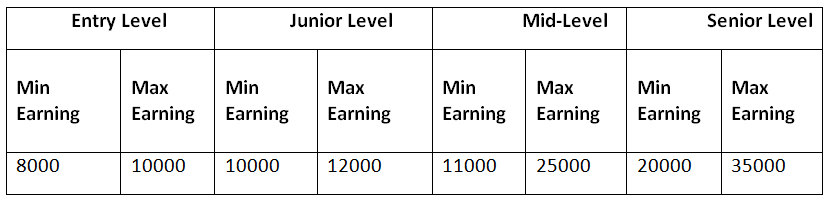
2. In the entry-level jobs: You may get about Rs. 8,000 – Rs. 10,000 or more per month.
3. Salaries increase with your work experience and as you get promoted.
4. After having 1-6 years of experience, you may expect about Rs. 10,000 – Rs. 12, 000 per month or more.
5. After having 6-12 years of experience, you may get about Rs. 11,000 – Rs. 25,000 or more per month.
6. In the senior level jobs, with 12-20 years of work experience, you may expect to get about Rs. 20,000 – Rs. 35, 000 or more per month.
MONTHLY EARNINGS IN INDIAN RUPEE
1. Entry level: 0 - 2 years of work experience
2. Junior Level: From 1 to 12 years of work experience
3. Mid-Level: From 5 to 20+ years of work experience
4. Senior Level: From 10 to 25+ years of work experience (there could be exceptions in some high-end technical, financial, engineering, creative, management, sports, and other careers; also in the near future, people will reach these levels much faster in many careers and in some careers, these levels will have no meaning as those careers will be completely tech skill driven such as even now, there is almost no level in a Cyber Security Expert’s job)
Work Activities
1. Processing information– Transcribing, entering, storing, recording or maintaining information in electronic, magnetic or written form; searching, compiling, tabulating, calculating, auditing, verifying or otherwise dealing with information processing including data entry, transcription, recording, storing and maintaining databases.
2. Using computers for work– Using computers for day-to-day office work; using computer software for various applications in day-to-day professional work; entering data and process information; for writing.
3. Getting Information and learning– Observing, hearing, reading, using computers, or otherwise obtaining information and learning from it.
4. Organising, planning and prioritising tasks - Planning and organising tasks in order to achieve work goals; prioritising tasks to achieve goals and making the best use of the time available.
5. Assessing and determining compliance with standards, laws, rules, and guidelines - Using relevant information, auditing information, processes and systems to determine whether organisations or people are complying with standards, laws, rules, and guidelines.
6. Communicating with co-workers and others- Communicating with people in writing, verbally or otherwise inside your workplace and various other people who have professional relationships with your place of work including vendors, government officials, etc. or with people at large.
Future Prospects
The prospects for this pathway look decently good. The demand for specialists in data entry and desktop publishing is mounting as digital copies of all possible tangible documents are the need of the hour since this is an era of digitization. Demand for professionals specializing in online data entry, catalog data entry, image data entry, data entry of surveys, database data entry, e-book data entry, offline data entry, data entry of company reports, data entry of insurance claims, data entry from yellow pages etc. is on the rise. There are various companies which are just into the data entry business and hire only data entry officers. Home-based roles for data entry are also preferred by many women of today who are unable to commute. India’s Outsourcing Sector is steadily scaling up the value chain and currently has a market share of 51% of the global worth of this sector. India is offering outsourcing services in arenas like knowledge process outsourcing (KPO), biotechnology and pharmaceuticals, research and development, automobile and aerospace research, engineering and legal processes. India’s IT-Business Process Outsourcing (BPO) sector will rake around 225 billion US Dollars of revenue.
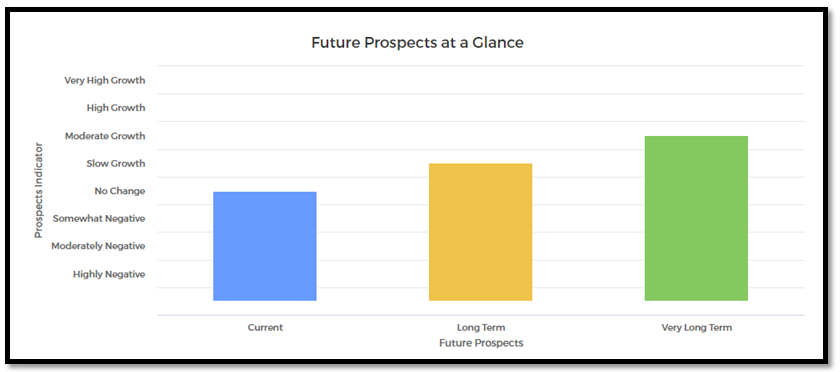
FUTURE PROSPECTS AT A GLANCE



