


Business Analyst
Entry Level Qualification
Class Graduate
Career Fields
Business & Management
For Specially Abled


About Career
A Business Analyst (BA) is an expert who analyses an organization and its business domains and documents its business model while integrating it with technology. Business Analyst helps a business by improving its processes, products, services etc. through data analysis.
As a Business Analyst, you will analyse business problems and then resolve it using technology. You may be working in different business sectors like Finance, Banking, Telecom, Social Media, Insurance, Marketing, Public Services, etc. As a Business Analyst, you will be involved in:
Business Development: You will identify the organizations’ need and business opportunities
Business Model Analysis: You will define policies of the organization and market approaches
Process Design: You will standardise the processes of the organization
System Analysis: You will interpret the business rules and the requirements for technical systems to improve the Business tech.
As a Business analyst, you will be mostly working on one of the above. You will work with the Information Technology team.
Key roles and responsibilities
As a Business Analyst, you will have different roles and responsibilities based on your profile. Following is the list of few roles and responsibilities across profiles:
1. You will analyse market strategies of competition through analysis of their products, market share, market trends, etc.
2. You will understand and interpret current business intelligence or trending and use them to recommend actions.
3. You will communicate with customers, competitors, suppliers, professional organizations, or others to keep yourself abreast with all trends in the market.
4. You will manage the timely flow of business intelligence information to users.
5. You will collect business intelligence data from different sources like industry reports, media interviews, public information, field reports, paid researches.
6. You will produce a project definition/project initiation document clearly defining scope and project objective on which you will be working.
7. You will be presenting your solutions and recommendations to stakeholders.
PARTICULARS | DESCRIPTION |
Name | Business Analyst |
Purpose | Analyse Market Strategies |
Career Field | Business & Management |
Required Entrance Exam | CAT, XAT, NMAT, GMAT, GRE |
Average Salary | 300000 - 2000000 Rs. Per Year |
Companies For You | Bain & Company, Boston Consulting Group (BCG) & Many More |
Who is Eligible | Graduate |
Career Entry Pathway
Class 10 all subjects as per scheme of studies– Class 11-12 Physics, Chemistry and Mathematics along with any other subject as per scheme of studies– UG in Mathematics/ Statistics/ Physics/ Applied Mathematics/ Economics/ Computer Science/ similar field (Honours or specialisation is an advantage) – Diploma/ Certification in Business Intelligence/ Business Analytics/ Data Analyst/ SAS Certification
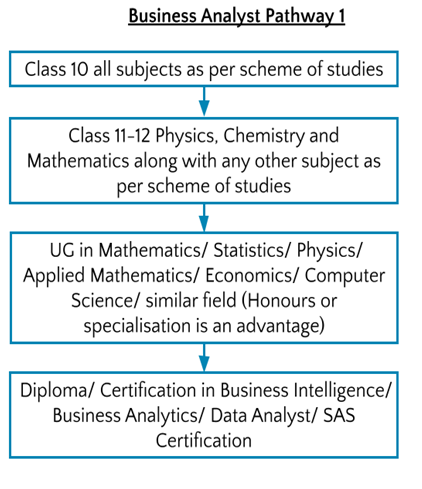
After Class 11-12 Physics, Chemistry and Mathematics along with any other subject as per scheme of studies and then study for an undergraduate degree in Mathematics/ Statistics/ Physics/ Applied Mathematics/ Economics/ Computer Science/ similar field (Honours or specialisation is an advantage). After finishing your under graduate course, you can opt for Diploma/ Certificate in Business Intelligence/ Business Analytics/ Data Analyst/ SAS Certification. Additionally, you should be trained in Python/ SQL/ UML/ Microsoft Visio/ similar tools.
Class 10 all subjects as per scheme of studies– Class 11-12 Physics, Chemistry and Mathematics along with any other subject as per scheme of studies – UG in Mathematics/ Statistics/ Physics/ Applied Mathematics/ Economics/ Computer Science/ similar field (Honours or specialisation is an advantage) – P.G. in Mathematics/ Statistics/ Applied Mathematics/ Economics/ Computer Science/ Data Mining/ Business Analytics / similar field – Diploma/ Certification in Business Intelligence/ Business Analytics/ Data Analyst/ SAS Certification
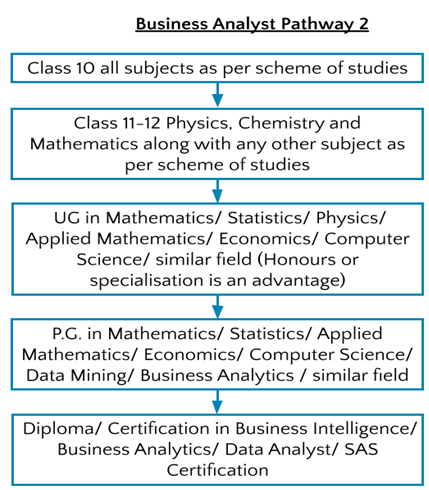
After your secondary level of schooling in Physics, Chemistry with science & Mathematics, you can study science stream with Physics, Chemistry and Mathematics in your higher secondary school and then study for an undergraduate degree in Mathematics/ Statistics/ Physics/ Applied Mathematics/ Economics/ Computer Science/ similar field (Honours or specialisation is an advantage). After finishing your under graduate course, you can opt for master’s degree in Mathematics/ Statistics/ Applied Mathematics/ Economics/ Computer Science/ Data Mining/ Business Analytics / similar field. After finishing your post graduate course, you can opt for Diploma/ Certificate in Business Intelligence/ Business Analytics/ Data Analyst/ SAS Certification. Additionally, you should be trained in Python/ SQL/ UML/ Microsoft Visio/ similar tools.
Class 10 all subjects as per scheme of studies– Class 11-12 with any subject as per scheme of studies – UG in any subject– P.G. in Business Administration (Business Analytics) - Diploma/ Certification in Business Intelligence/ Business Analytics/ Data Analyst/ SAS Certification
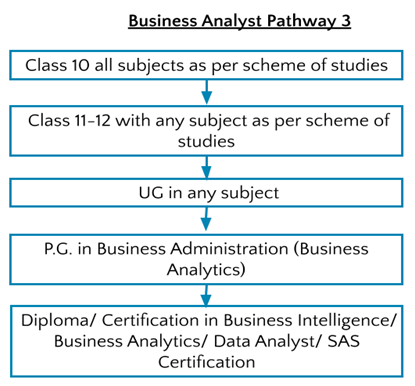
After your secondary level of schooling in Physics, Chemistry with science & Mathematics, you can study any stream in your higher secondary school and then study for an undergraduate degree in any subject. After finishing your under graduate course, you can opt for master’s degree in Business Administration in Business Analytics. After finishing your post graduate course, you can opt for Diploma/ Certificate in Business Intelligence/ Business Analytics/ Data Analyst/ SAS Certification. Additionally, you should be trained in Python/ SQL/ UML/ Microsoft Visio/ similar tools.
Required Qualification & Competencies
To become a Business Analyst, you can study for an undergraduate degree in the following fields or in any other related fields:
Computer Science & Engineering or any other field in Engineering
1. Data Science & Engineering
2. Information Science & Engineering
3. Information Technology
4. Business Analytics and Business Intelligence
5. Business Information Systems
6. Business System Management
7. Computer Applications
8. Information Technology Management
9. Computer Science
10. Data Analytics
11. Data Sciences
12. Mathematics and Computer Science
13. Mathematics and Statistics
14. Statistics and Computer Science
15. Applied Mathematics
16. Computational Mathematics
17. Financial Mathematics
18. Mathematics
19. Operations Research
20. Applied Statistics
21. Industrial Statistics
22. Mathematical Statistics
23. Statistics
After your graduation you may opt to do a post graduate degree or diploma in any one of the following fields or in any related field:
1. Data Analytics
2. Data Sciences
3. Data Science & Engineering
4. Business Analytics and Business Intelligence
5. Computer Science & Engineering
6. Information Science & Engineering
7. Information Technology
8. Applied Statistics
9. Business Statistics
It could be a good idea to obtain a certificate in SAS Business Analytics and Business Intelligence software / SAP HANA / IBM SPSS / Similar Business Analytics and Business Intelligence tools along with a certificate in Hadoop / Spark or similar big data analytics tools. Also, you may obtain a certificate in Python/ SQL/ UML/ Microsoft Visio/ similar tools.
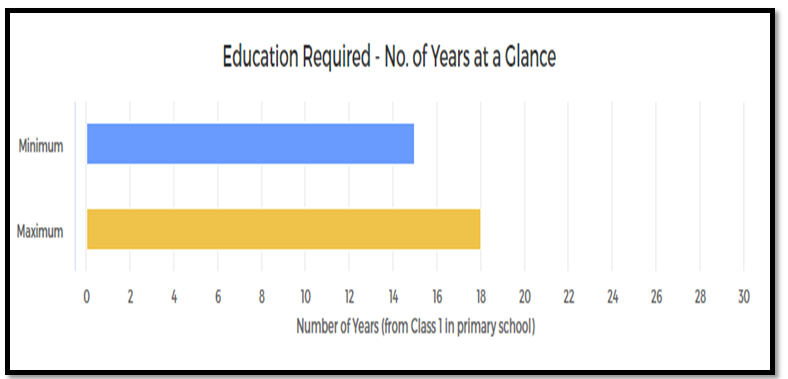
MINIMUM EDUCATION REQUIRED | MAXIMUM EDUCATION REQUIRED |
Under Graduate Undergraduate Degree / Honours Diploma / Graduate Diploma (equivalent to a Degree) Programs for which the minimum eligibility is a pass in Higher Secondary / Class XII School Leaving examination. | Post Graduate Postgraduate Degree / Diploma / Certificate Programs for which the minimum eligibility is a pass in Graduation / equivalent Diploma program like Honours Diploma or Graduate Diploma. |
COMPETENCIES REQUIRED
Interests
1. Investigative: You should have interests for Investigative Occupations. Investigative occupations involve working with ideas and quite a lot of thinking, often abstract or conceptual thinking. These involve learning about facts and figures; involve use of data analysis, assessment of situations, decision making and problem solving.
2. Conventional: You should have interests for Conventional Occupations. Conventional occupations involve repetitive and routine tasks as well as fixed processes or procedures for getting things done. These occupations involve working more with data, systems, and procedures and less with ideas or creativity.
3. Artistic: You should have interests for Artistic Occupations. Artistic occupations mostly involve working with creative ideas, art and designs. These occupations involve abstract or conceptual thinking, creative self-expression and often do not follow any set processes or rules for getting things done.
Abilities
1. Abstract Reasoning: The ability to understand ideas which are not expressed in words or numbers; the ability to understand concepts which are not clearly expressed verbally or otherwise.
2. Category Flexibility: The ability to generate or use different sets of rules for combining or grouping things in different ways.
3. Deductive Reasoning: The ability to apply general rules and common logic to specific problems to produce answers that are logical and make sense. For example, understanding the reasons behind an event or a situation using general rules and common logic.
4. Flexibility of Closure: The ability to identify or detect a pattern (a figure, object, word, or sound) that is hidden among other distracting materials.
5. Inductive Reasoning: The ability to combine pieces of information from various sources, concepts, and theories to form general rules or conclusions. For example, analysing various events or situations to come out with a set of rules or conclusions.
6. Information Ordering: The ability to arrange things or actions in a certain order or pattern according to a specific rule or set of rules (e.g., patterns of numbers, letters, words, pictures, mathematical operations).
7. Mathematical Reasoning: The ability to choose the right mathematical methods or formulas to solve a problem.
8. Mental Stamina: The ability to sustain prolonged mental effort.
9. Numerical Reasoning: The ability to add, subtract, multiply, divide, and perform other basic numerical calculations correctly.
10. Speed of Closure: The ability to quickly make sense of, combine, and organize information into meaningful patterns.
11. Verbal Reasoning: The ability to think and reason with words; the ability to reason out ideas expressed in words.
Knowledge
1. Mathematics: Knowledge of arithmetic, algebra, geometry, calculus, trigonometry, statistics, and other mathematical disciplines and their applications.
2. Computer (Data Analysis and Visualisation): Skills in using SPSS, SAS, SAP Hana, IBM Cognos, MATLAB, Minitab, Google Analytics, RapidMiner, R, Apache Hadoop, Apache Spark, Tableau, Visual Basic, etc.
3. Other tools: Python/ SQL/ UML/ Microsoft Visio/ similar tools.
Skills
1. Critical Thinking: Skills in analysis of complex situations, using of logic and reasoning to understand the situations and take appropriate actions or make interpretations and inferences.
2. Judgment and Decision Making: Skills in considering pros and cons of various decision alternatives; considering costs and benefits; taking appropriate and suitable decisions.
3. Problem Solving: Skills in analysis and understanding of problems, evaluating various options to solve the problems and using the best option to solve the problems.
4. Reading Comprehension: Skills in understanding written sentences and paragraphs in work related documents.
Personality
1. You are always imaginative or in most situations.
2. You always prefer to experience new things and have new experiences or you mostly do.
3. You can always act independently or could do so in most situations.
4. You are somewhat organised in your day-to-day life and activities.
5. You are somewhat careful about your actions and behaviour.
6. You are somewhat disciplined in your action and behaviour.
7. You remain calm in difficult situations sometimes but some other times you are anxious.
Career - Job Opportunities & Profiles
If you are inclined towards the analysis of the data, then you may be hired as Business Analyst / Data Analyst / Research Analyst / Management Trainee in different consulting firms as well as MNCs. Some of the leading consulting firms are Accenture, Bain & Company, Boston Consulting Group (BCG), Deloitte, Ernst & Young, KPMG, McKinsey, PwC, etc.





If you are inclined towards the business side of analytics where you use the results for strategies, you might be hired as Business Analyst Trainee by different MNCs, Media Houses, Retail and finance organizations.
Work Environment
The daily environment of a Data/ Business analyst depends on the role he or she is having. Role of a Data Analyst is mostly confined to officer work. However, they will be required to use a lot of mathematical tools and thus may feel the pressure to complete the research with accuracy. They will mostly coordinate with research associates. Business Analyst will also be working in offices but they will be working with a team and will focus on analysing the solutions and thus require a lot of brainstorming. They work timing will be regular for most of the duration of a career.
CAREER GROWTH
If you start your career as a Data Analyst / Research Analyst / Management Trainee, you can then become, Business Analyst or Financial Analyst. Later you can become Lead Business Analyst and then senior Business Analyst, and finally Analytics Manager. If you were a Financial analyst, then you can become a Senior Financial Analyst and then Finance Manager.
If you start your career as a Business Analyst Trainee, you may soon become a Business Analyst and then Senior Business Analyst.
You may then become Lead Business Analysts and then Management Consultant.
Salary Offered
1. At the entry level, as a Business Analyst, you will be earning anything between Rs. 20,000 to 2,00,000 per month. As a Market Research Associate, you will be earning anything between Rs. 20,000 to 1,00,000 per month. As a Business Analyst Trainee, you will be earning anything between Rs. 25,000 to 3,00,000 per month.
2. At the junior level after 2-6 years of experience, you will be earning anywhere between Rs 30,000 – 4,00,000 per month.
3. At the middle level of 6-12 years of work experience, your earning will rise to Rs 50,000-6,00,000 per month.
4. At the senior level after 12 years of work experience, your earning will be between Rs. 1,00,000 to 10,00,000 per month.
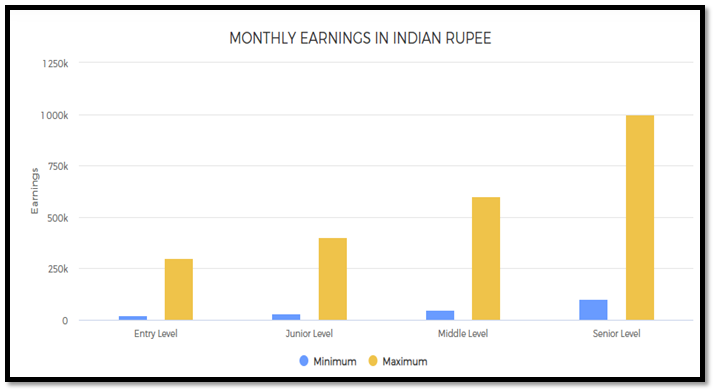
MONTHLY EARNINGS IN INDIAN RUPEE
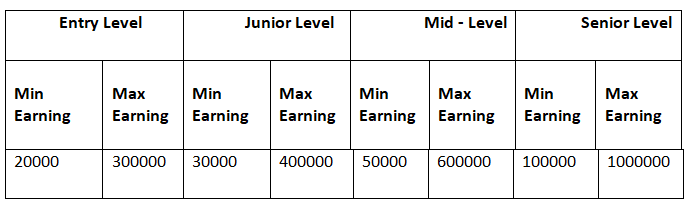
1. Entry level: 0 - 2 years of work experience
2. Junior Level: From 1 to 12 years of work experience
3. Mid-Level: From 5 to 20+ years of work experience
4. Senior Level: From 10 to 25+ years of work experience (there could be exceptions in some high-end technical, financial, engineering, creative, management, sports, and other careers; also in the near future, people will reach these levels much faster in many careers and in some careers, these levels will have no meaning as those careers will be completely tech skill driven such as even now, there is almost no level in a Cyber Security Expert’s job)
Work Activities
1. Analysing and interpreting data and information: Analysis of data and information to find facts, trends, reasons behind situations, etc.; interpretation of data to aid in decision making.
2. Calculating and computing: Calculating or computing using various mathematical formula and functions using computers or otherwise; doing financial or commercial calculations or computations.
3. Decision making and problem solving: Analysis of data and information; evaluation of alternative decisions and results of decisions; taking the right decisions and solving problems.
4. Getting Information and learning: Observing, hearing, reading, using computers, or otherwise obtaining information and learning from it.
5. Updating and using relevant knowledge: Keeping updated with the latest knowledge relevant to your fields of work and use of the relevant knowledge in getting things done.
6. Using computers for work: Using computers for day-to-day office work; using computer software for various applications in day-to-day professional work; entering data and process information; for writing.
Future Prospects
According to a report by Analytics India Magazine, Indian Market Research and Data Analytics industry is worth USD 2.71 billion currently.
At the same time, it is projected to grow at 33% per annum. With the current rate, it is estimated that by 2025, the Data Analytics industry will be a USD 20 Billion in India. This is almost 8 times the current market size. Around 45% of the market is related to the export of Research services to the USA, and this market is growing at a rate of 45% per annum. With such high staggering growth in the market, it is clear that not only India but even the International market are suing Indian Market research services. Another industry hiring Market Researchers is Consulting firms Even the consulting industry in India is growing at a rate of 9% per annum (according to Statista). Thus, overall, the market has a very high future prospect for a Business Analyst/ Data Analyst. Presently the growth is substantially high in core Data Analysis companies and Consulting companies.
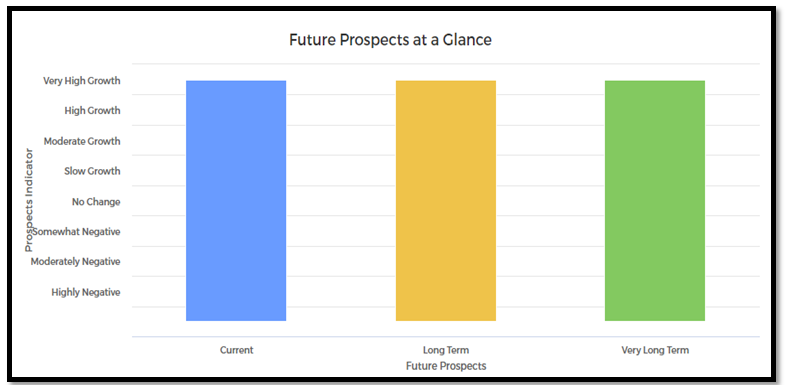
FUTURE PROSPECTS AT A GLANCE



