

Illustrator
Entry Level Qualification
Class 12
Career Fields
Animation, Graphics & Visual Communication
For Specially Abled


Career Entrance Exam
About Career
As an Illustrator, you will create a concept or original artwork using an array of mediums and techniques. You will be creating visual depictions of texts, concepts, and thoughts through the use of pen and ink, pencils, and computer software. You will have to use your skills to explain and simplify concepts through visual representation.
Key Roles And Responsibilities
1. Use pens and ink, watercolors, charcoal, oil, or computer software to create artwork.
2. Confer with clients, editors, writers, art directors, regarding the nature and content of artwork as required.
3. Marketing your artwork through brochures, mailings, or Web sites.
4. Study various techniques to learn how to apply them to artistic endeavors.
5. Keep an eye on events, trends, and other circumstances, attend art exhibitions, and read art publications to develop ideas.
6. Setting up exhibitions of artwork for display or sale.
7. Provide drawings, illustrations, and sketches of buildings, manufactured products, or models, working from sketches, blueprints, memory, models, or reference materials.
8. Submit artwork to shows or galleries.
9. Submit preliminary artwork or project plans to clients for approval, incorporating changes as necessary.
PARTICULARS | DESCRIPTION |
Name | Illustrator |
Purpose | Advertising and Social Media |
Career Field | Animation, Graphics & Visual Communication |
Required Entrance Exam | No Entrance Exam |
Average Salary | 150000 - 300000 Rs. Per Year |
Companies For You | UDLAB, Studio Fifi, Design Bucket & Many More |
Who is Eligible | Class 12th Pass |
Career Entry Pathway
Class 10 all subjects as per the scheme of studies – Class 11-12 with any subject combination as per the scheme of studies - Diploma In Fine Arts/ Graphic Design.
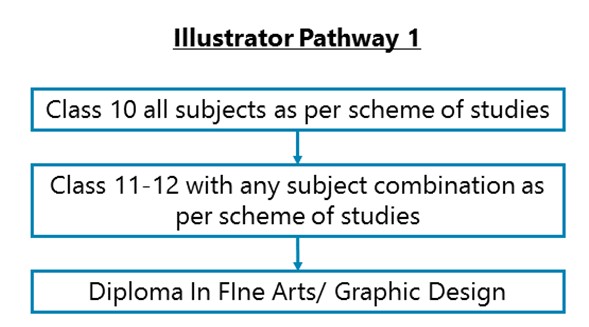
After class 12, follow it up with a Diploma In Fine Arts/ Graphic Design.
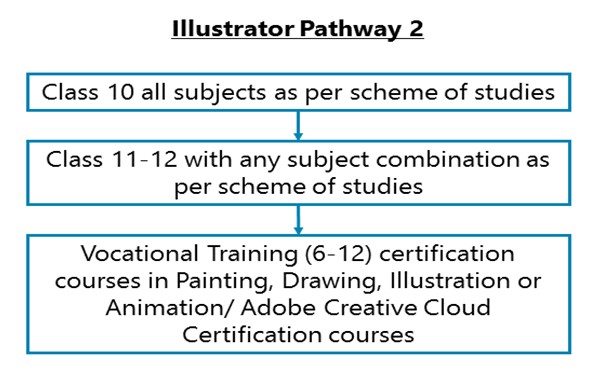
After class 12, various Institutes and educational outlets across India provide 6-12 month certification and Vocational Training (6-12 months) certification courses in Painting, Drawing, Illustration or Animation/Adobe Creative Cloud Certification courses.
Required Qualification & Competencies
1. After finishing 10+2, you can go for a Diploma in Fine Arts / Diploma In Graphic Design, Animation, and Multimedia to kick start your career as an illustrator.
2. After 10+2, there are several institutes and education outlets across India that provide 3 to 12-month diploma courses in Painting, Drawing, Illustration, Adobe products, and Graphic Design.
3. You can also train as an illustrator under the PMKVY (Pradhan Mantri Kaushal Vikas Yojana) scheme.
4. Alternatively, after you complete your secondary education, there is also a host of easily available drawing, painting, and sketching online certification courses on websites such as Udemy, Edx, Coursera, etc. A lot of people are turning to teaching themselves with the help of these comprehensive online courses.
5. You may also go for the Adobe Creative Cloud certification courses.
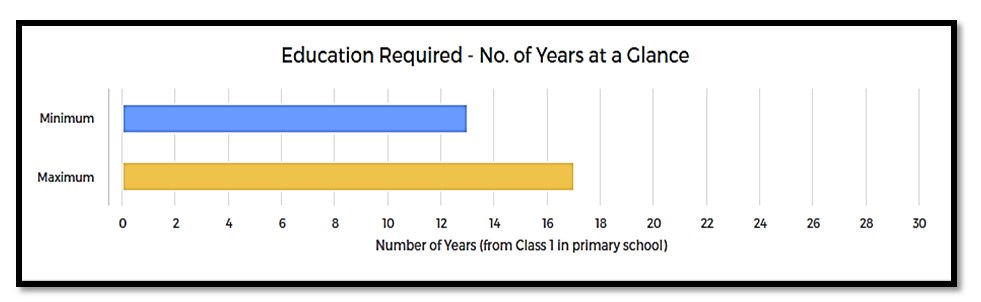
MINIMUM EDUCATION REQUIRED | MAXIMUM EDUCATION REQUIRED |
Post Higher Secondary Diploma / Certificate Programs for which the minimum eligibility is a pass in Higher Secondary / Class XII School Leaving examination. | Post Higher Secondary Diploma / Certificate Programs for which the minimum eligibility is a pass in Higher Secondary / Class XII School Leaving examination. |
Competencies Required
Interest
1. Enterprising: You should have an interest in Enterprising Occupations. Enterprising occupations involve taking initiative, initiating actions, and planning to achieve goals, often business goals. These involve gathering resources and leading people to get things done. These require decision-making, risk-taking, and action orientation.
2. Realistic: You should have an interest in Realistic Occupations. Realistic occupations involve more practical and hands-on activities than paperwork or office work. Realistic occupations often involve physical activities for getting things done using various tools and equipment.
3. Conventional: You should have interests in Conventional Occupations. Conventional occupations involve repetitive and routine tasks as well as fixed processes or procedures for getting things done. These occupations involve working more with data, systems, and procedures and less with ideas or creativity.
Knowledge
1. Biological Sciences: Knowledge of plants and animals, their anatomical structure, cell structure, tissues, physiological functions, evolution, and all other related aspects.
2. Healthcare Science and Services: Knowledge of different fields that are related to offering various types of healthcare services to people; assisting physicians and surgeons to carry out diagnosis, treatment, and prevention of human diseases, ailments, and disorders. This includes knowledge of different practices apart from medicine which are used to treat and prevent human diseases or to provide holistic healthcare and wellness. This also includes knowledge about drugs and medicines.
Skills
1. Active Listening: Giving full attention to what other people are saying, understanding the points being made by others, asking questions, etc.
2. Coordination: Skills in working together with other people to get things done.
3. Critical Thinking: Skills in the analysis of complex situations, using logic and reasoning to understand the situations and take appropriate actions or make interpretations and inferences.
4. Judgment and Decision Making: Skills in considering the pros and cons of various decision alternatives; considering costs and benefits; and making appropriate and suitable decisions.
5. Problem Solving: Skills in analysis and understanding of problems, evaluating various options to solve the problems, and using the best option to solve the problems.
6. Technical: Skills in using various technologies and technical methods to get things done or solve problems.
7. Time Management: Skills in prioritizing work, and managing time effectively.
8. Troubleshooting: Skills in determining causes of operating errors and deciding what to do about it
Abilities
1. Abstract Reasoning: The ability to understand ideas that are not expressed in words or numbers; the ability to understand concepts that are not clearly expressed verbally or otherwise.
2. Deductive Reasoning: The ability to apply general rules and common logic to specific problems to produce answers that are logical and make sense. For example, understanding the reasons behind an event or a situation using general rules and common logic
3. Inductive Reasoning: The ability to combine pieces of information from various sources, concepts, and theories to form general rules or conclusions. For example, analyzing various events or situations to come out with a set of rules or conclusions
4. Inter-Personal: The ability to build and maintain good relationships with others at workplaces and elsewhere.
5. Oral Comprehension: The ability to listen to and understand information and ideas presented through spoken words and sentences.
6. Oral Expression: The ability to communicate information and ideas in speaking so others will understand.
7. Problem Sensitivity: The ability to tell when something is wrong or is likely to go wrong. It does not involve solving the problem, only recognizing there is a problem.
8. Verbal Reasoning: The ability to think and reason with words; the ability to reason out ideas expressed in words.
Personality
1. You are always or mostly organized in your day-to-day life and activities.
2. You are always calm or generally remain calm in most situations.
3. You always feel secure in your surroundings and most situations.
4. You are a soft-hearted person sometimes.
5. You trust others sometimes but not always.
6. You are helpful to others sometimes.
7. You act independently sometimes but do not do so at some other times.
8. You are friendly and outgoing sometimes, but not always. You prefer the company of people sometimes but not always.
9. You are always practical in most situations.
Career - Job Opportunities & Profiles
After completing your ITI / diploma course or vocational training, there are a host of industries you can work as an illustrator, such as the advertising sector, print industry, media, and entertainment. Following are some of the entry-level jobs present as an Illustrator:
1. Comic Book Illustrator
2. Advertising Illustrator
3. Storyboard Artist
4. Scientific Illustrator
5. Technical Illustrator
6. Visual Artist
7. Sketching Artist
8. Newspaper And Magazine Illustrator
9. Children’s Book Illustrator
Some Organization’s where you can find jobs:
1. UDLAB
2. Studio Fifi
3. Fish Eye
4. Design Bucket
5. Newspapers And Magazines
6. Film Production Studios/Post Production Studios
Work Environment
Work Hours are typically dependent on the deadlines and quantity of work and may vary accordingly. Those having a job with a more professional approach may typically have the usual 40-hour work week. Others with more artistically uninhibited workspaces may have varying work hours. Freedom to make decisions is again decided by the nature of the job.
Specialisation Tracks In This Career
1. Concept Artist
For a concept illustration, an artist may present several interpretations and projections based on a certain theme, text, topic, or concept. The themes may be client-given or original artistic conceptions of the illustrator. They may usually include fantasy illustrations, gaming illustrations, or animation. The client has the freedom to choose from and see the different stages of development.
2. Comic Book Illustrator
Comic book illustrators are people working within the comics medium on comic strips, comic books, or graphic novels. They are artists who contribute to producing a work in comic form, from those who oversee all aspects of the work to those who contribute only a part.
3. Children's Book Illustrator
Children’s book illustrators involve colorful and simplistic drawings to facilitate young people—even those who cannot read yet—to understand or pay better attention to a story.
4. Medical Illustrator
A medical illustrator is a professional artist with advanced education in both the life sciences and visual communication. Collaborating with scientists, physicians, and other specialists, medical illustrators transform complex information into visual images that have the potential to communicate to broad audiences.
5. Scientific Illustrator
Scientific illustrators visually represent aspects of science, particularly observations of the natural world. The emphasis in scientific illustration is on accuracy and utility, rather than on aesthetics, although scientific illustrators are skilled artists and often known for aesthetic values.
6. Technical Illustrator
Technical illustrators work with design teams and technical writers to create an array of technical graphics. A technical illustrator takes information from text or data and creates illustrations that communicate this information concisely and accurately.
7. Illustrator (Advertising)
In advertising, illustrators seek to create illustrations with a commercial or ideological message to catch the consumer’s eye and create a lasting impression.
8. Digital Illustrator
Digital illustration is an artistic work or practice that uses digital technology and makes use of computer software as part of the creative or presentation process. Some examples of this software include Adobe Photoshop Adobe Illustrator Inkscape Corel Painter Adobe In Design.
Career Growth
Career growth as an illustrator is relatively moderate. You can hold editorial, managerial, and team leader positions after 7-8 years of experience.
Salary Offered
1. The salary scale as an Illustrator highly varies according to the job profiles.
2. The Average starting salaries as freshers for Graphic Designers, Print Illustrators, and Book Illustrators lie in the bracket of 12,000-22,000 per month.
3. Advertising Industries usually offer better pay, and starting jobs can be found at Rs 18,000 to 25,000 per month.
4. As you get experienced and acquire more skills, you will attract better offers and make your salary scale rise to fall in the 30,000-60,000 per month bracket, especially with mastering tools such as Adobe Illustrator.
5. The salaries can vary to greater heights, as most illustrator jobs are artistically oriented and often independent, and earn according to how much skill or experience they develop.
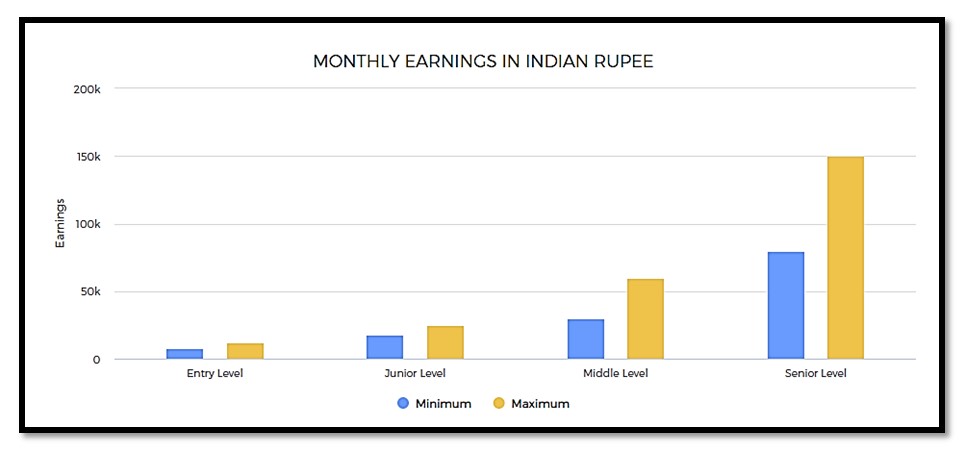
Monthly Earnings In Indian Rupee
Entry Level | Junior Level | Mid Level | Senior Level | ||||
Min Earning | Max Earning | Min Earning | Max Earning | Min Earning | Max Earning | Min Earning | Max Earning |
8000 | 12000 | 18000 | 25000 | 30000 | 60000 | 80000 | 150000 |
1. Entry level: 0 - 2 years of work experience
2. Junior Level: From 1 to 12 years of work experience
3. Mid-Level: From 5 to 20+ years of work experience
4. Senior Level: From 10 to 25+ years of work experience (there could be exceptions in some high-end technical, financial, engineering, creative, management, sports, and other careers; also in the near future, people will reach these levels much faster in many careers and in some careers, these levels will have no meaning as those careers will be completely tech skill driven such as even now, there is almost no level in a Cyber Security Expert’s job)
Work Activities
1. Communicating with co-workers and others: Communicating with people in writing, verbally or otherwise inside your workplace and various other people who have professional relationships with your place of work including vendors, government officials, etc., or with people at large
2. Decision-making and problem-solving: Analysis of data and information; evaluation of alternative decisions and results of decisions; making the right decisions and solving problems.
3. Developing and maintaining interpersonal relationships: Developing professional relationships with co-workers and others outside organizations and maintaining good relationships.
4. Getting Information and learning: Observing, hearing, reading, using computers, or otherwise obtaining information and learning from it.
5. Handling administrative activities: Handling various administrative tasks and managing day-to-day operations.
6. Inspecting equipment, systems, structures, and materials: Inspecting equipment, systems, structures, and materials to ascertain quality, performance, defects, causes of errors, etc.
7. Inspecting situations, events, and people: Inspecting situations, events, and people to understand the reasons and causes for the situation or events to happen; inspecting people to understand reasons behind their behavior and actions.
8. Managing and supervising: Managing and supervising the work of others; setting goals; giving instructions; monitoring work performance, etc.
9. Updating and using relevant knowledge: Keeping updated with the latest knowledge relevant to your fields of work and using the relevant knowledge in getting things done.
10. Using computers for work: Using computers for day-to-day office work; using computer software for various applications in day-to-day professional work; entering data and processing information; for writing.
11. Working in a team: Working in a team of people; developing a team; and maintaining professional relationships among team members.
Future Prospects
1. The Indian media and entertainment (M&E) industry has grown at a CAGR (Compound Annual Growth Rate) of 10.90 percent and it is expected to touch Rs 2,660.20 billion.
2. All these figures look promising as far as the future of illustrators goes. Since most of the Illustrator jobs present are in the media, entertainment, and advertising agencies, the rapid growth and good fortunes of these industries indicate a solid future prospect for illustrators.
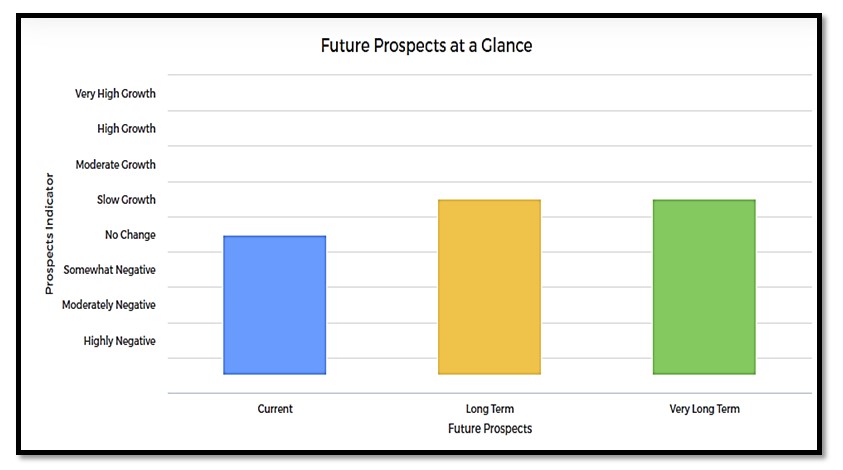
Future Prospects At A Glance
Current (0-1 year) | Long Term (2-5 years) | Very Long Term (6-10 years) |
No Change | Slow Growth | Slow Growth |


