
Textile Engineer
Entry Level Qualification
Class 12
Career Fields
Engineering & Technology
For Specially Abled


Career Entrance Exam
About Career
PARTICULARS | DESCRIPTION |
Name | Textile Engineer |
Purpose | Research and Development |
Career Field | Engineering & Technology |
Required Entrance Exam | JEE MAIN BE/BTECH, JEE ADVANCED, GATE |
Average Salary | 300000 - 400000 Rs. Per Year |
Companies For You | Raymond, Arvind Mills, Fabindia, Bombay Dyeing & Many More |
Who is Eligible | Class 12th Pass |
Textile Engineer is an expert who works in the textile manufacturing industry. As a textile engineer, you will be designing and controlling all aspects of production ranging from fibre, textile and apparel inputs (raw material), processes (production) and outputs (final fabric or cloths).
You will work on designing and controlling machinery too. You will research different kinds of yarn, dyes, colours, fabrics, fibres and then work with the research team to understand market needs and expectation. Once you have the requirement known, you will control the manufacturing. As a textile engineer, you should be able to do research and development too as this is one of the most important roles.
You will use principles of engineering and specific knowledge of textile raw material, equipment and processes.
As a textile engineer you can be working in the Research & Development Department, Production department, Quality control department, Process engineering department, sales department, etc.
Key roles and responsibilities
As a textile engineer, you will be working on several profiles and based on them some of your key roles and responsibilities are:
1. You will be responsible for the assessment of textile production project and the resources required for the project.
2. You will estimate the budget, timeline, etc. and then negotiate with your clients and management. Whenever necessary you will also renegotiate timelines and schedules. Thus, you will ensure that all production targets are achieved with the desired quality and 0 defects.
3. You will be responsible for determining the quality control standards for textile produced. You will regularly check the quality of products in terms of colour shades, knitting, and test approvals. You will identify any cause of undesirable quality.
4. You will oversee the production of textile and keep tracking of customers’ orders by time to ensure customer satisfaction.
5. You will be selecting, ordering and purchasing production material. Also, you will be controlling the cost of all dyes, raw material, etc.
6. You will oversee the management and maintenance of all production equipment.
7. You will coordinate with internal marketing and sales staff and external buyers.
8. You will regularly organize training sessions for your team.
Career Entry Pathway
Class 10 all subjects as per scheme of studies – Class 11-12 Physics, Chemistry, and Mathematics along with any other subject as per scheme of studies – UG in Textile Technology / Textile Chemistry – PG in Textile Technology / Textile Engineering
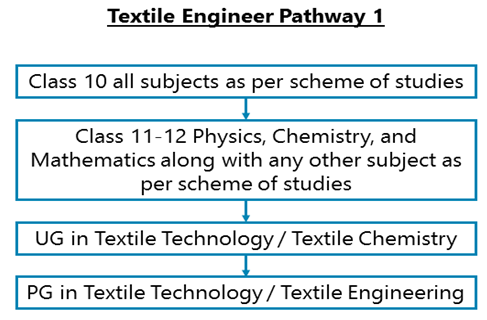
After your Class 11-12 Physics, Chemistry, and Mathematics along with any other subject as per scheme of studies in your higher secondary school and then study for an undergraduate engineering degree in Textile Technology / Textile Chemistry. After an undergraduate degree, you can complete a Master’s degree in engineering in Textile Technology / Textile Engineering.
Class 10 all subjects as per scheme of studies – Class 11-12 Physics, Chemistry, and Mathematics along with any other subject as per scheme of studies – UG in Textile Technology / Textile Chemistry
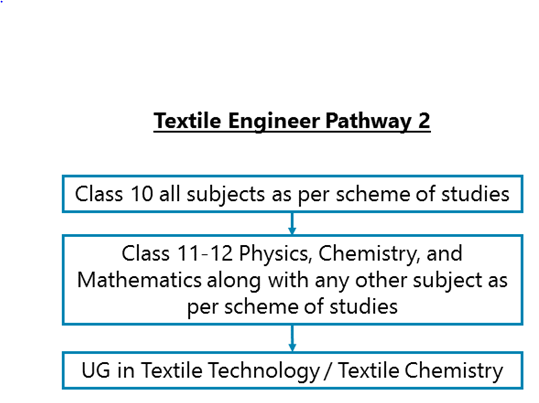
After your Class 11-12 Physics, Chemistry, and Mathematics along with any other subject as per scheme of studies in your higher secondary school and then study for an undergraduate degree in Textile Technology / Textile Chemistry.
Class 10 all subjects as per scheme of studies – Class 11-12 Physics, Chemistry, and Mathematics along with any other subject as per scheme of studies – UG in Textile Technology / Textile Chemistry – PG in Textile Technology / Textile Engineering– Ph.D. in Textile Engineering
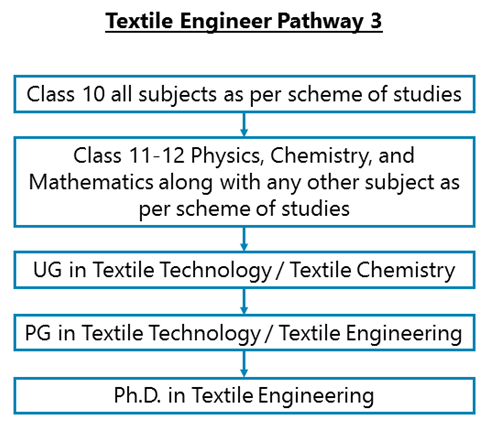
After your Class 11-12 Physics, Chemistry, and Mathematics along with any other subject as per scheme of studies in your higher secondary school and then study for an undergraduate degree in Textile Technology / Textile Chemistry followed by a master’s degree in Textile Technology / Textile Engineering. Further, you can take Textile Engineering in Ph.D. and complete the doctoral degree.
Class 10 all subjects as per scheme of studies – Class 11-12 Physics, Chemistry, and Mathematics along with any other subject as per scheme of studies – UG in Textile Technology / Textile Chemistry – Integrated Ph.D. in Textile Technology / Textile Engineering
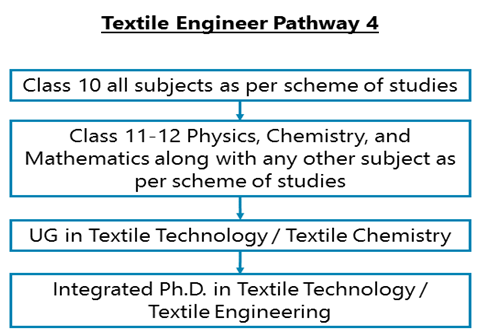
After your Class 11-12 Physics, Chemistry, and Mathematics along with any other subject as per scheme of studies in your higher secondary school and then study for an undergraduate degree in Textile Technology / Textile Chemistry. Following the B.E./B.Tech. Degree, you can study for Integrated Ph.D. in Textile Technology / Textile Chemistry Engineering.
Class 10 all subjects as per scheme of studies – Engineering Diploma in Textile Technology – UG in Textile Technology / Textile Chemistry – PG in Textile Technology / Textile Engineering
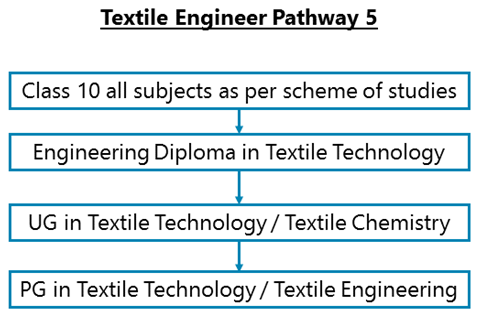
After your Class 10 all subjects as per scheme of studies, you can study Engineering Diploma in Textile Technology for 3 years and then study for a lateral undergraduate engineering degree in Textile Technology / Textile Chemistry. After an undergraduate degree, you can complete a Master’s degree in engineering in Textile Technology / Textile Engineering.
Class 10 all subjects as per scheme of studies – Engineering Diploma in Textile Technology – UG in Textile Technology / Textile Chemistry
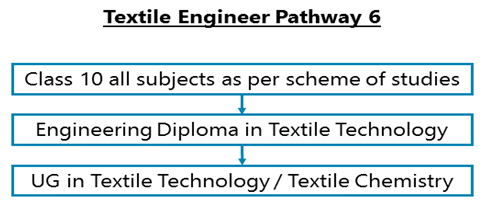
After your Class 10 all subjects as per scheme of studies, Engineering Diploma in Textile Technology for 3 years and then study for a lateral undergraduate degree in Textile Technology / Textile Chemistry.
Class 10 all subjects as per scheme of studies – Engineering Diploma in Textile Technology – UG in Textile Technology / Textile Chemistry – PG in Textile Technology / Textile Engineering– Ph.D. in Textile Engineering
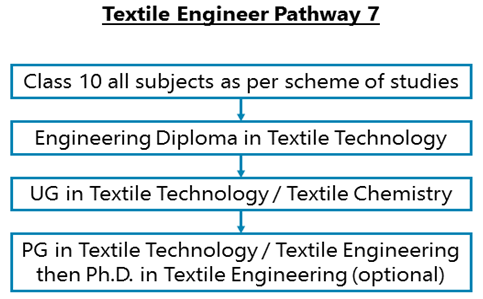
After your Class 10 all subjects as per scheme of studies, you can study Engineering Diploma in Textile Technology for 3 years and then study for a lateral undergraduate degree in Textile Technology / Textile Chemistry followed by a master’s degree in Textile Technology / Textile Engineering. Further, you can take Textile Engineering in Ph.D. and complete the doctoral degree.
Class 10 all subjects as per scheme of studies – Engineering Diploma in Textile Technology – UG in Textile Technology / Textile Chemistry – Integrated Ph.D. in Textile Technology / Textile Engineering
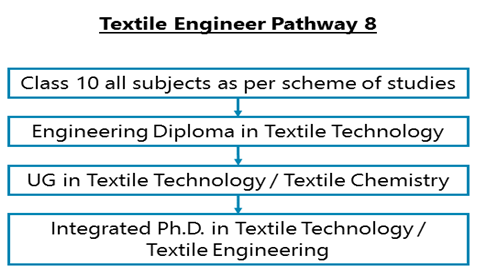
After your Class 10 all subjects as per scheme of studies, you can study Engineering Diploma in Textile Technology for 3 years and then study for a lateral undergraduate degree in Textile Technology / Textile Chemistry. Following the B.E./B.Tech. Degree, you can study for Integrated Ph.D. in Textile Technology / Textile Chemistry Engineering.
Required Qualification & Competencies
Undergraduate studies after school:
To become a Textile Engineer, you should complete Class 11-12 Physics, Chemistry, and Mathematics along with any other subject as per scheme of studies and join for an undergraduate course of B.E. or B.Tech. in Textile Engineering or Textile Chemistry.
Post Graduate studies:
After finishing B.E. or B.Tech., you can take an M.E. or M.Tech. Course in India or Foreign University. There are many specialisations in M.E. and M.Tech. You shall complete the following specialisation: R & D Engineering, Production Engineering, Textile Chemistry, etc.
You can go for further studies by choosing to complete a Ph.D. in Textile Technology or Textile Engineering after M.E. or M.Tech.
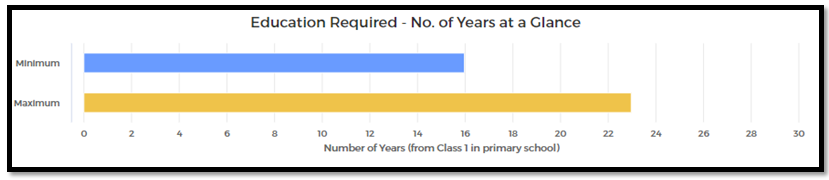
MINIMUM EDUCATION REQUIRED | MAXIMUM EDUCATION REQUIRED |
Under Graduate | Doctoral |
COMPETENCIES REQUIRED
You should have the following occupational interests:
1. Investigative - You should have interests for Investigative Occupations. Investigative occupations involve working with ideas and quite a lot of thinking, often abstract or conceptual thinking. These involve learning about facts and figures; involve the use of data analysis, assessment of situations, decision making and problem-solving.
2. Realistic - You should have interests for Realistic Occupations. Realistic occupations involve more practical and hands-on activities than paperwork or office work. Realistic occupations often involve physical activities for getting things done using various tools and equipment.
3. Enterprising - You should have interests for Enterprising Occupations. Enterprising occupations involve taking initiatives, initiating actions, and planning to achieve goals, often business goals. These involve gathering resources and leading people to get things done. These require decision making, risk-taking, and action orientation.
Following personality attributes are required:
1. You are always or mostly organised in your day-to-day life and activities.
2. You are always or mostly careful about your actions and behaviour.
3. You are always or mostly disciplined in your action and behaviour.
4. You are always practical or in most situations.
You should have the following skills and knowledge:
1. Critical Thinking - Skills in the analysis of complex situations, using logic and reasoning to understand the situations and take appropriate actions or make interpretations and inferences.
2. Problem Solving - Skills in analysis and understanding of problems, evaluating various options to solve the problems and using the best option to solve the problems.
3. Engineering & Technology - Knowledge of various applications of one or more branches of Engineering Science & Technology to manufacture and produce various goods or construct or erect various structures. This includes knowledge of design, development, prototype testing, manufacturing, construction, installation, repair, and maintenance.
4. Mathematics - Knowledge of arithmetic, algebra, geometry, calculus, trigonometry, statistics, and other mathematical disciplines and their applications.
5. Physical Science - Knowledge of physical principles, laws, their interrelationships, and applications to understand fluid, material, earth, ocean, atmosphere, and space dynamics, as well as mechanical, electrical, atomic and subatomic structures, properties and processes.
6. Chemical Science - Knowledge of relevant equipment, policies, procedures, and strategies to maintain law and order situations, providing state or national security for protecting geographical territories, marine territories and sky from potential enemy attacks and protecting people and properties.
7. Production and Processing - Knowledge of raw materials, production machinery, production systems, production processes, quality control, and other techniques for manufacturing or construction and distribution of goods.
You should have the following aptitudes and abilities:
1. Mechanical Reasoning - The ability to apply basic physical principles and theories to understand how mechanical objects such as tools and machinery works and the ability to understand the rules or laws governing the work of machinery, tools, and bodies in motion.
2. Written Comprehension - The ability to read and understand information and ideas presented in writing.
3. Inductive Reasoning - The ability to combine pieces of information from various sources, concepts, and theories to form general rules or conclusions. For example, analysing various events or situations to come out with a set of rules or conclusions.
4. Mathematical Reasoning - The ability to choose the right mathematical methods or formulas to solve a problem.
5. Numerical Reasoning - The ability to add, subtract, multiply, divide, and perform other basic numerical calculations correctly.
Career - Job Opportunities & Profiles
At the entry level, you will be hired at the following profiles:
1. If you are into the research and development side, you can join as a Research Engineer in the Textile industry.
2. You can join as a Process Engineer if you are into the processing side of the industry.
3. You will join as an Operations Trainee if you want to enter the production side of the business.
4. You can join as an Assistant Sales Manager if you want to sell textile rather than produce it.
5. If you are keener towards the quality control side of the business process, then you can join as a Quality Control Trainee / Quality Assurance Trainee.
6. In academics and research, after your doctorate degree in Textile Technology, you can join as an Assistant Professor. Some colleges may take you as an Instructor after your post-graduation also. But to have a good career in academics and research, you must have a Ph.D.
You will be working for the following institutions:
1. Textile Mills like Raymond, Arvind Mills, Fabindia, Bombay Dyeing, Grasim, etc.
2. Khadi board of each India State.
3. Khadi Udyog (cooperative industry)
4. Colleges and Universities are teaching Textile Technology including IITs.
Work Environment
Textile Engineer work in a highly demanding environment with intense pressure due to high production and quality demand. Most of you will be working with new client’s orders; fulfillment will mean high work capacity under high pressure.
SPECIALISATION TRACKS IN THIS CAREER
1. Textile Production (Manufacturing) Engineer
Textile Production Engineers specialise in the process of production of textile. As a production engineer, you will manage the inputs, production process, quality control and output of textile. You will ensure that the production of textile happens as per the desired plan, within the desired cost and within the desired quality.
2. Research & Development Engineer (Textile)
Research & Development Engineers (Textile) specialise in the research of different kinds of textile dyes, textile material, and textile designs. As an R & D Engineer, you will conduct research on various aspects of textile raw material, design, colours, etc. and come up with new products with improved quality.
3. Textile Chemical Processing Expert
Textile Chemical Processing Experts specialize in the processing of all kinds of fabrics that are used in the textile industry. As an expert, you will work on the pre-treatment of fabrics, where you will ensure that the fabric is removed from all kinds of manmade and natural dirt so that it is ready for being used as a raw material.
CAREER GROWTH
1. The career growth in university and college states from Assistant Professor and then Associate Professor, Professor and Professor Emeritus. Professors can also get administrative positions such as Director/Dean/Vice Chancellor, etc.
2. If you are hired as a research associate, then you will go on to become a Doctoral Research Fellow, then Post-Doctoral Research Fellow and then Scientist in Progressive Grades.
3. If you join at the role of Researcher in the Textile industry, then you will become Research Analyst and then R & D Associate and then R&D Manager.
4. If You join as an Operations Trainee, then you will become Operations Manager / Production Manager, and then Head Production Manager and some of you will become VP of Production.
5. If you join as an Assistant Sales Manager, then you will be promoted to Sales Manager, Area Sales Manager and then Regional Sales Manager.
6. If you join as a Quality Control Trainee / Quality Assurance Trainee, then later you will be promoted to Quality Controller Inspector and then Quality & Control Head.
7. In academics and research, after your doctorate degree in Textile Technology, you can join as an Assistant Professor. Some colleges may take you as an Instructor after your post-graduation also. But to have a good career in academics and research, you must have a Ph.D.
Salary Offered
1. At the entry level, you can join as a research associate with a basic salary of Rs. 25,000 to 30,000 per month. As an assistant professor, you would be earning anything between Rs. 65,000 to 70,000 per month. If you are working in the mills, then you will join as a process engineer and will earn anything between Rs. 15,000 to 1,00,000 per month. As an operations trainee and quality control trainee, you may be earning anything between Rs. 15,000 to 25,000 per month.
2. At the junior level with a work experience of 2-6 years, you would be earning anything between Rs. 50,000 to 1,50,000 per month.
3. At the middle level with an experience of 10-12 years, you would be earning anything between Rs. 70,000 to 1,90,000 per month as in textile mills and Rs. 1,20,000 to 1,60,000 as a professor.
4. At the senior level of over 15 years of work experience, you would be earning anything between Rs. 1,60,000 to 2,00,000 per month as a professor and Rs. 1,20,000 to 4,00,000 in textile mills.
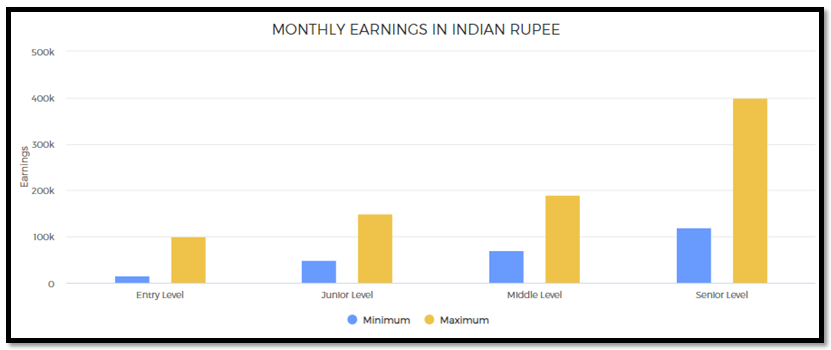
MONTHLY EARNINGS IN INDIAN RUPEE

1. Entry level: 0 - 2 years of work experience
2. Junior Level: From 1 to 12 years of work experience
3. Mid Level: From 5 to 20+ years of work experience
4. Senior Level: From 10 to 25+ years of work experience (there could be exceptions in some high-end technical, financial, engineering, creative, management, sports, and other careers; also in the near future, people will reach these levels much faster in many careers and in some careers, these levels will have no meaning as those careers will be completely tech skill driven such as even now, there is almost no level in a Cyber Security Expert’s job)
Work Activities
As a Textile Engineer, you might be involved in various applied areas of Engineering, Textile Production, etc. In these areas, you might be involved in different activities such as:
1. Getting information & learning - Observing, hearing, reading, using computers, or otherwise obtaining information and learning from it.
2. Analysis and interpretation of data and information - Analysis of data and information to find facts, trends, reasons behind situations, etc.; interpretation of data to aid in decision making.
3. Updating and using relevant knowledge - Keeping updated with the latest knowledge relevant to your fields of work and use of the relevant knowledge in getting things done.
4. Decision making and problem-solving - Getting information & learning: Observing, hearing, reading, using computers, or otherwise obtaining information and learning from it.
5. Monitoring processes, systems, and performance - Observing and recording information on various criteria to monitor mechanical, electronics, electrical and other processes and systems; monitoring the progress of projects and tasks.
Future Prospects
Textile sector is the oldest and largest manufacturing sector in India. Currently, the industry is on a growth curve in India.Textile exports from India grew from USD 11 billion to 31 billion. While world Textile industry is growing at a rate of 5.5 %, India will grow at 9.5% to reach approximately USD 221 billion. A further report from Technopack says that the declining textile industry in a Developed nation will additionally provide a market opportunity of USD 500 billion. Thus, the industry is not only seeing a major growth period; it will continue to do so in the future too. This is a good sign for people looking for opportunities in the textile sector.
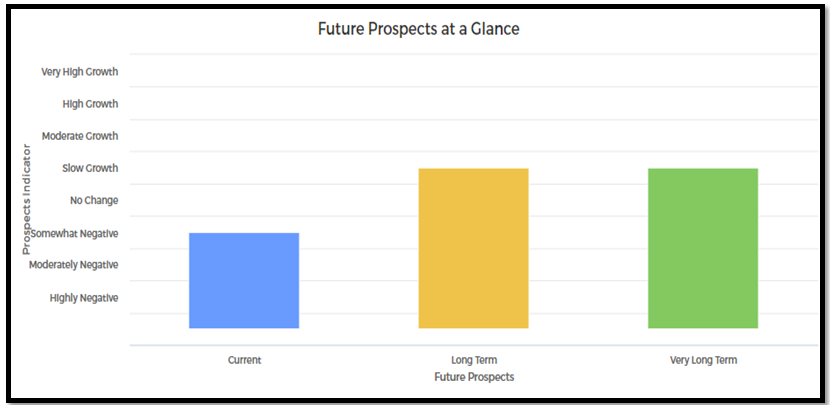
FUTURE PROSPECTS AT A GLANCE



