
Income Tax Officer
Entry Level Qualification
Class Graduate
Career Fields
Government & Defense Services
For Specially Abled


Career Entrance Exam
About Career
PARTICULARS | DESCRIPTION |
Name | Income Tax Officer |
Purpose | Tax Collection |
Career Field | Government & Defense Services |
Required Entrance Exam | UPSC IRS |
Average Salary | 8,00,000 - 14,00,000 Rs. Per Year |
Companies For You | Income Tax Department (India), Internal Revenue Service (IRS) & Many More |
Who is Eligible | Graduate |
Income Tax Officers may work in two primary roles:
1. Income Tax Officer: Income tax officer is responsible for the direct tax collection for the Government of India. A direct tax is the income tax that individual, companies, partnerships, etc. have to pay to the government. They also take care of any gifts tax, super profit tax (like prize money from Kaun Banega Crorepati), wealth tax, capital gain tax (profits from sharing of shares or other investments), etc.
2. Customs and Excise officer as well as Goods & Service Tax officers take care of other indirect tax earning of the Government including GST, excise tax on alcohol and tobacco, customs duty, tax on diesel and petrol, etc.
3. Income Tax Officers are responsible for ensuring that every individual, company and other tax paying entities follow and comply with the income tax laws, rules and regulations. They ensure that each tax paying individual or entity declares the actual earning, assets and liabilities and pay the right amount of due taxes. They have the power to enforce tax laws and investigate violation of laws.
Key roles and responsibilities:
As an Income Tax Officer, you might be handling these following roles and responsibilities:
1. You will maintain knowledge of all tax laws, changes in tax laws, of any accounting procedures and process to duly evaluate financial information.
2. You will maintain records for each tax filling entity or individual, including contacts, telephone numbers, and actions are taken.
3. If required you will contact taxpayers by mail or telephone to address discrepancies and to request supporting documentation.
4. You will send notices to taxpayers when accounts are not paid.
5. You will review filed tax returns to determine whether credits and deductions claimed are allowed by law.
6. You will conduct field audits and investigations of income tax returns to verify information or to update tax liabilities.
7. You will notify taxpayers of any overpayment or underpayment and either issue a refund or request additional payment.
8. Policy formulation: As an Income Tax Officer, you would be an integral part of the team who will be responsible for forming taxation policies. You will need to keep evaluating the existing policies and change them as per the need of the economy and the nation. These policies are not restricted to revenue. You will also assist the government of India through tax policies to address several other subjects leading to the development of the nation. These segments may include providing incentives or taking back incentives to different targets of the economy. For policy formation, you will also have to do intensive field research and take inputs from different sources and compiling them together.
9. Tax administrator, investigator, quasi-judicial authority and prosecutor: As a tax officer, you will be directly involved in this. Although most of the detect tax collection in India is still a voluntarily process as people pay taxes in India as per the mandate of law. However, not everyone complies with this rule. Many people do not comply as they suppress information, facts, tax theft and sometimes simple mistakes. You would be required to detect such mistakes from the taxpayer and promote them to pay taxes voluntarily. You can also do an investigation through a scrutiny process of returns, statements, surveys, bank statements, etc. You can also seize their property, bank accounts to complete the investigation. If a defaulter is found with a serious case, you are required to file a criminal case against such defaulters.
Career Entry Pathway
Class 10 all subjects as per scheme of studies – Class 11-12 with any subject as per scheme of studies – UG in any subject – Appear in the Indian Civil Services Examination – IRS Grade “A” Officer
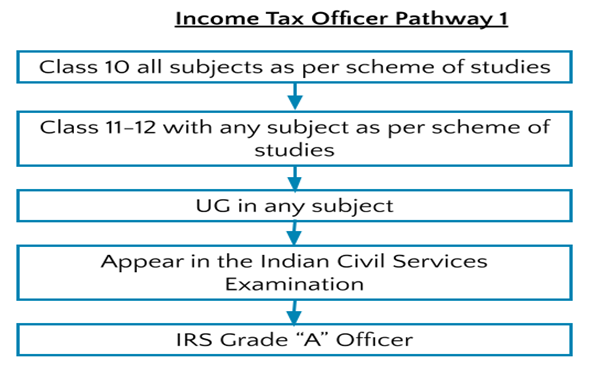
After your secondary level of schooling in any subjects, Class 11-12 with any subject as per scheme of studies and then study for an undergraduate degree in any stream. Appear in the Indian Civil Services Examination conducted by the UPSC (Union Public Service Commission). You can then join the Indian Income Tax Department as a Grade “A” officer.
Class 10 all subjects as per scheme of studies –Class 11-12 with any subject as per scheme of studies – UG in any subject – Appear in the CGL Examination for Central Services Group B & Group C – IRS Group B Officer
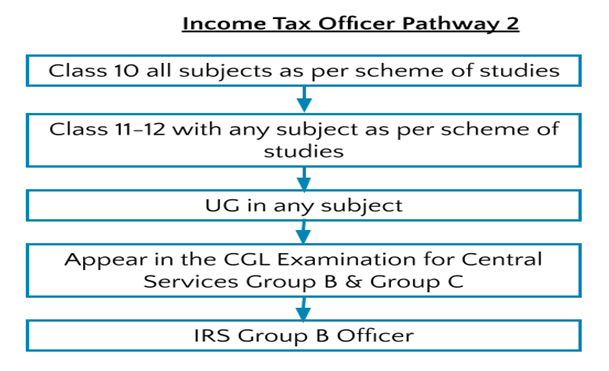
After your secondary level of schooling in any subjects, Class 11-12 with any subject as per scheme of studies and then study for an undergraduate degree in any subject. Appear in the Combined Graduate Level (CGL) Central Services Group B & C examination conducted by the SSC (Staff Selection Commission. Once you clear the exam, you can then join the Indian Income Tax Department as a Grade “B” officer through the graduate exam.
Class 10 all subjects as per scheme of studies – Class 11-12 with any subject as per scheme of studies – Appear in the CHSL Examination conducted by SSC – Upper Division Clerk or other positions with the Income Tax Department – Promotion to Group B Officer ranks
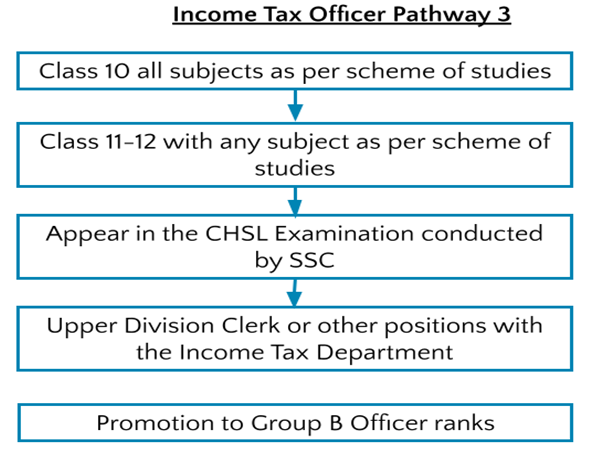
After your secondary level of schooling in any subjects, Class 11-12 with any subject as per scheme of studies. Then you can appear for the Combined Higher Secondary Level Exam (CHSL) conducted by Staff Selection Commission. You and then join the Indian Income Tax Department as an Upper Division Clerk or other positions. Later you can be promoted to Group B officer ranks.
Required Qualification & Competencies
Undergraduate studies after school:
There is no specific requirement to become an Income Tax Officer in India other than having a Bachelor's degree. Thus you can graduate with any subject to be eligible for Income Tax Department:
Post Graduate studies:
You are not required to study beyond graduation to become an officer with the Income Tax department of India. However, you can take post-graduation in any stream and join IRS before you cross 30 years of age and Graduate level post before crossing 27 years of age.
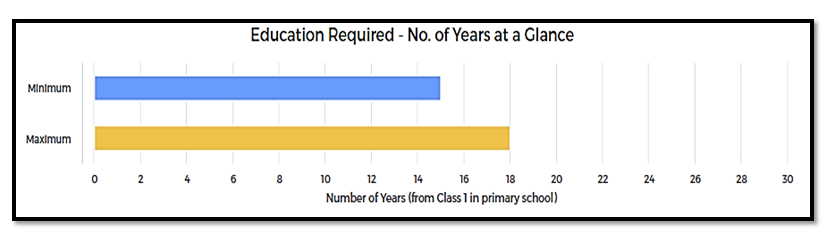
MINIMUM EDUCATION REQUIRED | MAXIMUM EDUCATION REQUIRED | |
Under Graduate Undergraduate Degree / Honours Diploma / Graduate Diploma (equivalent to a Degree) Programs for which the minimum eligibility is a pass in Higher Secondary / Class XII School Leaving examination. | Post Graduate Postgraduate Degree / Diploma / Certificate Programs for which the minimum eligibility is a pass in Graduation / equivalent Diploma program like Honours Diploma or Graduate Diploma. | |
| ||
Competencies Required
You should have the following occupational interests:
1. Conventional - You should have interests for Conventional Occupations. Conventional occupations involve repetitive and routine tasks as well as fixed processes or procedures for getting things done. These occupations involve working more with data, systems, and procedures and less with ideas or creativity.
2. Enterprising - You should have interests for Enterprising Occupations. Enterprising occupations involve taking initiatives, initiating actions, and planning to achieve goals, often business goals. These involve gathering resources and leading people to get things done. These require decision making, risk-taking and action orientation.
Following personality attributes are required:
1. You are always or mostly organised in your day-to-day life and activities.
2. You are always or mostly disciplined in your action and behaviour.
3. You don't trust others easily.
4. You are always or most helpful to others.
5. You are always calm or generally remain calm in most situations.
6. You always or mostly prefer to stick within a routine or carry out routine and repetitive activities.
7. You are always or mostly dependent on others or set rules and procedures.
You should have the following skills and knowledge:
1. Active Listening - Giving full attention to what other people are saying, understanding the points being made by others, asking questions, etc.
2. Critical Thinking - Skills in the analysis of complex situations, using logic and reasoning to understand the situations and take appropriate actions or make interpretations and inferences.
3. Writing - Skills in communicating effectively in writing as appropriate for the needs of the readers.
4. Reading Comprehension - Skills in understanding written sentences and paragraphs in work related documents.
5. Communication in Vernacular Languages - Skills in communicating effectively in writing as well as verbally with others in a local or indigenous language such as Hindi, Tamil, Telugu, Gujarati, Bengali, Assamese, etc.
6. Law & Government - Knowledge of laws, legal codes, legal procedures, regulations, Government orders, etc.
7. English Language - Knowledge about English grammar, words, spelling, sentence construction, using English to communicate with others, reading in English, etc.
8. Economics - Knowledge of economic principles and practices; understanding how various resources such as land, labourand capital are used; how market demands rise and fall; how a country collects and spends money; and similar other economic issues and situations.
9. Accounting - Knowledge of various principles and methods for maintaining records of commercial and financial transactions and records, preparing various reports and statements, ensuring compliance with commercial and business laws and rules of a country, etc.
You should have the following aptitudes and abilities:
1. Oral Comprehension - The ability to listen to and understand information and ideas presented through spoken words and sentences.
2. Oral Expression - The ability to communicate information and ideas in speaking so others will understand.
3. Inductive Reasoning - The ability to combine pieces of information from various sources, concepts, and theories to form general rules or conclusions. For example, analysing various events or situations to come out with a set of rules or conclusions.
4. Deductive Reasoning - The ability to apply general rules and common logic to specific problems to produce answers that are logical and make sense. For example, understanding the reasons behind an event or a situation using general rules and common logic.
5. Problem Sensitivity - The ability to tell when something is wrong or is likely to go wrong. It does not involve solving the problem, onlyrecognising there is a problem.
Career - Job Opportunities & Profiles
Income Tax Officer job is a government of India job at Income Tax Department. There is a strict hierarchy in the job, and there are three ways to enter into the service:
1. You may join as a Grade A officer with the post of Assistant Commissioner of Income Tax.
2. You may also join as a Grade B Officer with the post of Tax Assistant.
3. You may also join as an Upper Division Clerk.
Work Environment
Tax examiners and collectors, and revenue agents work primarily in an office environment; others spend most of their time conducting field audits in taxpayers’ homes or places of business. The work can get hectic during the end of the financial year when a tax assessment is one major task. Although most of the job is 8 hours, the raids can be longer. During raids, you might be required to stay at the defaulters’ place for hours or days without rest. You could also have to deal with the aggressive nature of defaulters, although police protection is given during raids.
Career Growth
1. If you will join Income Tax Office as an IRS Officer, then you would start as a Grade an Officer “Assistant Commissioner of Income Tax”. After two years of service, you will be promoted to Deputy Commissioner of Income Tax. Within a few years, you will be promoted to Additional/Joint Commissioner of Income Tax. Few of you will rise to Commissioner of Income Tax and then Principal Commissioner of Income Tax. Some of you might become Chief Commissioner of Income Tax and finally the highest post of Principal Chief Commissioner of Income Tax.
2. If you join as a Graduate level, then you will join as a Tax Assistant, and later you will be promoted to Senior Tax Assistant. Later you will be promoted to Inspector of Income Tax and the Income Tax officer. Some of you will rise above even to become Assistant Commissioner of Income Tax.
Salary Offered
1. At the entry level, if you will join as a Grade A “Assistant Commissioner of Income Tax.” Your gross salary Rs. 56,100 to 1,77,500 per month with a grade pay of Rs. 5,400 per month.
2. As a Deputy Commissioner of Income Tax, your gross salary will range from Rs. 67,700 to 2,08,000 per month and grade pay of Rs. 6,600.
3. As an Additional/Joint Commissioner of Income Tax, your gross salary will range from Rs. 1,23,100 to 2,15,900 per month and grade pay of Rs. 8,700.
4. As a Commissioner of Income Tax, your gross salary will range from Rs. 1,44,200 to 2,18,200 per month and grade pay of Rs. 10,000.
5. As a Principal Commissioner of Income Tax, your gross salary will range from Rs. 1,82,200 INR to 2,24,100.
6. As a Chief Commissioner of Income Tax, your gross salary will range from Rs. 2,05,400 to 2,24,400.
7. As a Principal Chief Commissioner of Income Tax, your salary will be fixed at Rs. 2,25,000 per month.
8. If you will join as a Grade B Tax Assistant, your monthly gross salary will be Rs. 25,500 to 81,100 with the grade pay of Rs. 2,400.
9. As Senior Tax Assistant, you will earn Rs. 35,400 to 1,12,400 per month with a grade
pay of Rs. 4,200.
10. As Inspector of Income Tax, you will earn Rs. 44,900 to 1,44,400 per month with a grade pay of 4,600.
11. As Income Tax officer, you will earn Rs. 47,600 to 1,51,100 per month with a grade pay of 5,400.
12. Apart from the salary, you would also get several other benefits from the Government of India.
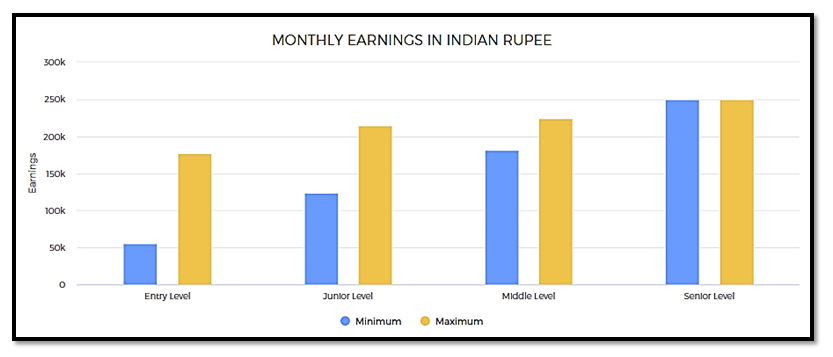
Monthly Earning In Indian Rupee
Entry Level | Junior Level | Mid Level | Senior Level | |||||
Min Earning | Max Earning | Min Earning | Max Earning | Min Earning | Max Earning | Min Earning | Max Earning | |
56000 | 177500 | 123900 | 215000 | 182000 | 224000 | 250000 | 250000 | |
1. Entry level: 0 - 2 years of work experience
2. Junior Level: From 1 to 12 years of work experience
3. Mid Level: From 5 to 20+ years of work experience
4. Senior Level: From 10 to 25+ years of work experience
Work Activities
As an Income Tax Officer, you would be required to do the following work activities regularly:
1. Getting Information - Observing, hearing, reading, using computers, or otherwise obtaining information and learning from it.
2. Communicating with others - Communicating with people outside the organisation in writing, verbally or otherwise.
3. Information Processing - Searching, compiling, tabulating, calculating, auditing, verifying or otherwise dealing with information processing including data entry, transcription, recording, storing and maintaining databases.
4.Assessing and determining compliance with standards, laws, rules and guidelines - Using relevant information, auditing information, processes and systems to determine whether organisations or people are complying with standards, laws, rules and guidelines.
Future Prospects
Income Tax Officer is a government job. There is a limited number of openings in the field. Also, the Government focuses on hiring people based on skills, but they do not compromise the selection. Thus, many times the number of seats remain empty. The number of jobs is not likely to be increased in the near future. Thus, if you are dedicated to this career, then only you should apply.
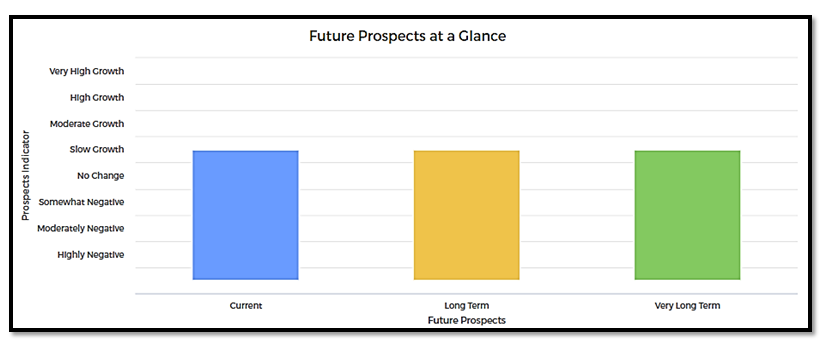
Future Prospects At A Glance
Current (0-1 year) | Long Term (2-5 year) | Very Long Term (6-10 years) |
Slow Growth | Slow Growth | Slow Growth |


