
Geological Engineer
Entry Level Qualification
Class Graduate
Career Fields
Engineering & Technology
For Specially Abled


Career Entrance Exam
JEE MAIN BE/BTECH, JEE ADVANCED, GATE, VITEEE BE/BTECH, VITEEE ME/MTECH, SRMJEEE ME/MTECH, TANCET MTECH/MARCH
About Career
Geology is the study of the earth crust. Thus as a Geological Engineer, you will add the knowledge of engineering to explore earth’s crust (the top layer). You will explore the earth crust to mine important minerals like coal, granite, stones, etc. You will also explore metals like iron gold, copper, etc. from the earth crust.
If you specialise in petroleum engineering, then you will explore oil and petroleum fields. You will study the ore, field or mine for feasibility test and then find the best suitable way to start mining or exploration. You will ensure the safety of your team and also work to reduce the damage to the environment. As a Geological Engineer, you will work to optimise the use of ores, fields, and mines.
Key roles and responsibilities
As a Geological Engineer, you will have different roles and responsibilities based on your specialization. Some of these roles and responsibilities are as discussed below:
1. You will prepare all technical reports that can be used for engineering, mining, and management purpose.
2. You will inspect the mining and extraction area and determine if it is safe for exploration. You will also inspect equipment and working conditions before approving exploration and mining.
3. You will develop the exploration and mining location; develop methods of extraction and production based on a number of factors like safety, cost, etc.
4. You will ensure that exploration and mining happen in a safe environment with proper methods.
5. You will study the mine production/ petroleum exploration to determine if the operation is effective and viable.
6. You will supervise the conditions of mine shafts, oil wells, etc.
7. You will be responsible for determining methods to transfer the minerals, rocks, fossils, petroleum products that have been mined.
8. You will search for mineral deposits and evaluate the possible sites. Once you have identified the sites, you will plan how metals, minerals, fossils etc. can be extracted from the place.
9. You will provide solutions to potential air, water, and soil pollution. You will work on the sustainability of the plan and also work on land reclamation.
10. Select locations and plan underground or surface mining operations, specifying processes labour usage, and equipment that will result in safe, economical, and environmentally sound extraction of minerals and ores.,
11. Prepare schedules, reports, and estimates of the costs involved in developing and operating mines.
12. If you work as a Petroleum Engineer, then you will also be required to asses oil wells and gas fields. You will monitor oil drilling operations.
Career Entry Pathway
Class 10 all subjects as per scheme of studies – Class 11-12 Physics, Chemistry, and Mathematics along with any other subject as per scheme of studies – UG in Civil Engineering / Geological Engineering / Petroleum Engineering / similar field – PG in Geological Engineering
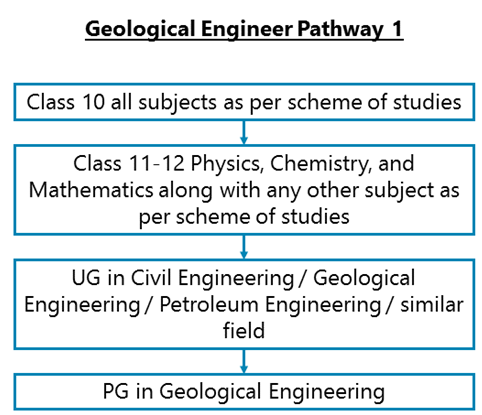
After your Class 11-12 Physics, Chemistry, and Mathematics along with any other subject as per scheme of studies in your higher secondary school and then study for an undergraduate degree in Civil Engineering / Geological Engineering / Petroleum Engineering / similar field followed by a master’s degree in Geological Engineering.
Class 10 all subjects as per scheme of studies – Class 11-12 Physics, Chemistry, and Mathematics along with any other subject as per scheme of studies – UG in Civil Engineering / Geological Engineering / Petroleum Engineering / similar field – PG in Geological Engineering – Ph.D. in Geological Engineering
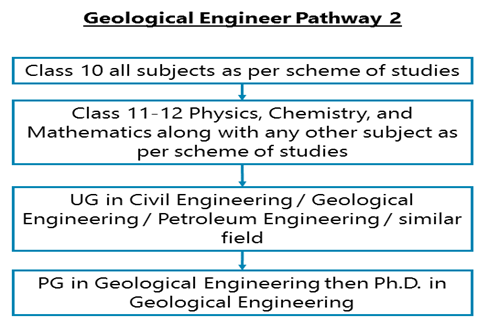
After your Class 11-12 Physics, Chemistry, and Mathematics along with any other subject as per scheme of studies in your higher secondary school and then study for an undergraduate degree in Civil Engineering / Geological Engineering / Petroleum Engineering / similar field, followed by a master’s degree in Geological Engineering. Further, you can take Geological Engineering in Ph.D. and complete the doctoral degree.
Class 10 all subjects as per scheme of studies – Class 11-12 Physics, Chemistry, and Mathematics along with any other subject as per scheme of studies – UG in Geological Engineering
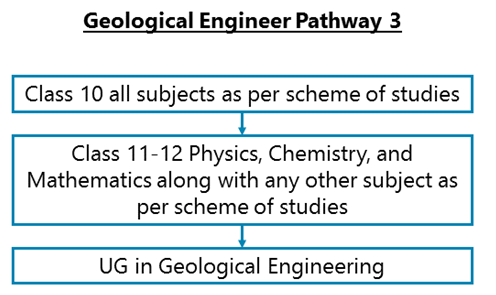
After your Class 11-12 Physics, Chemistry, and Mathematics along with any other subject as per scheme of studies in your higher secondary school and then study for an undergraduate degree in Geological Engineering.
Class 10 all subjects as per scheme of studies – Class 11-12 Physics, Chemistry, and Mathematics along with any other subject as per scheme of studies – UG in Civil Engineering / Geological Engineering / Petroleum Engineering / similar field – Integrated Ph.D. in Geological Engineering
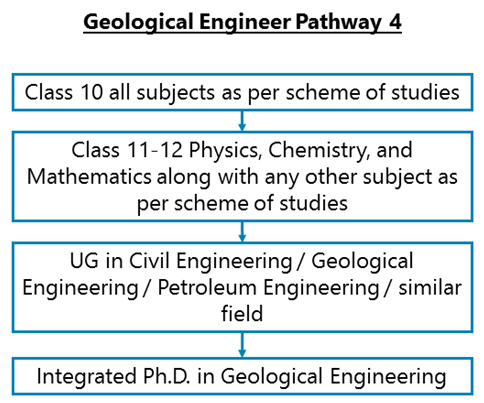
After your Class 11-12 Physics, Chemistry, and Mathematics along with any other subject as per scheme of studies in your higher secondary school and then study for an undergraduate degree in Civil Engineering / Geological Engineering / Petroleum Engineering / similar field. Following the B.E./B.Tech. Degree, you can study for Integrated Ph.D. in Geological Engineering.
Class 10 all subjects as per scheme of studies – Class 11-12 Physics, Chemistry, and Mathematics along with any other subject as per scheme of studies – UG (B.Sc.) in Earth Science / Applied Geology / Geology / Geophysics / similar field – PG (M.Sc.) in Earth Science / Applied Geology / Geology / Geophysics / similar field – M.Tech. in Geological Engineering
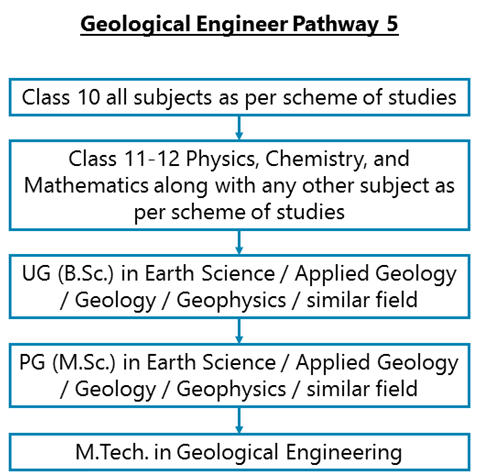
After your Class 11-12 Physics, Chemistry, and Mathematics along with any other subject as per scheme of studies in your higher secondary school and then study for an undergraduate degree in Earth Science / Applied Geology / Geology / Geophysics / similar field. Following the Under Graduate Science degree, you can complete M.SC. in Earth Science / Applied Geology / Geology / Geophysics / similar field and then M.Tech. in Geological Engineering.
Class 10 all subjects as per scheme of studies – Class 11-12 Physics, Chemistry, and Mathematics along with any other subject as per scheme of studies – UG (B.Sc.) in Earth Science / Applied Geology / Geology / Geophysics / similar field – PG (M.Sc.) in Earth Science / Applied Geology / Geology / Geophysics / similar field – M.Tech. in Geological Engineering – Ph.D. in Geological Engineering
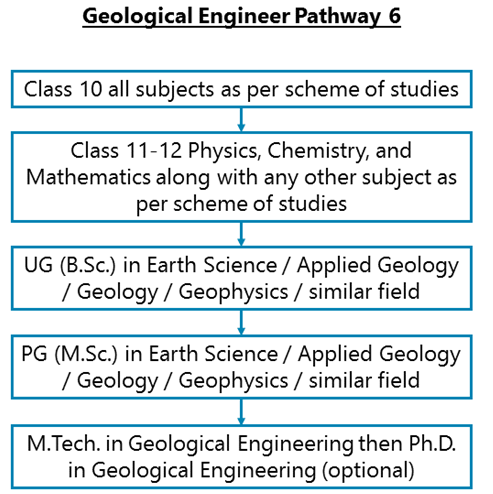
After your Class 11-12 Physics, Chemistry, and Mathematics along with any other subject as per scheme of studies in your higher secondary school and then study for an undergraduate degree in Earth Science / Applied Geology / Geology / Geophysics / similar field. Following the Under Graduate Science degree, you can complete M.SC. in Earth Science / Applied Geology / Geology / Geophysics / similar field and then M.Tech. in Geological Engineering. Further, you can take up a Ph.D. in Geological Engineering.
Class 10 all subjects as per scheme of studies – Class 11-12 Physics, Chemistry, and Mathematics along with any other subject as per scheme of studies – UG (B.Sc.) in Earth Science / Applied Geology / Geology / Geophysics / similar field – PG (M.Sc.) in Earth Science / Applied Geology / Geology / Geophysics / similar field – Integrated Ph.D. in Geological Engineering
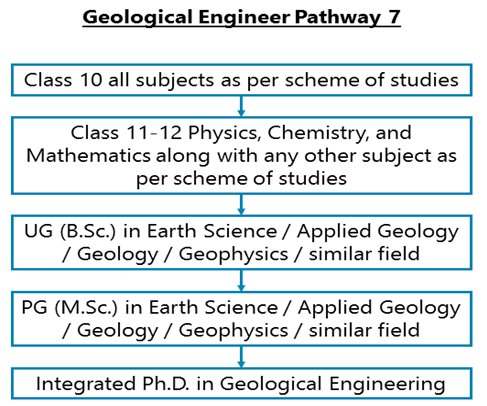
After your Class 11-12 Physics, Chemistry, and Mathematics along with any other subject as per scheme of studies in your higher secondary school and then study for an undergraduate degree in Earth Science / Applied Geology / Geology / Geophysics / similar field. Following the Under Graduate Science degree, you can complete M.SC. in Earth Science / Applied Geology / Geology / Geophysics / similar field and then an integrated Ph.D. in Geological Engineering.
Required Qualification & Competencies
Undergraduate studies after school:
1. To become a Geological engineer, you should complete your schooling and join for an undergraduate course of B.E. or B.Tech. in Geological Engineering/ Civil Engineer/ Petroleum Engineer or similar field.
2. You can also complete a B.Sc. degree in Earth Sciences, Geophysics, Applied Geology, and similar subjects.
Post Graduate Studies:
1. After finishing B.E. or B.Tech, you can take an M.E. or M.Tech. course in India or Foreign University. There are many specializations in M.E. and M.Tech. Including Geological Engineering, Geophysical Engineering, Exploration Engineering, Petroleum Geoscience Engineering, Geochemical Engineer, Marine Geologist, Mineral Exploration Engineer, etc.
2. You can go for further studies by choosing to complete a Ph.D. in Geological Engineering after M.E. or M.Tech.
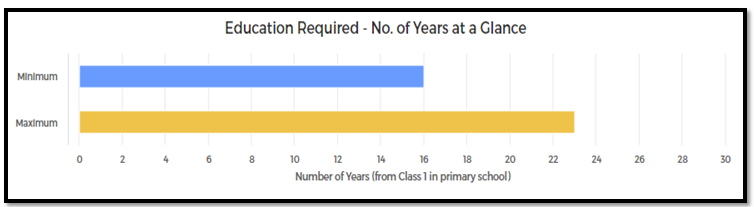
MINIMUM EDUCATION REQUIRED | MAXIMUM EDUCATION REQUIRED |
Under Graduate | Doctoral |
COMPETENCIES REQUIRED
You should have the following occupational interests:
1. Investigative - You should have interests for Investigative Occupations. Investigative occupations involve working with ideas and quite a lot of thinking, often abstract or conceptual thinking. These involve learning about facts and figures; involve the use of data analysis, assessment of situations, decision making and problem-solving.
2. Realistic - You should have interests for Realistic Occupations. Realistic occupations involve more practical and hands-on activities than paperwork or office work. Realistic occupations often involve physical activities for getting things done using various tools and equipment.
3. Enterprising - You should have interests for Enterprising Occupations. Enterprising occupations involve taking initiatives, initiating actions, and planning to achieve goals, often business goals. These involve gathering resources and leading people to get things done. These require decision making, risk-taking, and action orientation.
Following personality attributes are required:
1. You are always or mostly care about your actions and behaviour.
2. You are always or mostly disciplined in your action and behaviour.
3. You don't trust others easily.
4. You are always practical or in most situations.
5. You can always act independently or could do so in most situations.
6. You always prefer to experience new things and have new experiences, or you mostly do.
You should have the following skills and knowledge:
1. Critical Thinking - Skills in the analysis of complex situations, using logic and reasoning to understand the situations and take appropriate actions or make interpretations and inferences.
2. Reading Comprehension - Skills in understanding written sentences and paragraphs in work related documents.
3. Problem Solving - Skills in analysis and understanding of problems, evaluating various options to solve the problems and using the best option to solve the problems.
4. Judgement & decision making - Skills in considering the pros and cons of various decision alternatives; considering costs and benefits; taking appropriate and suitable decisions.
5. Engineering & technology - Knowledge of various applications of one or more branches of Engineering Science & Technology to manufacture and produce various goods or construct or erect various structures. This includes knowledge about design, development, prototype testing, manufacturing, construction, installation, repair, and maintenance.
6. Mathematics - knowledge of arithmetic, algebra, geometry, calculus, trigonometry, statistics, and other mathematical disciplines and their applications.
7. Production & Processing - Knowledge of raw materials, production machinery, production systems, production processes, quality control, and other techniques for manufacturing or construction and distribution of goods.
You should have the following aptitudes and abilities:
1. Deductive reasoning – The ability to apply general rules and common logic to specific problems to produce answers that are logical and make sense. For example, understanding the reasons behind an event or a situation using general rules and common logic.
2. Inductive Reasoning - The ability to combine pieces of information from various sources, concepts, and theories to form general rules or conclusions. For example, analysing various events or situations to come out with a set of rules or conclusions.
3. Oral Comprehension – The ability to listen to and understand information and ideas presented through spoken words and sentences.
4. Category Flexibility - The ability to generate or use different sets of rules for combining or grouping things in different ways.
Career - Job Opportunities & Profiles
1. As a Geological Engineer, if you are working at the exploration of oil, gas, petroleum then you may start the career as an assistant engineer or assistant officer.
2. As a mining engineer, you can join mining organisations as a graduate mining engineer or trainee mining engineer.
3. If you are into teaching, then you may join college or university at the profile of an assistant professor.
4. If you are into research, then you can join a research institute at the role of research associate.
5. If you are into scientific research, then you can join as a Scientist with Grade “C”.
You will find job opportunities at the following facilities:
1. Government Oil & Gas Exploration companies like Indian Oil, Bharat Petroleum, Hindustan Oil Exploration Company, ONGC, Gujarat State Petroleum Corporation, etc.


2. Private Oil & Gas Exploration companies like British Gas India, Shell India, Reliance, ESSAR, Cairn Energy, etc.
3. Government Mining companies like Coal India, Steel India, Hindustan Zinc, Manganese Ore India, etc.


4. Private mining companies like Vedanta, Hindalco, Adhunik group of Industries, etc.



5. Geological Survey of India
6. Research Institutes like National Geophysical Research Institute, Institute of Himalayan Geology, etc.
7. Institutes and IITs teaching Geological Engineering
Work Environment
Most of the Geological Engineers work in the field like oil fields, oil wells, mines, and ores. The working environment is challenging as you might have to work against the natural climate of the region. Most of the petroleum fields are in barren deserts with hot climate or ocean bed with a humid climate. Mines and ores also have a challenging working environment. If you are working in remote mine or ore, you may sometime expect variable work schedule. In city offices, you will have a normal work schedule but working in an office is not so common for Geological Engineers.
SPECIALISATION TRACKS IN THIS CAREER
1. Geophysical Engineer
Geophysical Engineer specialises in extracting ores, minerals, gems, etc. from the earth crust. They use the physical properties of the minerals to identify them and find extraction methods to extract them.
2. Mining Engineer
Mining Engineers specialises in the mining of minerals from the earth surface. They oversee the operations, feasibility test, regulation of health laws, etc.
3. Engineer (Petroleum Geoscience)
Petroleum Geoscience Engineers specialises in the extraction and exploration of petroleum products from petrol and oil fields.
4. Geochemical Engineer
Geochemical Engineers specialise in searching economic mineral and petroleum deposits). Economic means that the extraction of these minerals is economical and not expensive. They use the concentration of the chemical composition of these minerals to find them underground.
CAREER GROWTH
1. If you have joined an oil and gas exploration company as an assistant engineer, then you will move to Assistant executive Engineer and then will be promoted to Senior Officer/Engineer. Then you will be promoted to Deputy Superintendent Engineer and then Superintendent Engineer and then Chief Engineer. You may also be promoted to admin side as Deputy General Manager.
2. If you have joined the onshore department of exploration company as an assistant officer, then you will be promoted to Officer, Senior Officer, Deputy Manager, Manager, and Chief Manager. You may also be promoted to admin side as Deputy General Manager.
3. The career growth in university and college states from Assistant Professor and then Associate Professor, Professor and Professor Emeritus. Professors can also get administrative positions such as Director/Dean/Vice Chancellor, etc
4. If you are hired as a research associate, then you will go on to become a Doctoral Research Fellow, then Post-Doctoral Research Fellow and then Scientist in Progressive Grades.
5. Research laboratories will hire you as a scientist/scientist officer with the lowest grade and the grade changes from low to high. In India, grades are “Scientist “C” as the joining level and then D, E, F, G, H and finally DS. A senior-level scientist can also get into administrative positions like Principal Scientist, Assistant Director, Deputy Director, Director, etc
6. If you join a mining organisation as a Graduate Mining Engineer, then you may be promoted to Mining Engineer and then Senior Mining Engineer. You may also switch to Marketing or Business Development from there.
Salary Offered
1. At the entry level, you can join as a research associate with a basic salary of 25,000 INR to 30,000 INR*. As a doctoral research fellow (junior research fellow) you would be earning around 35,000 INR to 38,000 INR per month. At the entry level, as a Scientist (grade C) you would be earning around 80,000 to 100,000 INR per month. As an assistant professor, you would be earning anything between 65,000 INR to 70,000 INR per month. As a mining engineer or Assistant engineer or an assistant officer, you would be earning anything between 50,000 INR to 1,60,000 INR per month.
2. At the junior level with a work experience of 2-6 years, you would be earning anything between 1,20,000 INR to 1,80,000 INR per month.
3. At the middle level with an experience of 10-12 years, you would be earning anything between 1,40,000 to 1,90,000 INR per month as a scientist and 1,20,000 INR to 1,60,000 INR as a professor and 1,00,000 INR to 2,40,000 INR as an engineer.
4. At the senior level of over 15 years of work experience, you would be earning anything between 1,60,000 to 2,00,000 INR per month as a professor and 2,10,000 to 2,50,000 INR per month as a Scientist. As an Engineer, you would be earning anything between 1,20,000 to 3,00,000 INR per month.
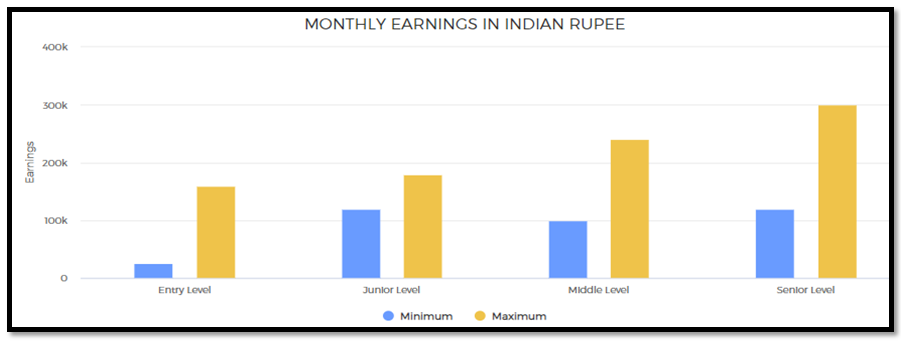
MONTHLY EARNINGS IN INDIAN RUPEE

1. Entry level: 0 - 2 years of work experience
2. Junior Level: From 1 to 12 years of work experience
3. Mid Level: From 5 to 20+ years of work experience
4. Senior Level: From 10 to 25+ years of work experience (there could be exceptions in some high-end technical, financial, engineering, creative, management, sports, and other careers; also in the near future, people will reach these levels much faster in many careers and in some careers, these levels will have no meaning as those careers will be completely tech skill driven such as even now, there is almost no level in a Cyber Security Expert’s job).
Work Activities
Here are few of the common work activities of a Geological Engineer:
1. Decision making and problem solving: Analysis of data and information; evaluation of alternative decisions and results of decisions; taking the right decisions and solving problems.
2. Communication with co-workers and others: Communicating with people in writing, verbally or otherwise inside your workplace and various other people who have professional relationships with your place of work including vendors, government officials, etc. or with people at large.
3. Getting Information and learning: Observing, hearing, reading, using computers, or otherwise obtaining information and learning from it. Information can be in any form.
4. Using computers for work: Using computers for day-to-day office work; using computer software for various applications in day-to-day professional work; entering data and process information; for writing.
5. Processing Information: Searching, compiling, tabulating, calculating, auditing, verifying or otherwise dealing with information processing including data entry, transcription, recording, storing and maintaining databases.
Future Prospects
According to the report by ibef.org, India is the 3rd largest producer of coal, 4th largest producer of iron and 3rd largest producer of steel. The Indian mining industry is expected to grow rapidly with steel production likely to double by 2031. With 100% FDI investment allowed in the industry, International originations too are coming to India. Thus, the mining and exploration prospects for geological engineers are growing in India. While Petroleum exploration is still limited, with a growing partnership with Gulf nations, we might see a flux of jobs for Indians in the Gulf.
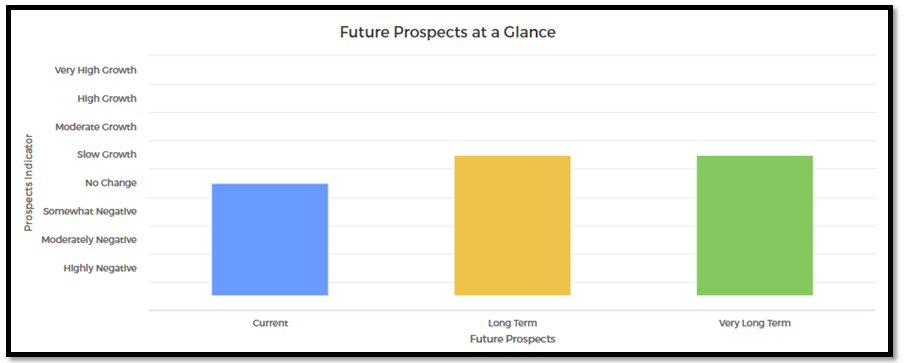
FUTURE PROSPECTS AT A GLANCE



