

Industrial Engineer
Entry Level Qualification
Class Graduate
Career Fields
Engineering & Technology
For Specially Abled


Career Entrance Exam
JEE MAIN BE/BTECH, JEE ADVANCED, GATE, BITSAT UG, VITEEE BE/BTECH, SRMJEEE BE/BTECH, MHTCET, WBJEE
About Career
Industrial Engineering is a multi-disciplinary field of study that focuses on the optimization of industrial and manufacturing processes and systems.
Industrial Engineers, also known as Production Engineers, use their mathematical, physical, and social science knowledge and skills in combination with the principles of engineering analysis and design to determine, predict, and evaluate the results obtained from industrial and manufacturing processes. They study the various industrial manufacturing processes to understand the requirements of the production process (that is, what raw materials are required, what is the requirement of labor and human resources, what technology to be used in production, what is the time required to complete the production process, what are the quality aspects of the finished products, and so on). After carefully studying these factors, they design and develop specialized and advanced manufacturing/industrial processes with a goal to boost productivity, reduce cost of operations, and improve quality of the finished products.
To put it simply, the primary goal of Industrial Engineers is to find ways to complete the production process in a cost-efficient and timely manner, while also boosting the productivity quotient and reducing the waste produced during the process.
Key Roles & Responsibilities
1. To research and develop ways and techniques to enhance and optimize the use of raw materials involved in the production process (human labour, resources, tools and equipment, etc.).
2. To study and review production schedules, engineering specifications, process flows, and other necessary information to understand various industrial manufacturing/production methods and activities.
3. To participate in the entire life cycle of the product manufacturing process, right from meeting clients and understanding their needs to acquiring raw materials, and liasing with distributors and vendors, and finally delivering the finished product.
4. To design innovative ways to boost the production efficiency and improve the quality of the finished product.
5. To design control systems to help coordinate production planning and activities so that the finished product meets the industrial quality standards.
6. To draft and design actionable layout for raw materials, equipment, and workspace to deliver maximum efficiency.
7. To formulate sampling procedures, designs, forms, and specialized instructions for recording, evaluating, and reporting the quality and reliability of data.
8. To determine the precision and accuracy of production and testing equipment and engineering plans and to devise corrective action plan if needed.
9. To analyze production costs and implement quality control measures/procedures to prevent unnecessary expenses and optimize cost-efficiency.
10. To develop production reports, handle purchase orders, schedule deliveries according to production forecasts, oversee storage and handling activities, and maintenance functions.
11. To conduct regular evaluations of industrial plants and facilities to evaluate their efficacy and find out if there’s any scope for improvement in the same.
12. To identify potential health hazards and any kind of dangerous situations in production plants/facilities and establish strict safety measures and standards.
13. To communicate with clients about product requirements, with vendors regarding purchases/raw materials, with management staff about manufacturing capacity, and with production staff about the status of various industrial projects.
Career Entry Pathway
Class 10 all subjects as per scheme of studies – Class 11-12 Physics, Chemistry, and Mathematics along with any other subject as per scheme of studies - Bachelor’s degree (B.E. or B.Tech) in Production Engineering/Production & Industrial Engineering/Industrial Engineering/Manufacturing Engineering/Mechanical Engineering.
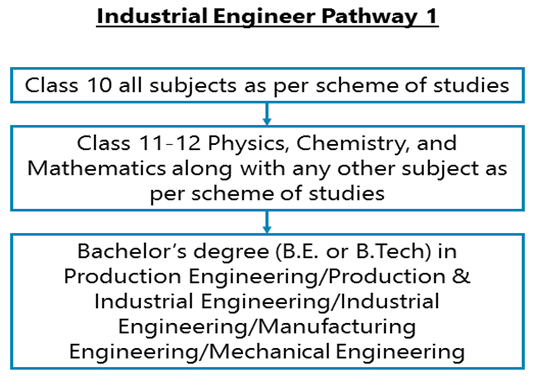
After completing your Class 11-12 Physics, Chemistry, and Mathematics along with any other subject as per scheme of studies. Then you can pursue your graduation with a Bachelor’s degree (B.E. or B.Tech) in Production Engineering/Production & Industrial Engineering/Industrial Engineering/Manufacturing Engineering/Mechanical Engineering.
Class 10 all subjects as per scheme of studies – Class 11-12 Physics, Chemistry, and Mathematics along with any other subject as per scheme of studies - Bachelor’s degree (B.E. or B.Tech) in Production Engineering/Production & Industrial Engineering/Industrial Engineering/Manufacturing Engineering/Mechanical Engineering/Chemical Engineering - Master of Engineering (M.E.) in Industrial Engineering/Industrial Engineering & Management.
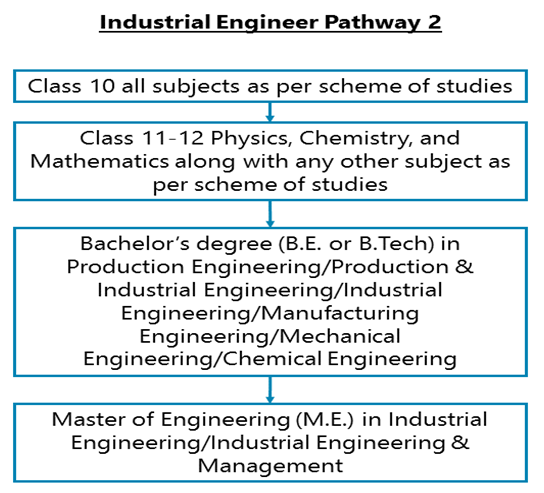
After completing your Class 11-12 Physics, Chemistry, and Mathematics along with any other subject as per scheme of studies. Then you can pursue your graduation with a Bachelor’s degree (B.E. or B.Tech) in Production Engineering/Production & Industrial Engineering/Industrial Engineering/Manufacturing Engineering/Mechanical Engineering, followed by Master’s degree (M.E) in Industrial Engineering/Industrial Engineering & Management.
Required Qualification & Competencies
To become an Industrial Engineer, you can do a Bachelor’s degree in Manufacturing Engineering / Production Engineering / Industrial Engineering / Production & Industrial Engineering / Mechanical Engineering or in a similar field.
You may also opt for a Master degree in the above mentioned fields or you may do a Master degree/diploma in Industrial Engineering and Management.
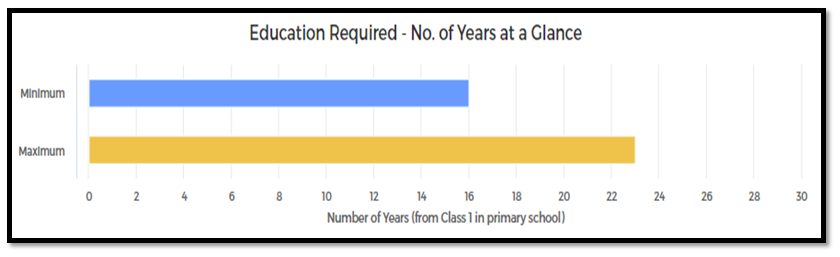
MINIMUM EDUCATION REQUIRED | MAXIMUM EDUCATION REQUIRED |
Under Graduate | Doctoral |
COMPETENCIES REQUIRED
Occupational Interests
1. Investigative: You should have interests for Investigative Occupations. Investigative occupations involve working with ideas and quite a lot of thinking, often abstract or conceptual thinking. These involve learning about facts and figures; involve use of data analysis, assessment of situations, decision making and problem solving.
2. Realistic: You should have interests for Realistic Occupations. Realistic occupations involve more practical and hands-on activities than paperwork or office work. Realistic occupations often involve physical activities for getting things done using various tools and equipment.
3. Conventional: You should have interests for Conventional Occupations. Conventional occupations involve repetitive and routine tasks as well as fixed processes or procedures for getting things done. These occupations involve working more with data, systems, and procedures and less with ideas or creativity.
Abilities
1. Abstract Reasoning: The ability to understand ideas which are not expressed in words or numbers; the ability to understand concepts which are not clearly expressed verbally or otherwise.
2. Deductive Reasoning: The ability to apply general rules and common logic to specific problems to produce answers that are logical and make sense. For example, understanding the reasons behind an event or a situation using general rules and common logic.
3. Inductive Reasoning: The ability to combine pieces of information from various sources, concepts, and theories to form general rules or conclusions. For example, analysing various events or situations to come out with a set of rules or conclusions.
4. Inter-Personal: The ability to build and maintain good relationships with others at workplaces and elsewhere.
5. Mathematical Reasoning: The ability to choose the right mathematical methods or formulas to solve a problem.
6. Mechanical Reasoning: The ability to apply basic physical principles and theories to understand how mechanical objects such as tools and machinery works and the ability to understand the rules or laws governing the work of machinery, tools and bodies in motion.
7. Numerical Reasoning: The ability to add, subtract, multiply, divide, and perform other basic numerical calculations correctly.
8. Spatial Ability: The ability to visualize three-dimensional objects by looking at the objects in paper or visualise objects mentally in three dimensions.
9. Speed of Closure: The ability to quickly make sense of, combine, and organize information into meaningful patterns.
10. Verbal Reasoning: The ability to think and reason with words; the ability to reason out ideas expressed in words.
11. Written Comprehension: The ability to read and understand information and ideas presented in writing.
Knowledge
1. Engineering and Technology: Knowledge of various applications of one or more branches of Engineering Science & Technology to manufacture and produce various goods or construct or erect various structures. This include knowledge about design, development, prototype testing, manufacturing, construction, installation, repair and maintenance.
2. Mathematics: Knowledge of arithmetic, algebra, geometry, calculus, trigonometry, statistics, and other mathematical disciplines and their applications.
3. Physical Science: Knowledge of physical principles, laws, their interrelationships, and applications to understand fluid, material, earth, ocean, atmosphere, and space dynamics, as well as mechanical, electrical, atomic and sub- atomic structures, properties and processes.
4. Production and Processing: Knowledge of raw materials, production machinery, production systems, production processes, quality control, and other techniques for manufacturing or construction and distribution of goods.
5. Technical and Engineering Design: Knowledge of various techniques, methods, specifications and tools for creating, developing and laying out designs of various machines, equipment, devices, manufacturing plants, structures, systems and processes. This includes developing blueprints, drawing and models.
Skills
1. Active Learning: Focused and continuous learning from various sources of information, observation and otherwise for application in getting work done.
2. Communication in English: Skills in communicating effectively in writing as well as verbally with others in English language.
3. Coordination: Skills in working together with other people to get things done.
4. Critical Thinking: Skills in analysis of complex situations, using of logic and reasoning to understand the situations and take appropriate actions or make interpretations and inferences.
5. Judgment and Decision Making: Skills in considering pros and cons of various decision alternatives; considering costs and benefits; taking appropriate and suitable decisions.
6. Operations and Process Analysis: Skills in analysis of operations and processes such as industrial manufacturing, chemical processing, etc. so as to device better and more efficient operational processes and systems.
7. Problem Solving: Skills in analysis and understanding of problems, evaluating various options to solve the problems and using the best option to solve the problems.
8. Process and Operation Controlling: Skills in controlling processes and operations of various machines, equipment, devices and systems using different types electrical and electronic control instruments and systems.
9. Reading Comprehension: Skills in understanding written sentences and paragraphs in work related documents.
10. Supervising: Skills in Supervising and monitoring performance of others, businesses, and different projects.
11. Technical: Skills in using various technologies and technical methods to get things done or solve problems.
12. Technical Design and Drawing: Skills in creating and developing designs and drawings for various structures, machines, equipment, and devices.
13. Troubleshooting: Skills in determining causes of operating errors and deciding what to do about it.
Personality
1. You are always or mostly organised in your day-to-day life and activities.
2. You always feel secure in your surroundings and in most situations.
3. You are imaginative sometimes.
4. You prefer to experience new things and have new experiences sometimes.
5. You act independently sometimes but do not do so in some other times.
6. You are friendly and outgoing sometimes, but not always.
7. You prefer company of people sometimes but not always.
8. You are always practical or in most situations.
Career - Job Opportunities & Profiles
1. After Bachelor's, you can get the role of a Graduate Engineer Trainee in manufacturing companies across various industry sectors, right from steel and chemicals to machinery and consumer products.
2. After Master's, you can get the role of an Assistant Engineer (Industrial Engineering) in manufacturing companies across various industry sectors, right from steel and chemicals to machinery and consumer products.
3. After Master's, you can also get the job of an Associate Consultant in engineering consulting organisations.
Usually, Industrial Engineers are recruited to handle areas like Technology Management, Operations Research, Systems Engineering, Production Engineering, Industrial Management, and Performance Evaluation, among other things.
Work environment
The work enrironment of Industrial Engineers largely depends on their job profile and designation. For instance, if an Industrial Engineer is specifically in charge of the production process, they have to spend a significant amount of time in manufacturing plants/facilities. Whereas, if an Industrial Engineer exclusively handles the Operations Research department, she/he may work from within an office. However, irrespective of their designation, Industrial Engineers have to work full-time (that is nearly 9-10 hours) on a daily basis. They may also have to work extra shifts to meet deadlines.
SPECIALISATION TRACKS IN THIS CAREER
1. Manufacturing Engineering
Manufacturing Engineering is a branch of Engineering where the main focus lies in understanding, analysing, and enhancing the complex industrial and manufacturing processes and systems. Manufacturing Engineers are required to carefully plan the different techniques of manufacturing, research and to develop appropriate tools, machines, and equipment, and to incorporate the right raw materials, systems, and techniques to produce quality products cost-efficiently.
2. Production Engineering
Production Engineering is a subset of Mechanical Engineering and combines manufacturing technology with Management Science and the various Engineering Sciences. A Production Engineer must have in-depth knowledge of both Engineering practices and should also be aware of the production-related management challenges. Like Manufacturing Engineers, even Production Engineers aim to complete the production process smoothly in the most cost-efficient manner.
3. Industrial Engineering & Management
Industrial Engineering & Management is a specialized branch of Engineering that focuses on the management of Industrial process. It deals in Industrial design, construction, management, and application of science and engineering principles to improve the entire infrastucture of the Industrial process. Industrial Engineering & Management incorporates the principles of Manufacturing system, Logistics, Supply Chain Management, Materials Management, Entrepreneurship, among other things.
4. Industrial Automation
Industrial Automation involves the use of advanced control systems and information technology to successfully take over and complete specific tasks that are usually performed by humans. The aim is to improve the productivity (number of products churned out per min/hour), enhance the product quality, and most importantly, to reduce the dependency on human labour.
5. Operations Research
Operations Research is an analytical method of problem-solving and decision-making that is integral to the management of companies/organizations. In Operations Research, complex problems are broken down into smaller fragments using tools like Mathematical modeling, Statistical Analysis, Simulation, Network Analysis, etc., and then solved.
6. Robotics
In simple words, Robotics involves the study of robots. It is an interdisciplinary branch of Engineering and Science that combines Mechanical Engineering, Electronic Engineering, Computer Science, to name a few. Robotics primarily focuses on the design, construction, operation, and use of robots and computer systems to control them. It is becoming increasingly important in industrial manufacturing as it helps to boost productivity.
CAREER GROWTH
If you join an Industrial Manufacturing firm/organization after your graduation, you will begin your career as a Graduate Engineer Trainee. After about two years, you can upgrade to the post of an Assistant Engineer. Then, after 8-10 years of service, you can get promoted to a Senior Engineer and further to Plant Engineer. Once you gain around 12-20 years of experience, you can get promoted to General Manager.
If you choose to work in Engineering Management organizations after your post-graduation, you can join as an Assistant Consultant. Then you can get promoted to Junior Consultant and finally to Senior Consultant.
Salary Offered
1. The starting salary of an Industrial Engineer will be anywhere around Rs. 35,000 - 65,000 per month.
2. After about 6-8 years, their average monthly salary will be around Rs. 60,000 - 1,40,000.
3. After 10-15 years, they would earn around Rs. 1,50,000 - 2,40,000 per month. And after 17-20 years of experience, their monthly salary would top at around Rs. 2, 40,000 - 3,80,000.
4. However, if you join as a Consultant in an Engineering Management organization, your monthly salary range will be slightly on the higher side. On joining, you will get a starting salary of Rs.45,000 - 75,000 per month. Once you become a Junior Consultant, your average monthly salary will be around Rs. 90,000 - 1,70,000. After 10-15 years, when you get promoted to Senior Consultant, your monthly salary will be anywhere between Rs. 1,80,000 - 3,00,000.
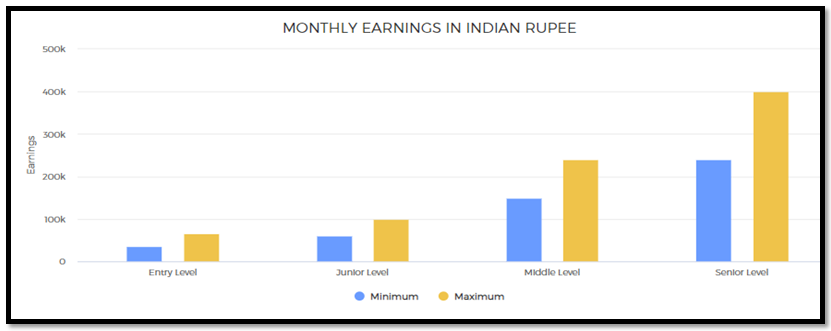
MONTHLY EARNINGS IN INDIAN RUPEE

1. Entry level: 0 - 2 years of work experience
2. Junior Level: From 1 to 12 years of work experience
3. Mid Level: From 5 to 20+ years of work experience
4. Senior Level: From 10 to 25+ years of work experience (there could be exceptions in some high-end technical, financial, engineering, creative, management, sports, and other careers; also in the near future, people will reach these levels much faster in many careers and in some careers, these levels will have no meaning as those careers will be completely tech skill driven such as even now, there is almost no level in a Cyber Security Expert’s job).
Work Activities
1. Analysing and interpreting data and information: Analysis of data and information to find facts, trends, reasons behind situations, etc.; interpretation of data to aid in decision making.
2. Calculating and computing: Calculating or computing using various mathematical formula and functions using computers or otherwise; doing financial or commercial calculations or computations.
3. Communicating with co-workers and others: Communicating with people in writing, verbally or otherwise inside your workplace and various other people who have professional relationships with your place of work including vendors, government officials, etc. or with people at large.
4. Decision making and problem solving: Analysis of data and information; evaluation of alternative decisions and results of decisions; taking the right decisions and solving problems.
5. Drawing, drafting, laying out and specifying objects, equipment, devices, tools, and systems: Creating and developing designs, drawings, layouts and specifications about how to construct, manufacture, assemble, build, use, and maintain various equipment, devices, tools and systems.
6. Estimating quantity, cost, time and resources: Estimating sizes, volumes, distance, and quantity; estimating and determining time, costs, and resources; estimating materials required to perform a task.
7. Getting Information and learning: Observing, hearing, reading, using computers, or otherwise obtaining information and learning from it.
8. Leading: Inspiring and motivating co-workers to work to achieve specific goals; enabling and facilitating others to perform tasks effectively; addressing issues and solving problems in order to help people perform well.
9. Managing and supervising: Manging and supervising work of others; setting goals; giving instructions; monitoring work performance, etc.
10. Organising, planning and prioritising tasks: Planning and organising tasks in order to achieve work goals; prioritising tasks to achieve goals and making the best use of the time available.
11. Scheduling tasks: Scheduling project timelines, tasks and activities.
12. Updating and using relevant knowledge: Keeping updated with the latest knowledge relevant to your fields of work and use of the relevant knowledge in getting things done.
13. Using computers for work: Using computers for day-to-day office work; using computer software for various applications in day-to-day professional work; entering data and process information; for writing.
14. Working in a team: Working in a team of people; developing team; maintaining professional relationships among team members.
Future Prospects
According to the latest IBEF (India Brand Equity Foundation) statistics, in FY19, the GVA (Gross Value Added) generated from the manufacturing sector in India at current prices grew by 12.4% year-on-year to reach US$ 395.89 billion. Furthermore, under the ‘Make in India’ initiative, the Indian government aims to achieve 25% GDP share (from the present 16%) and create 100 million new jobs in the manufacturing sector by 2022. Overall, employment opportunities in the Indian manufacturing sector show a positive trend.
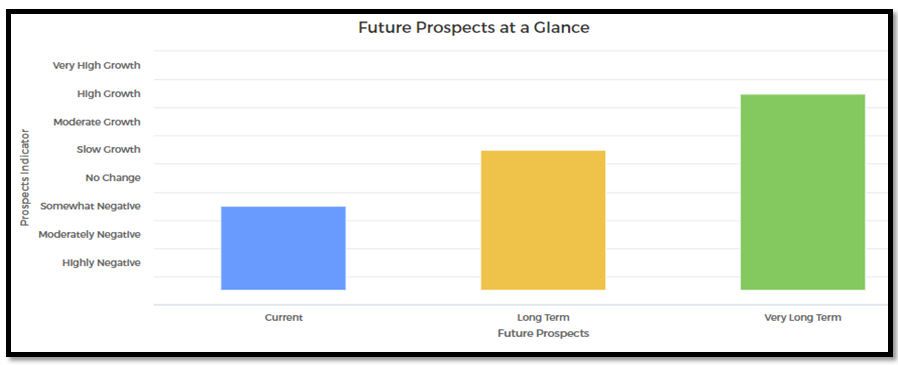
FUTURE PROSPECTS AT A GLANCE



