

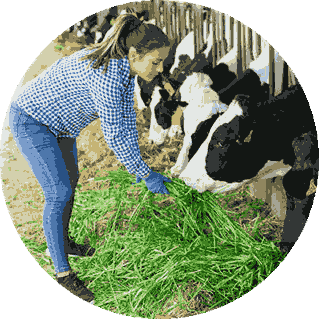
Animal Husbandry Worker
Entry Level Qualification
Class 12
Career Fields
Agriculture & Food Science
For Specially Abled


About Career
1. As an Animal Husbandry Worker, you will work in livestock or animal husbandry farms which breed and raise livestock animals for production of milk, eggs, meat, leather and other food products. Animals that are bred and raised in animal farms include cattle, goats, pigs, rabbit, sheep, etc. You will be responsible for various ground level activities involved in managing a livestock farm including proper care of the animals (health and productivity), milking and marketing of produced milk etc.
2. You need to ensure high quality livestock produce as well as animal comfort and wellbeing. Your work will mainly involve rearing and feeding of the animals, ensuring that their rearing areas are clean and sanitised, and making sure that all the animals are in proper health conditions. You have to pay maximum attention to the animals during their breeding period.
3. Animal Husbandry Workers spend a lot of time working in open fields with a variety of farm animals including cows, sheep, goats, pigs, horses, and hens, among others. They usually work in dusty and wet environments. You have to work around 40-45 hours every week as an Animal Husbandry Worker.
4. As an Animal Husbandry Worker, you will have to look after the needs of every animal at your farm, clean the facility/equipment and monitor the animals’ behavior and health issues. You will have to dispose animal wastes in the prescribed manner following established rules. You will have to report any hazard or signs of ill health as soon as you notice them. You will also have to monitor and maintain the condition of tools and farm equipments.
Key Roles and Responsibilities:
As an Animal Husbandry Worker, you will be engaged with one or more of the following roles and responsibilities: -
1. You will be ensuring proper breeding of the animals, taking care during reproduction period and cleaning their rearing or living quarters.
2. You will be feeding the animals properly and ensure they have adequate supply of food and water.
3. You will be herding animals to pasture for grazing (in some large scale animal farms).
4. You will be performing artificial insemination on livestock to produce the desired offspring.
5. You will be examining the animals daily or at regular intervals to detect illness, injury or diseases, growth, weight gain and other physical characteristics and taking timely action to maintain their health and well-being.
6. You will be ensuring proper medical treatment which includes giving medicines and vaccinations and checkups by veterinarians.
7. You will be ensuring proper maintenance and repair of all farm equipment, machinery, buildings, pens, stalls, yards, etc. and helping fellow workers in repair and maintenance activities
8. You will be training assistant workers in animal care routines and techniques, maintenance duties, and safety precautions.
9. You will be meeting and interacting with farm managers/supervisors to determine production requirements, work schedules, the status of equipment and supplies, budget for purchasing various farm supplies, animal feed, medicines etc.
10. You will be transporting or arranging for the transportation of animals (by grading, marking, tagging etc.), equipment, food, animal feed, and other supplies to and from the workplace.
Career Entry Pathway
Class 8 in school – NSQF Level 3 Certificate for ‘Animal Health Worker’
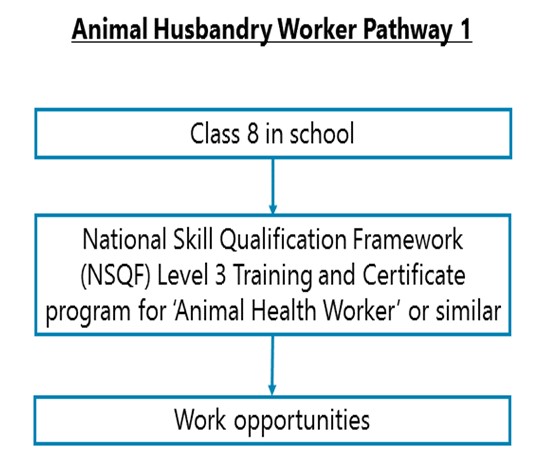
After completing Class 8 in school, you can go for National Skill Qualification Framework (NSQF) Level 3 Training and Certificate program for ‘Animal Health Worker’ or similar courses. The total number of training hours is 150.
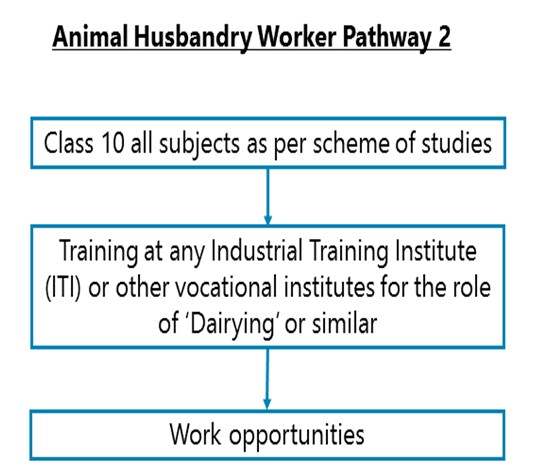
After Class 10, you can go for training at any Industrial Training Institute (ITI), National Skill Training Institute (NSTI), Regional Vocational Training Institute (RVTI), National Vocational Training Institute (NVTI), Industrial Training Center (ITC), Vast Vocational Training Institute (VVTI) or other vocational institutes for the role of ‘Dairying’ or similar. You will sit for All India Trade Test (AITT) to get a National Trade Certificate (NTC) after this course. This exam is held twice a year in the months of February and July.
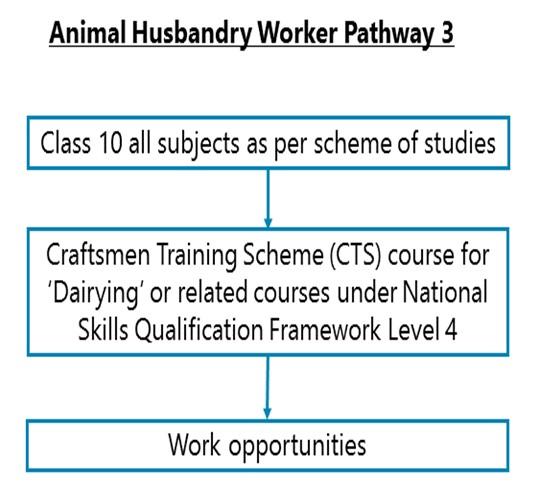
After Class 10, you can go for Craftsmen Training Scheme (CTS) course for ‘Dairying’ or related courses under National Skills Qualification Framework Level 4. This is a 1-year course with 2 semesters of 6 months each.
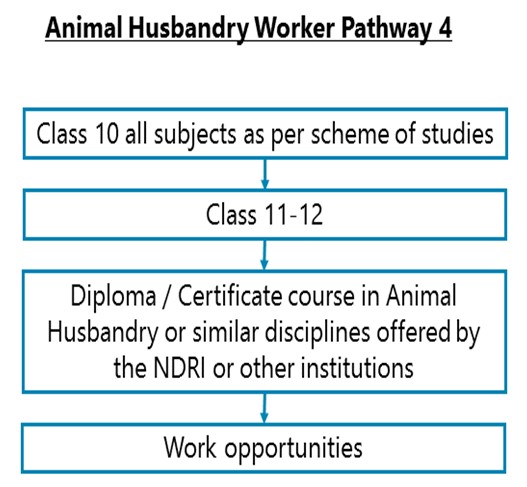
After Class 12, you can go for a Diploma / Certificate course in Animal Husbandry or similar disciplines offered by the NDRI or other institutions. The course at NDRI is a full-time diploma course of three years.
Required Qualification & Competencies
You may not need any formal education or training to get a work as a farm hand in the animal husbandry business. However, it is better to complete Class 8 in school before trying to get a job. Ideally, you should do a training course for Animal Husbandry or obtain training certificates as described.
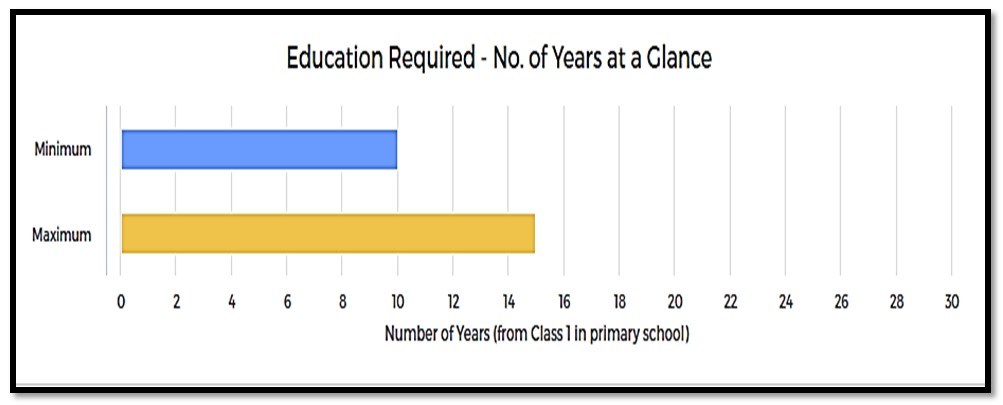
MINIMUM EDUCATION REQUIRED | MAXIMUM EDUCATION REQUIRED |
Under Secondary Certificate Programs for which the minimum eligibility is a pass in any class below class X. | Post Higher Secondary Diploma / Certificate Programs for which the minimum eligibility is a pass in Higher Secondary / Class XII School Leaving examination. |
Competencies Required
1. You should have interests for Realistic Occupations. Realistic occupations involve more practical and hands-on activities than paperwork or office work. Realistic occupations often involve physical activities for getting things done using various tools and equipment.
2. You should have interests for Conventional Occupations. Conventional occupations involve repetitive and routine tasks as well as fixed processes or procedures for getting things done. These occupations involve working more with data, systems, and procedures and less with ideas or creativity.
3. You should have good hand-eye coordination.
4. You should have knowledge of Mathematics – basic arithmetic and other mathematical disciplines and their applications.
5. Animal Care: Knowledge about how to take care of animals and cater to different needs for both domestic and farm animals. This includes knowledge about animal breeding, raring, raising, basic healthcare and grooming,
6. Animal Healthcare: Knowledge about how to diagnose, treat and prevent animal diseases, ailments and disorders. This includes knowledge about the various methods and procedures for assisting Veterinary Doctors as well as the knowledge about how to provide primary healthcare to domestic and farm animals.
7. You should have Coordination Skills - working together with other people to get things done.
8. You should have skills in Managing Material Resources - sourcing, buying, storing, and use of appropriate raw materials, machines, equipment, and devices for various purposes.
9. You should have Manual Dexterity – The ability to quickly move your hand, your hand together with your arm, or your two hands to grasp, manipulate, or assemble objects.
10. You should have Arm-Hand Steadiness - The ability to keep your hand and arm steady while moving your arm or while holding your arm and hand in one position.
11. You should have Physical Stamina - The ability to exert yourself physically over long periods of time without getting winded or out of breath.
12. You should have Oral Comprehension Ability - listen to and understand information and ideas presented through spoken words and sentences.
13. You should have Oral Expression Ability - communicate information and ideas in speaking so others will understand.
14. You should have Skills for Communication in Vernacular Languages - Skills in communicating effectively in writing as well as verbally with others in a local or indigenous language such as Hindi, Tamil, Telugu, Gujarati, Bengali, Assamese, etc.
Career - Job Opportunities & Profiles
You will find work as an Animal Husbandry Worker at various individually owned animal husbandry farms or farms contracted by various corporate organizations as well as at large animal farms, aviaries, livestock operation, and agribusiness companies, State Animal Husbandry Department, which are involved in breeding, raising, sales and export of livestock produce.
Career Growth
You can grow within the dairy business through roles such as Senior Worker, Farm Supervisor, Farm Manager, etc.
Salary Offered
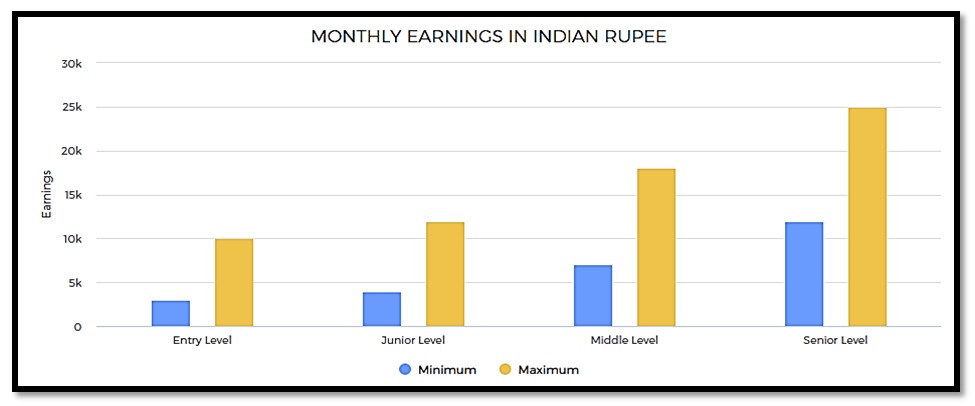
1. In entry-level jobs, you can expect a monthly salary package of around Rs. 3,000 - 10,000 or more a month.
2. As you gain more experience, say around 5-6 years, you can expect a monthly salary of around Rs. 7,000 - 18,000 or more a month.
3. When you have nearly 10-12 years of experience in the field, your monthly salary package will range anywhere between Rs. 12,000 - 25,000 or more a month.
Monthly Earnings In Indian Rupee
Entry Level | Junior Level | Mid Level | Senior Level | ||||
Min Earning | Max Earning | Min Earning | Max Earning | Min Earning | Max Earning | Min Earning | Max Earning |
3000 | 10000 | 4000 | 12000 | 7000 | 18000 | 12000 | 25000 |
Entry level: 0 - 2 years of work experience
Junior Level: From 1 to 12 years of work experience
Mid Level: From 5 to 20+ years of work experience
Senior Level: From 10 to 25+ years of work experience (there could be exceptions in some high-end technical, financial, engineering, creative, management, sports, and other careers; also in the near future, people will reach these levels much faster in many careers and in some careers, these levels will have no meaning as those careers will be completely tech skill driven such as even now, there is almost no level in a Cyber Security Expert’s job)
Work Activities
1. Handling and moving objects and materials - Using hands or otherwise use physical strength to handle and move objects and materials; maneuver, install, lift, place, manipulate, etc.
2. Performing physical activities - Performing physical activities that require use of your arms and legs and moving your whole body, such as climbing, lifting, balancing, walking, stooping, and handling of materials.
3. Inspecting equipment, systems, structures, and materials - Inspecting equipment, systems, structures, and materials to ascertain quality, performance, defects, causes of errors, etc.
4. Identifying objects, actions, and events - Identifying various characteristics of objects; observing and understanding actions and events; understanding changes in actions and events.
5. Operating machines, equipment, devices, systems and processes - Using various methods and techniques to operate machines, equipment, devices, systems and processes in industrial and other settings.
6. Assessing and evaluating quality - Assessing and evaluating quality of materials, systems, processes, products, services, etc.
7. Operating vehicles, mechanized devices, or other movable devices - Running, maneuvering, navigating, or driving vehicles or mechanized equipment.
8. Communicating with co-workers and others - Communicating with people in writing, verbally or otherwise inside your workplace and various other people who have professional relationships with your place of work including vendors, government officials, etc., or with people at large.
Future Prospects
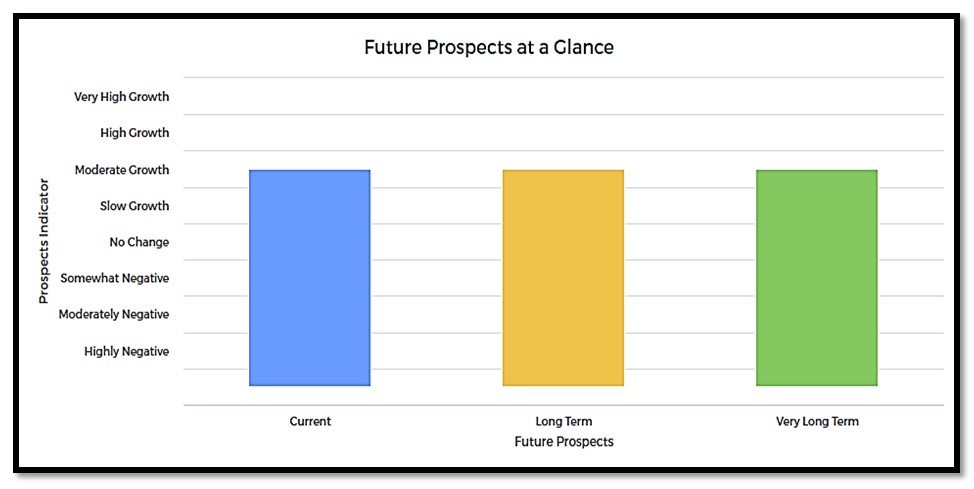
You can expect a bright future in this field as the industry growth prospects are encouraging. By 2030, the milk and meat consumption in developing countries will be double that of 1990. Exports will also increase as the size of the market in developed countries will be double that of developing countries by 2030. India has the largest livestock population of around 512 million. As this number will only continue to scale up in the future, employment in the Animal Husbandry sector will also increase significantly. After obtaining proper training and certification, you may also set up and run your own livestock farm.
Future Prospects At A Glance
Current (0-1 year) | Long Term (2-5 year) | Very Long Term (6-10 years) |
Moderate Growth | Moderate Growth | Moderate Growth |


