


Health Psychologist
Entry Level Qualification
Class 12
Career Fields
Medical Services
For Specially Abled


About Career
PARTICULARS | DESCRIPTION |
Name | Health Psychologist |
Purpose | Provide Care |
Career Field | Medical Services |
Required Entrance Exam | NEET UG |
Average Salary | 300000 - 400000 Rs. Per Year |
Companies For You | AIIMS, Medica, Narayana Health & Many More |
Who is Eligible | Class 12th Pass |
1. Health Psychologists deal with the study of psychological, cognitive (the process of learning), and behavioral processes in a state of good health as well as during an illness, health abnormalities, and injuries.
2. Health Psychologists help people cope with mental issues such as frustration, stress, despondency, lack of self-belief, etc. arising out of an illness, physical disability, injury, and other medical conditions. For example, people suffering from cancer often develop despondency or hopelessness. They give up their hope. This leads to low spirit and therefore the recovery, if possible, takes longer than usual. A person, after facing a critical injury, may feel frustrated as his life after the recovery might not be as usual before the injury. This delays the person’s response to medical treatment.
Health Psychologists Diverse Research Methods
1. This is both a theoretical and applied field. The diverse research methods of health Psychologists include controlled randomized experiments, quasi-experiments, longitudinal studies, time-series designs, cross-sectional studies, case-control studies, qualitative research as well as action research. These are technical names given to different approaches to separate cases.
2. Health psychologists study a broad range of health phenomena including cardiovascular disease (cardiac psychology), smoking habits, the relation of religious beliefs to health, alcohol use, social support, living conditions, emotional state, social class, and more.
3. Some health psychologists treat individuals with sleep problems, headaches, alcohol problems, etc. Other health psychologists work to empower community members by helping community members gain control over their health and improve the quality of life of entire communities.
Key Roles and Responsibilities
You will be engaged in one or more of the following roles and responsibilities as well as other associated duties:
1. You will provide care, or arrange for the provision of appropriate care, for child, adolescent, adult, and geriatric population of patients suffering from stress, substance abuse, or family situations, to modify behavior or to improve personal, social, or vocational adjustment.
2. You will interpret the appropriate information needed to identify each patient's requirements.
3. You will obtain and evaluate relevant historical information and incorporate that into the evaluation & treatment planning.
4. You will determine the urgency of a patient’s needs, provide a professional interpretation of them, recommend a course of therapeutic action, and select an appropriate treatment modality (way to administer the therapy).
5. You will develop appropriate treatment plans and discuss them with the patient and/or caregivers to ensure they participate in the development of the plan and consent to treatments.
6. You will perform psychological evaluations and use a variety of treatment methods, such as psychotherapy, hypnosis, behavior modification, stress reduction therapy, psychodrama, or play therapy, appropriate to each patient and their functional abilities.
7. You will provide counseling education, cognitive/ retraining/ behavior management, and/or crisis intervention as needed to treat problem areas identified in the assessment process.
8. You will be responsible for test selection, scoring, & interpretation and you will understand the limitations of them and correctly apply the norms of each test used.
9. You will maintain a written record of therapy, as well as coordinate with social agencies, schools, relatives, and friends to obtain pertinent information about your patient.
10. You will utilize psychometrics for the administration &scoring of tests as appropriate, ensure the accuracy of that administration & scoring as well as prepare reports from the evaluation data.
11. You will train professional team members involved in the care of a patient about appropriate observational methods, behavior management techniques, and appropriate supportive roles in the patient's treatment.
12. You will independently research human behavior & possible methods for eliminating psychological disorders or offer research design consultation to other researchers/ scientists.
Career Entry Pathway
Class 10 all subjects as per scheme of studies – Class 11-12 with any subject combination as per scheme of studies – Bachelor’s in Psychology/Applied Psychology or similar – Master’s in Psychology/ Clinical Psychology/Health Psychology/ Health Psychology & Behavior/ Health & Medical Psychology/ Counseling Psychology/ Applied Psychology/ or similar.
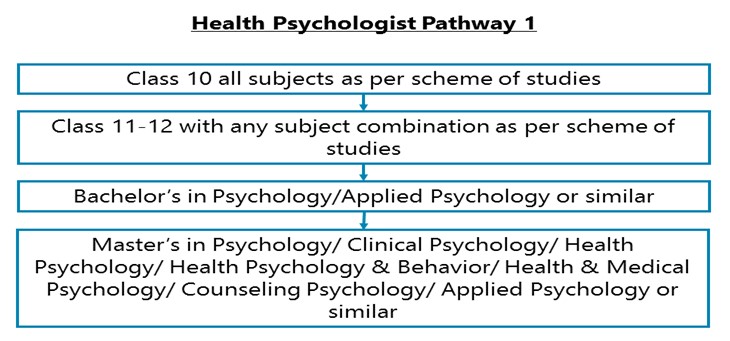
After completing Class 11-12 with any subject combination as per the scheme of studies, go for a Bachelor’s in Psychology/Applied Psychology or similar then do a Master’s in Psychology/ Clinical Psychology/Health Psychology/ Health Psychology & Behavior/ Health & Medical Psychology/ Counseling Psychology/ Applied Psychology/ or similar.
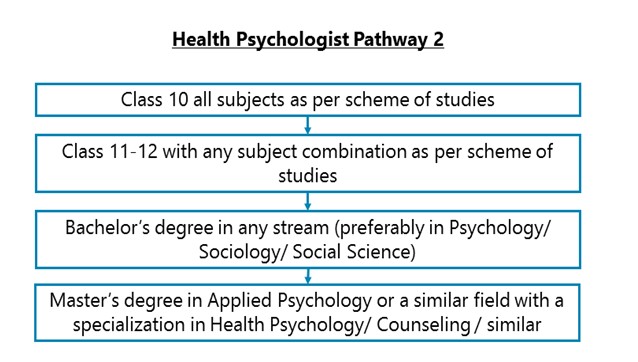
After completing Class 11-12 with any subject combination as per the scheme of studies, study for a Bachelor’s degree in any subject. However, it is better to do a Bachelor’s degree in Psychology/ Sociology/ Social Science to be eligible for a Master’s degree in the field of Psychology. After your Bachelor’s, you can do a Master’s degree in Applied Psychology or a similar field with a specialization in Health Psychology/ Counselling/ or in a similar field.
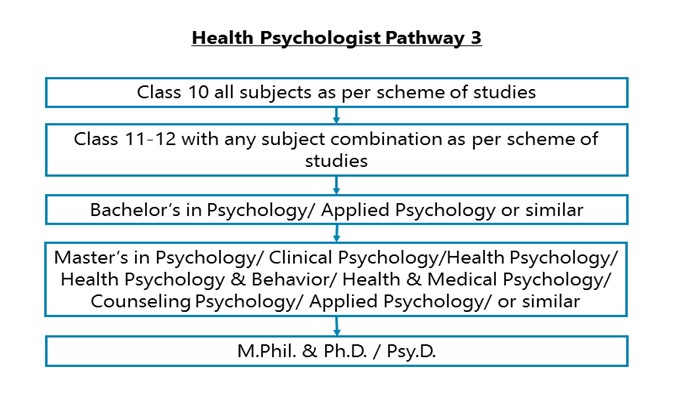
After completing Class 11-12 with any subject combination as per the scheme of studies, you can go for a Bachelor’s in Psychology/Applied Psychology or a similar field. Then do a Master’s degree in Psychology/ Clinical Psychology/Health Psychology/ Health Psychology & Behavior/ Health and medical Psychology/ Counseling Psychology/ Applied Psychology/ or in a similar field. Thereafter, you may go for an M.Phil. degree in Psychology& then get your Doctorate or directly pursue Doctoral degrees like Ph.D. in Psychology/ Psy.D. after your Master’s degree. Psy.D. is a clinical doctorate that is focused more on the practice of psychology. These types of programs can take 4 to 8 years to complete. Psy.D. programs provide extensive training in applied topics such as diagnosing mental illness, performing psychological assessments, and conducting clinical interventions.
Required Qualification & Competencies
After Class 11-12:
1. You can go for a Bachelor’s in Psychology/ Applied Psychology
2. You can go for a Bachelor’s in Sociology/ Social Science/ similar
3. You can do a Bachelor’s degree in any subject (but it is better to do a Bachelor’s in the above-mentioned fields.
You can study for a Bachelor’s / Master’s / Doctoral degree in any of the following fields (Note that all these fields may not offer you a degree at all three levels, that is in Bachelor’s, Master’s, and Doctoral. Some fields may offer a degree only at the Master’s or at the Doctoral level):
1. Applied Psychology
2. Clinical Psychology
3. Child Psychology
4. Computational Psychology
5. Counseling Psychology
6. Experimental Psychology
7. Health Psychology
8. Mental Health Counseling
9. Psychology
10. Rehabilitation Psychology
11. Social Psychology
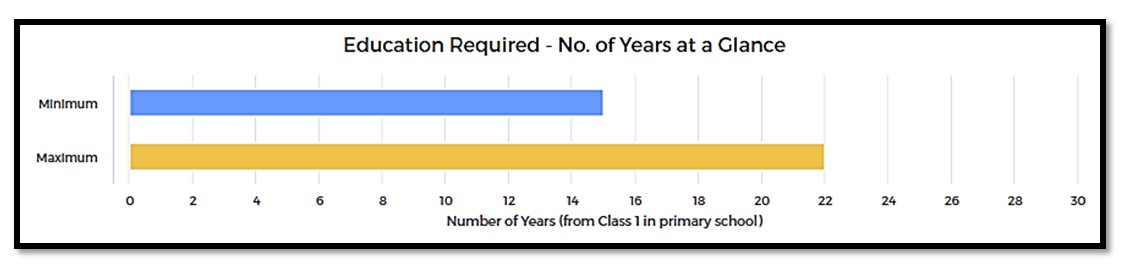
MINIMUM EDUCATION REQUIRED | MAXIMUM EDUCATION REQUIRED |
Under Graduate Undergraduate Degree / Honours Diploma / Graduate Diploma (equivalent to a Degree) Programs for which the minimum eligibility is a pass in Higher Secondary / Class XII School Leaving examination. | Doctoral All Ph.D. or equivalent degree programs for which the minimum eligibility is a Postgraduate or a Pre-Doctoral degree. |
Competencies Required
Interests
1. You should have an interest in Investigative Occupations. Investigative occupations involve working with ideas and quite a lot of thinking, often abstract or conceptual thinking. These involve learning about facts and figures; involve the use of data analysis, assessment of situations, decision-making, and problem-solving.
2. You should have an interest in Realistic Occupations. Realistic occupations involve more practical and hands-on activities than paperwork or office work. Realistic occupations often involve physical activities for getting things done using various tools and equipment.
3. You should have an interest in Social Occupations. Social occupations involve helping or assisting others; these involve working with and communicating with people to provide various services; these may involve educating and advising others.
Knowledge
1. You should know about Therapy and Counseling - Knowledge of the principles, methods, and procedures for diagnosis, treatment, and rehabilitation of physical and mental dysfunctions or disorders in humans.
2. You should know about Psychology - Knowledge of why and how humans behave the ways they behave. This includes an understanding of mental processes and Knowledge of perception, beliefs, motives, attitudes, personality, values, interests, learning styles, and abilities as well as methods to do research and understand the causes of behavioral disorders and treating them.
Skills
1. You should have Active Listening Skills - Giving full attention to what other people are saying, understanding the points being made by others, asking questions, etc.
2. You should have Critical Thinking skills- Skills in the analysis of complex situations, using logic and reasoning to understand the situations and take appropriate actions or make interpretations and inferences.
3. You should have Reading Comprehension Skills - Skills in understanding written sentences and paragraphs in work-related documents.
4. You should have Instruction Skills - training others how to do something.
5. You should have Judgment and Decision-Making Skills - considering the pros and cons of various decision alternatives; considering costs and benefits; and making appropriate and suitable decisions.
6. You should have Problem Solving Skills - Skills in analysis and understanding of problems, evaluating various options to solve the problems, and using the best option to solve the problems.
7. You should have Persuasion Skills- persuading others to change their minds or behavior.
Ability
1. You should have Oral Comprehension Ability - listen to and understand information and ideas presented through spoken words and sentences.
2. You should have Oral Expression Ability - communicate information and ideas in speaking so others will understand.
3. You should have Deductive Reasoning Ability - apply general rules and common logic to specific problems to produce answers that are logical and make sense. For example, understanding the reasons behind an event or a situation using general rules and common logic.
4. You should have Problem Sensitivity - The ability to tell when something is wrong or is likely to go wrong. It does not involve solving the problem, only recognizing there is a problem.
5. You should have Inductive Reasoning Ability - The ability to combine pieces of information from various sources, concepts, and theories to form general rules or conclusions. For example, analyzing various events or situations to come out with a set of rules or conclusions.
Personality Traits
1. You are always or mostly careful about your actions and behavior.
2. You are always or mostly disciplined in your actions and behavior.
3. You are always or mostly a soft-hearted person.
4. You are always or mostly helpful to others.
5. You are always calm or generally remain calm in most situations.
6. You can always act independently or can do so in most situations.
Career - Job Opportunities & Profiles
Multiple jobs will be available for you in this field, including serving as a Counselor, Psychology Associate, or Research Assistant in environments such as:
1. Mental health clinics and inpatient hospitals
2. Outpatient clinics
3. Private/ government research laboratories
4. Prisons and detention centers
5. Private corporations
6. Central and state government agencies/ offices
7. Law enforcement institutions
8. Human resource divisions in companies or governments
After joining a professional set-up as an Intern/ Trainee/ Assistant, you may aspire to become a:
1. Health Psychologist
2. Behavioral Health Specialist
3. Psychometrician
4. Counselor
5. Psychology Associate
6. Clinical Psychologist
7. Research Psychologist
8. Behavior Analyst
Depending on your profile & specialization, you may find opportunities at the following or related organizations:
1. Government as well as private hospitals like AIIMS, Medica, Narayana Health, etc.
2. Day-care and healthcare centers like Sarvam Global Healthcare, CIPHER Healthcare, etc.
3. MNCs like Hindustan Unilever, Colgate-Palmolive, etc.


4. Rehab Centres for drug addicts, clinically diagnosed mentally ill individuals, etc.
5. Government forensic labs like Central Forensic Science Laboratory in New Delhi, Hyderabad, Chandigarh & Kolkata, and state forensic science laboratories like Forensic Science Laboratory Jaipur, Mumbai, etc.
6. Hospitals for the treatment of mental diseases & disorders like NIMHANS (National Institute of Mental Health and Neurosciences), Institute of Psychiatry (Ranchi), etc.
Career Growth
1. If you start your career as an associate psychologist, then you will become a psychologist, then a Consultant Psychologist, and then Head of Department.
2. If you start as a Senior Scientist Officer (Grade II) in the forensic department, you will soon be a Senior Scientist Officer (Grade I) then Principal Scientific Officer, and finally Director of the Laboratory.
3. The career growth in university and college begins from Assistant Professor and then Associate Professor, Professor, and Professor Emeritus. Professors can also get administrative positions such as Director/Dean/Vice Chancellor, etc.
4. If you are hired as a research associate, then you will go on to become a Doctoral Research Fellow, then a Post-Doctoral Research Fellow, and then a Scientist in Progressive Grades.
5. If you join as a Health Psychologist in a hospital, then you will go on to Senior Psychologist and Head of Department. Though your pay grades with go upward faster than your profile.
Salary Offered
1. At the entry-level jobs, after your post-graduation, you may expect to get about Rs. 20,000 – 25,000 or even more a month. In junior-level jobs (after 4-5 years of post-graduation), you can make about Rs. 25,000 – 50,000 or more per month.
2. In mid-level jobs in India, you can expect to earn about Rs. 45,000 – 85,000 or even more a month.
3. In senior-level jobs in India, you can expect to earn about Rs. 60,000 – 2,50,000 or even more a month.
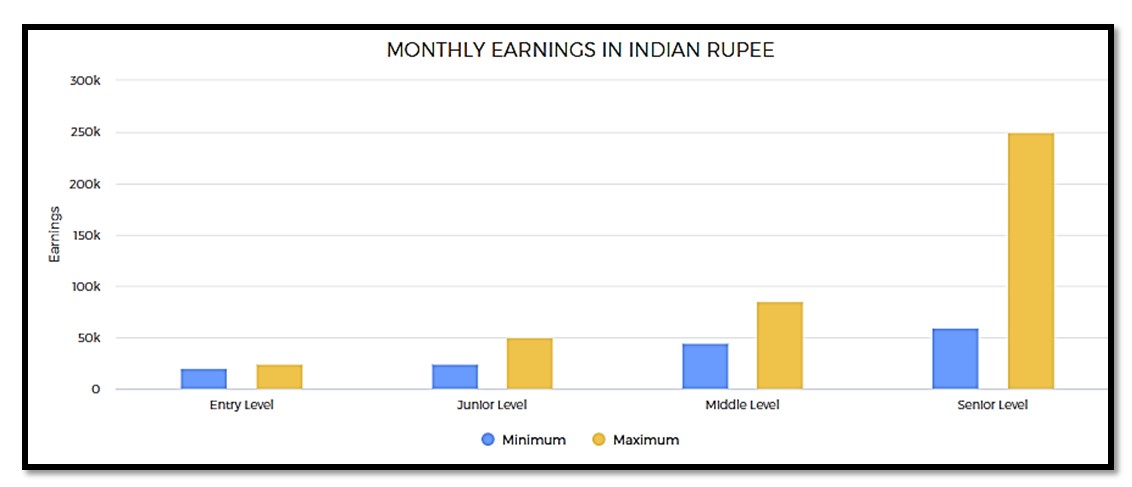
Monthly Earnings In Indian Rupee
Entry Level | Junior Level | Mid Level | Senior Level | ||||
Min Earning | Max Earning | Min Earning | Max Earning | Min Earning | Max Earning | Min Earning | Max Earning |
20000 | 25000 | 25000 | 50000 | 45000 | 85000 | 60000 | 250000 |
1. Entry level: 0 - 2 years of work experience
2. Junior Level: From 1 to 12 years of work experience
3. Mid Level: From 5 to 20+ years of work experience
4. Senior Level: From 10 to 25+ years of work experience (there could be exceptions in some high-end technical, financial, engineering, creative, management, sports, and other careers; also shortly, people will reach these levels much faster in many careers and some careers, these levels will have no meaning as those careers will be completely tech skill driven such as even now, there is almost no level in a Cyber Security Expert’s job)
Work Activities
1. Analysing and interpreting data and information - Analysis of data and information to find facts, trends, reasons behind situations, etc.; interpretation of data to aid in decision-making.
2. Assisting and caring for people - Assisting people in availing of services; taking care of people in different situations; offering help and services to others.
3. Communicating with co-workers and others - Communicating with people in writing, verbally or otherwise inside your workplace and various other people who have professional relationships with your place of work including vendors, government officials, etc., or with people at large.
4. Developing and maintaining interpersonal relationships - Developing professional relationships with co-workers and others outside organizations and maintaining good relationships.
5. Getting Information and learning - Observing, hearing, reading, using computers, or otherwise obtaining information and learning from it.
6. Inspecting situations, events, and people - Inspecting situations, events, and people to understand the reasons and causes for the situation or events to happen; inspecting people to understand reasons behind their behavior and actions
7. Making decisions and solving problems - Analysis of data and information; evaluation of alternative decisions and results of decisions; taking the right decisions and solving problems.
8. Processing information - Compiling, tabulating, calculating, auditing, verifying, or otherwise dealing with information processing including data entry, transcription, recording, storing, and maintaining databases
9. Providing advice and consultation to others - Giving advice or consultation to others about various issues, conceptual matters, know-how, scientific matters, products, or services
10. Strategic planning - Developing visions and goals, developing strategies and action plans for achieving visions and goals.
11. Updating and using relevant knowledge - Keeping updated with the latest knowledge relevant to your fields of work and using the relevant knowledge in getting things done.
12. Using computers for work - Using computers for day-to-day office work; using computer software for various applications in day-to-day professional work; entering data and processing information; for writing.
13. Working directly with people - Working directly with people to offer them products and services, assisting, etc.
Future Prospects
1. It is safe to predict that this field will remain steadfast in the many years to come. Mental health continues to be one of the biggest health challenges, especially in India but fails to receive much attention even in the current scenario.
2. At one time, the role of health psychologists in health care was largely confined to the task of administering tests and interpreting the test results of individuals who were clinically diagnosed with psychological disturbances.
3. Now, however, caregivers, physicians, and other healthcare professionals are increasingly recognizing that psychological factors are important in health and sickness. This is resulting in the increasing acceptance of health psychologists within the medical community.
4. India, China, and the US remain the most affected by anxiety, schizophrenia, and bipolar disorders. More than 56 million people suffer from clinical depression and 42.5% of corporate employees in the organized sector of India.inc suffer from the same. Further, over 38 million people are suffering from an anxiety disorder in India.
5. The Healthcare Market in India has the potential to increase 3 fold to 133.44 billion US Dollars. Indian Government is willing to expand public health spending to 2.5% of GDP by 2025.
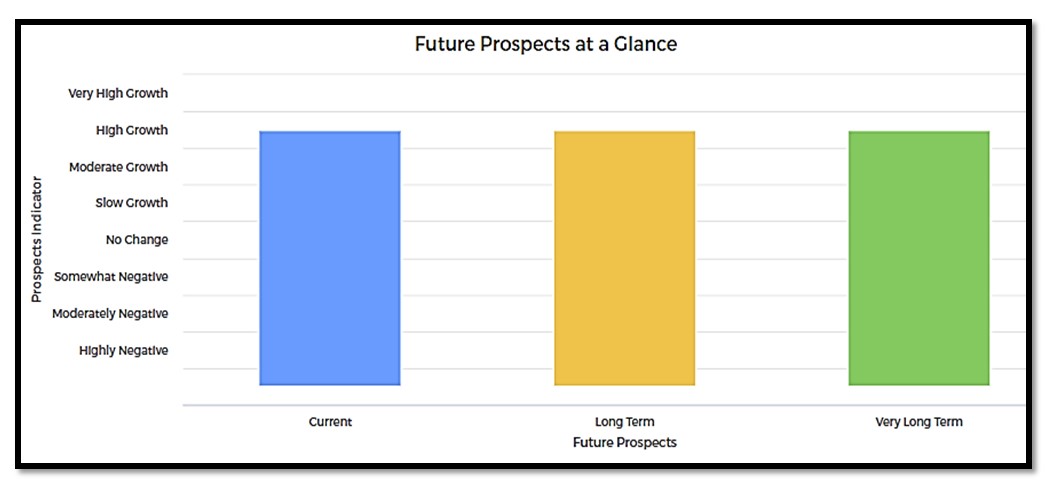
Future Prospects At A Glance
Current (0-1 year) | Long Term (2-5 years) | Very Long Term (6-10 years) |
High Growth | High Growth | High Growth |


