


Forensic Medicine Specialist
Entry Level Qualification
Class Graduate
Career Fields
Medical Services
For Specially Abled


About Career
1. Forensic Medicine applies the application of science and medicine to criminal and civil laws. Criminal laws are laws related to the crime that is harmful, threatening or endangering properties or lives. Murder comes under criminal law. Civil laws are laws of private rights like cheating, business fraud, etc. Forensic Medicine Specialist use the knowledge of medicine and surgery to collect evidence and bring them to the notice of police or court.
2. Forensic Medicine Specialists carry out autopsy or post-mortem procedures in cases of unnatural deaths which might have happened as a result of criminal intent. They analyse the musculoskeletal structure, various organs, systems and tissues, bones, body fluids, stomach content, etc. for establishing the cause of death
3. Forensic Medicine Specialist may also carry out medical examination of the victims of criminal activities. For example, they may carry out a physical examination of a person who has been subjected to sexual violence.
Key roles and responsibilities
1. As a Forensic Medicine Expert, you might be working on the crime scene or in the laboratory.
2. Perform relevant biological (blood, semen, saliva, hair urine, vaginal fluids, facial fluids, etc.) analysis.
3. You will work to create a possible link between the collected evidence and the victim and or accused.
4. You will perform a post-mortem of the body, you will also do DNA analysis, fingerprints analysis, blood sample analysis, etc. as requested and required.
PARTICULARS | DESCRIPTION |
Name | Forensic Medicine Specialist |
Purpose | Apply Medical Knowledge |
Career Field | Allied & Para Medical Science |
Required Entrance Exam | NEET PG, AIIMS PG INICET |
Average Salary | 72000 - 300000 Rs. Per Year |
Companies For You | Government hHospitals, Forensic Laboratories, Law Enforcement Agencies & Many More |
Who is Eligible | Post Graduate |
Career Entry Pathway
Class 10 all subjects as per scheme of studies – Class 11-12 Science along with any other subject as per scheme of studies – UG in Medicine – M.D. in Forensic Medicine/ Forensic Pathology.
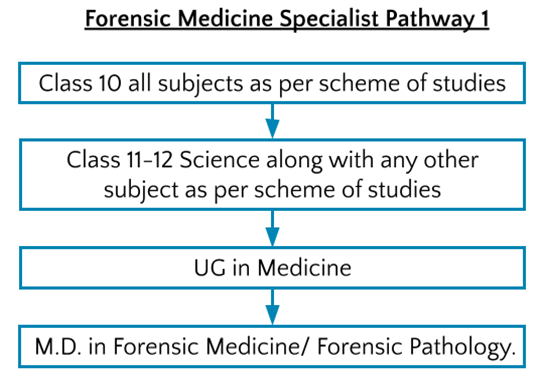
After your Class 11-12 Science along with any other subject as per scheme of studies, study for an undergraduate degree in Medicine (M.B.B.S.) followed by an M.D. degree in Forensic Medicine/ Forensic Pathology.
Class 10 all subjects as per scheme of studies – Class 11-12 Physics, Chemistry and Biology along with any other subject as per scheme of studies– UG in Medicine – D.N.B. in Forensic Medicine/ Forensic Pathology.
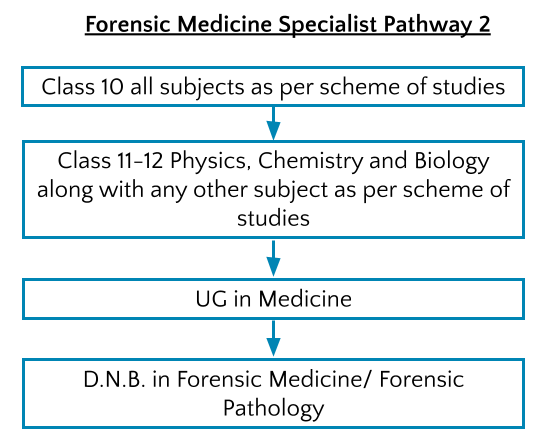
After your Class 11-12 Physics, Chemistry and Biology along with any other subject as per scheme of studies, study for an undergraduate degree in Medicine (M.B.B.S.) followed by an D.N.B. degree in Forensic Medicine/ Forensic Pathology.
Class 10 all subjects as per scheme of studies – Class 11-12 Physics, Chemistry and Biology along with any other subject as per scheme of studies – UG in Medicine – M.D. in Forensic Medicine/ Forensic Pathology – Ph.D. in Forensic Medicine
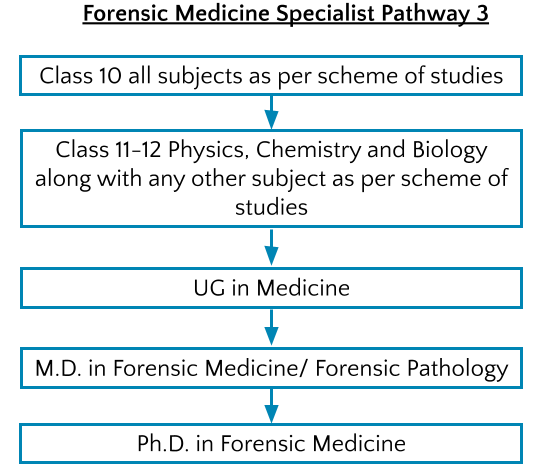
After your Class 11-12 Physics, Chemistry and Biology along with any other subject as per scheme of studies, study for an undergraduate degree in Medicine (M.B.B.S.) followed by an M.D. degree in Forensic Medicine/ Forensic Pathology. Now you can take a Ph.D. in Forensic Medicine.
Class 10 all subjects as per scheme of studies - Class 11-12 Physics, Chemistry and Biology along with any other subject as per scheme of studies – UG in Medicine – D.N.B. in Forensic Medicine/ Forensic Pathology – Ph.D. in Forensic Medicine
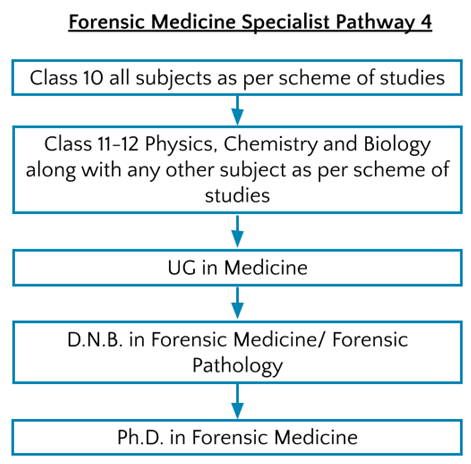
After your Class 11-12 Physics, Chemistry and Biology along with any other subject as per scheme of studies, study for an undergraduate degree in Medicine (M.B.B.S.) followed by an D.N.B. degree in Forensic Medicine/ Forensic Pathology. Now you can take a Ph.D. in Forensic Medicine
Required Qualification & Competencies
To become a Forensic Medicine Specialist you should first do an MBBS after your Class 11-12 Physics, Chemistry and Biology along with any other subject as per scheme of studies. Then you must do an MD in Forensic Medicine.
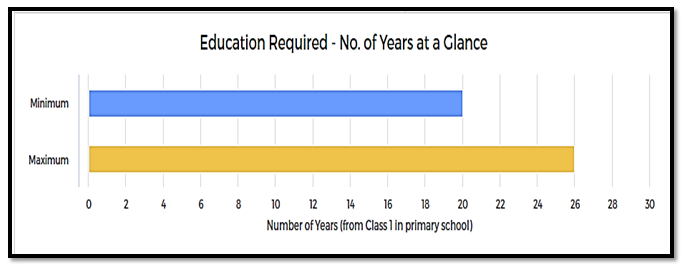
MINIMUM EDUCATION REQUIRED | MAXIMUM EDUCATION REQUIRED |
Doctoral All Ph.D. or equivalent degree programs for which the minimum eligibility is a Postgraduate or a Pre-Doctoral degree. | Post-Doctoral Post Ph.D. programs for which the minimum eligibility is a Doctoral degree. |
Competencies Required
Interests
1. Investigative: You should have interests for Investigative Occupations. Investigative occupations involve working with ideas and quite a lot of thinking, often abstract or conceptual thinking. These involve learning about facts and figures; involve use of data analysis, assessment of situations, decision making and problem-solving.
2. Realistic: You should have interests for Realistic Occupations. Realistic occupations involve more practical and hands-on activities than paperwork or office work. Realistic occupations often involve physical activities for getting things done using various tools and equipment.
3. Social: You should have interests for Social Occupations. Social occupations involve helping or assisting others; these involve working with and communicating with people to provide various services; these may involve educating and advising others.
Abilities
1. Abstract Reasoning: The ability to understand ideas which are not expressed in words or numbers; the ability to understand concepts which are not clearly expressed verbally or otherwise.
2. Arm-Hand Steadiness: The ability to keep your hand and arm steady while moving your arm or while holding your arm and hand in one position.
3. Deductive Reasoning: The ability to apply general rules and common logic to specific problems to produce answers that are logical and make sense. For example, understanding the reasons behind an event or a situation using general rules and common logic.
4. Emotional Intelligence: The ability to understand your own and others' emotions and feelings; empathy for others; adjusting your behaviour or self-control and self-regulation according to others' emotions and situations.
5. Finger Dexterity: The ability to make precisely coordinated movements of the fingers of one or both hands to grasp, manipulate, or assemble very small objects.
6. Flexibility of Closure: The ability to identify or detect a pattern (a figure, object, word, or sound) that is hidden among other distracting materials.
7. Hand-Eye Coordination: The ability to make quick and precise hand movements as per visual observations and understanding (that is, what you see and comprehend).
8. Inductive Reasoning: The ability to combine pieces of information from various sources, concepts, and theories to form general rules or conclusions. For example, analysing various events or situations to come out with a set of rules or conclusions.
9. Inter-Personal: The ability to build and maintain good relationships with others at workplaces and elsewhere.
10. Mental Stamina: The ability to sustain the prolonged mental effort.
11. Oral Comprehension: The ability to listen to and understand information and ideas presented through spoken words and sentences.
12. Oral Expression: The ability to communicate information and ideas in speaking so others will understand.
13. Problem Sensitivity: The ability to tell when something is wrong or is likely to go wrong. It does not involve solving the problem, only recognizing there is a problem.
14. Selective Attention: The ability to concentrate on a task over a long period of time without being distracted.
15. Verbal Reasoning: The ability to think and reason with words; the ability to reason out ideas expressed in words.
16. Written Comprehension: The ability to read and understand information and ideas presented in writing.
Knowledge
1. Biological Sciences: Knowledge of plants and animals, their anatomical structure, cell structure, tissues, physiological functions, evolution, and all other related aspects.
2. English Language: Knowledge about English grammar, words, spelling, sentence construction, using English to communicate with others, reading in English, etc.
3 .Medicine: Knowledge of the science of diagnosis, treatment and prevention of human diseases, ailment, injuries and disorders. This includes understanding the symptoms, knowledge of the diagnostic processes, knowledge of the treatment procedures and medicines, and preventive healthcare measures.
Skills
1. Active Learning: Focused and continuous learning from various sources of information, observation and otherwise for application in getting work done.
2. Active Listening: Giving full attention to what other people are saying, understanding the points being made by others, asking questions, etc.
3. Communication in English: Skills in communicating effectively in writing as well as verbally with others in the English language.
4. Critical Thinking: Skills in the analysis of complex situations, using of logic and reasoning to understand the situations and take appropriate actions or make interpretations and inferences.
5. Judgment and Decision Making: Skills in considering the pros and cons of various decision alternatives; considering costs and benefits; taking appropriate and suitable decisions.
6. Problem Solving: Skills in analysis and understanding of problems, evaluating various options to solve the problems and using the best option to solve the problems.
7. Reading Comprehension: Skills in understanding written sentences and paragraphs in work related documents.
8. Scientific: Skills in using various scientific rules and methods to get things done or solve problems.
9. Service Orientation: Skills in or a keen interest to help and assist people.
Personality
1. You are always or mostly organized in your day-to-day life and activities.
2. You are always or mostly disciplined in your action and behaviour
3. You are always or mostly a soft-hearted person.
4. You are always or mostly helpful to others.
5. You are always calm or generally remain calm in most situations.
6. You always feel secure in your surroundings and in most situations.
7. You can always act independently or could do so in most situations.
8. You are always or mostly caring, supportive, sympathetic and kind to others.
Career - Job Opportunities & Profiles
1. If you join a hospital college, then you will start your career as a junior resident doctor and continue your M.D. studies.
2. You can join a hospital as a medical officer (Forensic medicine specialist).
3. Most of the universities and college will hire you as a professor at the position of Junior Professor or Assistant Professor.
As a Forensic Medicine Specialist, you will get a job in:
Government hospitals have forensic medicine departments. Most private hospitals do not have forensic medicine departments.
Work Environment
Forensic Medicine Specialists mostly work in forensic medicine laboratories. You need a good stomach and steady hands to work in forensic medicine as you might have to spend a lot of time in a day in carrying out post-mortem of dead bodies. In the lab, you will carry out different analysis such as analysis of body fluids, viscera, etc.
Specialisation Tracks In This Career
Forensic Pathologist
Forensic Pathologists carry out post-mortem examination of a human corpse to determine the cause of death, probable time of death and other related aspects. They examine various body fluids, viscera (the internal organs of the human body, mainly the gastrointestinal tract), etc.
Career Growth
1. The career growth in university and college started as an Assistant Professor and then as Associate Professor, Professor and Professor Emeritus. Professors can also get administrative positions such as Director/Dean/Vice Chancellor, etc.
2. If you join as a Medical Officer (Forensic Medicine), then you will go on to become Deputy Medical Superintendent and then Additional Medical Superintendent and then Medical Superintendent. You might also become the director of the Hospital.
Salary Offered
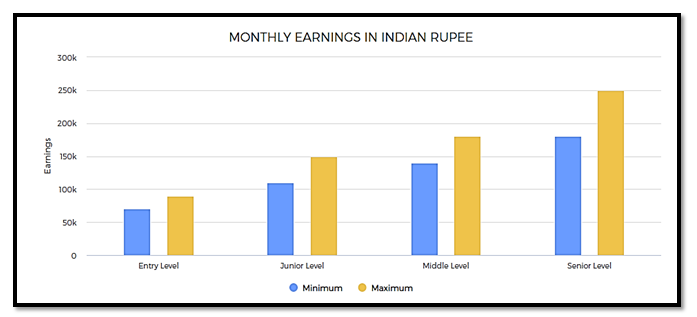
1. If you join as an Assistant Professor, you would be earning anything between Rs. 70,000 to 80,000 a month. If you join as a Medical Officer (Forensic Medicine) in the hospital, then you would be earning anything between Rs. 70,000 to 90,000 per month.
2. With a work experience of 4-5 years, you would be earning anything between Rs.1, 10,000 to 1,50,000 per month.
3. With an experience of 8-12 years, you would be earning anything between Rs. 1, 40,000 to 1, 80,000 per month.
4. At the senior level of work experience over 12-15 years of government jobs, you would be earning anything between Rs 1, 80,000 to 2, 50,000.
Monthly Earning In Indian Rupee
Entry Level | Junior Level | Mid Level | Senior Level | |||||
Min Earning | Max Earning | Min Earning | Max Earning | Min Earning | Max Earning | Min Earning | Max Earning | |
70000 | 90000 | 110000 | 150000 | 140000 | 180000 | 180000 | 250000 | |
1. Entry level: 0 - 2 years of work experience
2. Junior Level: From 1 to 12 years of work experience
3. Mid-Level: From 5 to 20+ years of work experience
4. Senior Level: From 10 to 25+ years of work experience (there could be exceptions in some high-end technical, financial, engineering, creative, management, sports, and other careers; also in the near future, people will reach these levels much faster in many careers and in some careers, these levels will have no meaning as those careers will be completely tech skill driven such as even now, there is almost no level in a Cyber Security Expert’s job)
Work Activities
1. Analyzing and interpreting data and information: Analysis of data and information to find facts, trends, reasons behind situations, etc.; interpretation of data to aid in decision making.
2. Assisting and caring for people: Assisting people in availing of services; taking care of people in different situations; offering help and services to others.
3. Communicating with co-workers and others: Communicating with people in writing, verbally or otherwise inside your workplace and various other people who have professional relationships with your place of work including vendors, government officials, etc. or with people at large.
4. Decision making and problem solving: Analysis of data and information; evaluation of alternative decisions and results of decisions; taking the right decisions and solving problems.
5. Getting Information and learning: Observing, hearing, reading, using computers, or otherwise obtaining information and learning from it.
6. Identifying objects, actions, and events: Identifying various characteristics of objects; observing and understanding actions and events; understanding changes in actions and events.
7. Inspecting situations, events, and people: Inspecting situations, events and people to understand the reasons and causes for the situation or events to happen; inspecting people to understand reasons behind their behaviour and actions.
8. Organising, planning and prioritising tasks: Planning and organising tasks in order to achieve work goals; prioritising tasks to achieve goals and making the best use of the time available.
9. Providing advices and consultation to others: Giving advices or consultation to others about various issues, conceptual matters, know-hows, scientific matters, products or services.
10. Updating and using relevant knowledge: Keeping updated with the latest knowledge relevant to your fields of work and use of the relevant knowledge in getting things done.
11. Using computers for work: Using computers for day-to-day office work; using computer software for various applications in day-to-day professional work; entering data and process information; for writing.
12. Working directly with people: Working directly with people to offer them products and services, providing assistance, etc.
13. Working in a team: Working in a team of people; developing team; maintaining professional relationships among team members.
Future Prospects
Forensic Medicine experts’ jobs are very niche. There are not many opportunities available. Although in the US, as per the report, the market is growing at the rate of 17%, as the base is so small that such high growth rate would still not mean a large number of openings. The trend is similar in India as apart from restricted government roles, there is not much need of private forensic scientist at a large scale. Central Forensic Science Laboratories have less than 150 jobs (each),so less than 10-15 are vacated each year. AS there are a handful of such labs in India, the overall job openings are also restricted.
Future Prospects At A Glance
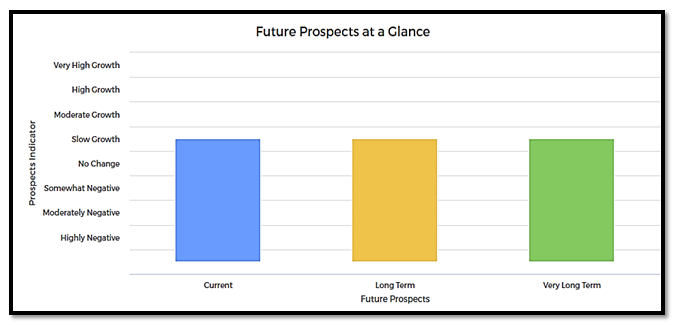
Current (0-1 year) | Long Term (2-5 year) | Very Long Term (6-10 years) |
Slow Growth | Slow Growth | Slow Growth |